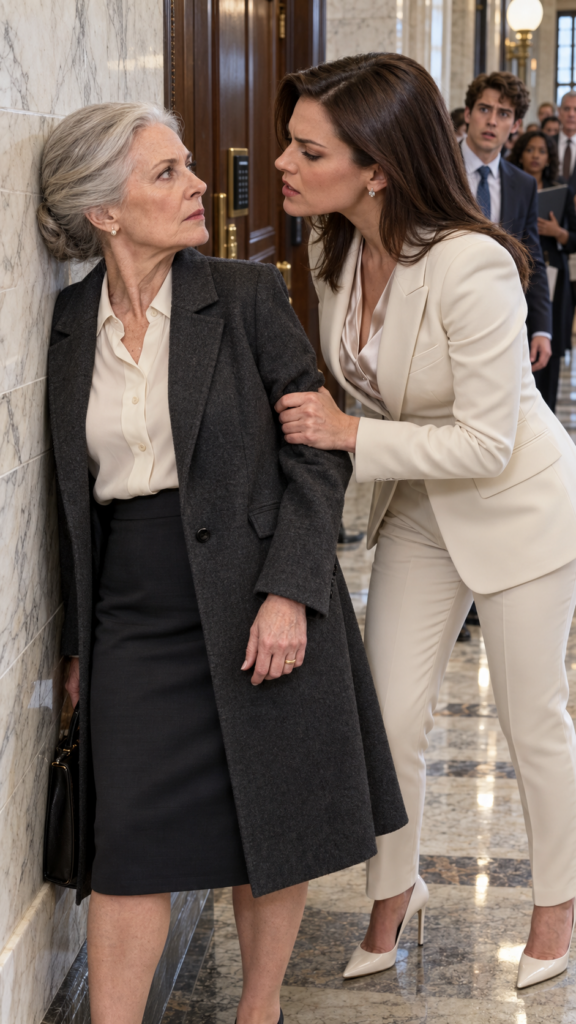
My son called every Sunday evening unless trial work interfered. He asked whether the furnace was behaving, whether I had remembered my cardiology appointment, whether I wanted him to drive down for Thanksgiving.
He worried too much sometimes.
But he had never questioned my mind.
I looked directly at Vanessa.
“I am not confused.”
“Of course you aren’t,” she replied in the slow, exaggerated tone people sometimes use with children and the elderly. “But this is a federal-level civil matter with major parties involved. There are reporters downstairs. Senior partners from my firm are here. I cannot have you wandering into places you’re not supposed to be.”
I noticed something then.
She was afraid.
Not of me.
Of embarrassment.
That explained more than anger would have.
My presence threatened the version of herself she was trying to sell.
Vanessa had grown up in a family that moved often and struggled financially. She had once told Daniel that she learned early how differently teachers spoke to children whose parents wore suits.
I had admired her determination when we first met.
I understood wanting to escape shame.
What I did not understand was becoming the kind of person who inflicted it on others.
“Go downstairs,” Vanessa ordered. “Sit in the lobby until I have time to deal with you.”
I said nothing.
She leaned closer.
“And please don’t tell anyone you’re related to me.”
That sentence hurt more than the wall.
I had buried my husband six years earlier.
I had sat beside Daniel through his father’s final night, holding one of their hands in each of mine while the machines grew quieter.
Afterward, I tried never to interfere in my son’s marriage.
When Vanessa and Daniel bought their condo, I gave them a check and told them to spend it on something unnecessary.
When Vanessa passed the bar, I mailed flowers.
When she joined Bradford, Lane & Mercer, I sent her a handwritten note telling her that the first years of practice were exhausting and that integrity mattered most when no one believed it would cost anything.
She had never mentioned the note.
I had not minded.
Until then.
“Vanessa,” I said, “you should remove your hand.”
She smiled.
“And what exactly are you going to do if I don’t?”
The chambers door opened.
Officer Marcus Bell stepped into the corridor, followed by two judicial assistants.
He stopped.
His gaze went first to Vanessa’s hand.
Then to me.
“Ma’am,” he said sharply.
Vanessa released me immediately.
Her entire posture changed.
“I’m sorry, Officer. My mother-in-law wandered into a restricted section. I was helping her find her way out.”
Marcus did not look at her.
He looked at me.
“Your Honor,” he said, “we’ve been waiting for you.”
Silence has texture.
That morning, it felt like ice breaking.
Vanessa’s mouth opened.
No sound came out.
I adjusted the sleeve she had twisted.
Then I walked toward chambers.
Noah hurried forward with the robe he had been carrying from the robing room.
Through the open doorway, Vanessa could see my desk, the stacked motions awaiting argument, and the black robe hanging from its hook.
I removed my coat.
My shoulder protested.
Noah held the robe open.
I slipped my arms inside.
When I turned around, Vanessa was still standing exactly where I had left her.
Her face had lost all color.
“Ms. Holloway,” I said, “you may want to inform your firm that the judge assigned to your case has arrived.”
Her lips trembled.
“Margaret—I didn’t—”
“Not here.”
She stopped.
I fastened the robe.
“Not now.”
Then I entered the courtroom.
And for the first time that morning, I allowed myself to wonder how much worse this could become.
Because Vanessa had not merely insulted me.
She was an associate on a case assigned to my courtroom.
And now I had a problem far larger than a bruised shoulder.
I had to decide what justice required when the person who had crossed the line was family.
PART 2: THE CASE I COULD NOT PRETEND DIDN’T EXIST
The first thing I did after entering chambers was close the door.
The second was sit down.
My hands were steady.
That surprised me.
My shoulder throbbed beneath the robe, but what disturbed me more was Vanessa’s sentence.
My husband has been trying to convince her she shouldn’t travel alone anymore.
Had she been lying spontaneously?
Or had she said something similar before?
Noah stood near the bookshelf, uncertain.
“Judge Holloway?”
“Yes?”
“Do you need medical attention?”
“No.”
He hesitated.
“With respect, Your Honor, that looked—”
“I know what it looked like.”
“I saw her shove you.”
“I know.”
He swallowed.
Noah Pierce had been clerking for the court less than a year. Earnest, observant, and still young enough to believe every difficult situation had one correct procedural answer hidden somewhere in the rules.

