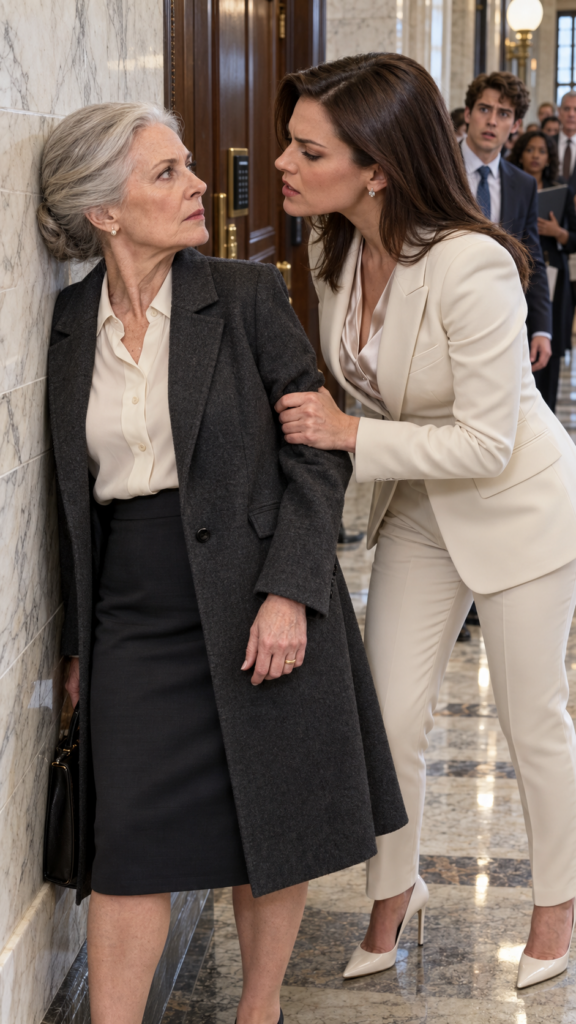
Then someone identified Vanessa.
My phone began ringing.
I declined every call from reporters.
At two seventeen, Elaine called.
“The security office needs you to come in tomorrow.”
“For what?”
“Formal statement.”
I closed my eyes.
“Is that necessary?”
“Yes.”
“Why?”
There was a pause.
“Because Vanessa filed a complaint.”
I sat up straighter.
“Against whom?”
“You.”
The room seemed to narrow.
“What does she allege?”
Elaine sounded almost angry.
“That you used your position to humiliate and intimidate her after a family dispute.”
I did not speak.
“She says you intentionally concealed your identity,” Elaine continued, “allowed her to misunderstand why you were in the restricted corridor, and then publicly revealed yourself to embarrass her.”
For the first time, I understood what Vanessa was doing.
If she could not deny what happened, she would reverse it.
She would make my silence the trap.
My restraint the weapon.
My identity the deception.
And suddenly the courthouse corridor was no longer merely a private humiliation.
It had become a question of credibility.
Hers against mine.
Except this time, the truth had witnesses.
PART 4: THE TRUTH IN THE CORRIDOR
I had watched thousands of witnesses take oaths.
Some trembled.
Some performed.
Some confused confidence with credibility.
When I entered the courthouse conference room the following morning to give my own statement, I understood more deeply than ever why ordinary people feared official interviews.
Two judicial conduct administrators sat across from me.
An attorney representing the court system sat beside them.
I had been advised that I could bring counsel.
I declined.
Not because I believed I was above needing representation.
Because the facts were simple.
I described the encounter from beginning to end.
I did not call Vanessa arrogant.
I did not call her cruel.
I did not speculate about why she lied.
I said what she did.
What she said.
What I said.
Where I stood.
Where she stood.
When the door opened.
When Officer Bell arrived.
When I disclosed the relationship to counsel.
When I recused.
The administrator asked, “Why didn’t you identify yourself immediately?”
“Because she knew me personally.”
“I mean as the assigned judge.”
“I did not initially realize she was assigned to the case.”
“When did you realize?”
“When she referenced an important case involving her firm and I noticed materials in the corridor bearing the Hollister matter designation.”
“And after that?”
“I intended to enter chambers and determine the appropriate ethical response.”
“You did not tell Ms. Holloway?”
“No.”
“Why?”
I thought carefully.
“Because she was not entitled to private information about judicial assignment decisions from me simply because she is my daughter-in-law.”
The administrator nodded.
“And why did you tell her to remove her hand rather than identifying yourself?”
I looked at him.
“Because no person should need to identify herself as a judge before being entitled not to be shoved against a wall.”
The room went very quiet.
The interview lasted another hour.
Afterward, I met Daniel for coffee.
He looked exhausted.
“Did Vanessa come home?” I asked.
“Yes.”
“How is she?”
He laughed without humor.
“Terrified.”
That was not the answer I expected.
“Of losing her job?”
“Of everything.”
He stirred coffee he had not touched.
“She keeps saying one moment ruined her life.”
“One moment revealed a problem.”
He looked at me.
“That’s what I told her.”
I waited.
“She admitted she had been telling people you were declining mentally.”
The words still hurt.
“What reason did she give?”
“She said she panicked whenever coworkers asked about my family.”
I frowned.
“Why?”
“Because she told them you were retired.”
That surprised me.
“She told them I was retired?”
“Yes.”
“Why?”
“She didn’t want them asking questions.”
“What questions?”
He looked embarrassed.
“About whether she had connections.”
For several seconds I could only stare.
The irony was almost too precise.
She had hidden my position because she wanted professional success to appear entirely separate from family influence.
Yet she had also been ashamed of how ordinary she believed I looked.
So she had invented a version of me that solved both problems.
An aging retired widow.
Forgetful.
Provincial.
Dependent.
Small enough not to threaten her identity.
“She created a fictional mother-in-law,” I said.
Daniel nodded.
“And then I walked into the courthouse.”
“Yes.”
“And didn’t fit the fiction.”
“No.”
I looked out the café window.
People hurried along the sidewalk beneath a gray sky.
“So she tried to make me fit.”
Daniel’s eyes filled.
“I’m sorry.”
“You did not do it.”
“I let her say things.”
“That is different.”
“Not different enough.”
I did not argue.
Accountability loses meaning when everyone rushes to comfort themselves out of it.
Two days later, the firm completed its internal review.
Richard Mercer called me personally.
I nearly did not answer.

