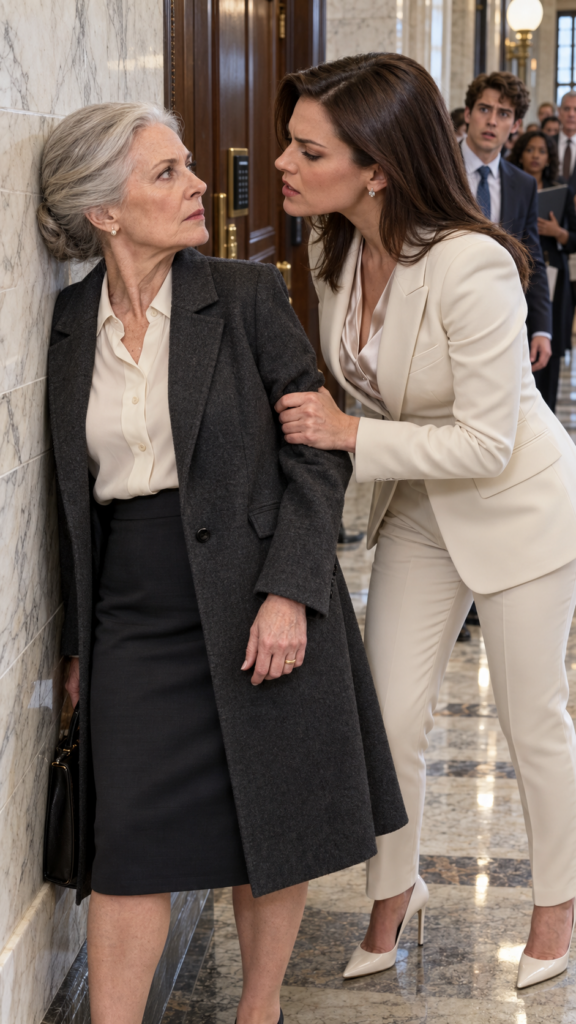
“Will you report it?”
“I haven’t decided what I will do.”
A knock came.
My courtroom deputy, Elaine Carter, stepped inside.
She had worked with me for eleven years and had developed an extraordinary ability to read my mood from the angle at which I placed my glasses on the desk.
She looked at my shoulder.
Then at Noah.
Then back to me.
“What happened?”
“I had an unpleasant encounter in the corridor.”
Noah blurted, “Her daughter-in-law shoved her into the wall.”
Elaine stared.
“My daughter-in-law,” I said, “is apparently on Bradford, Lane & Mercer’s litigation team.”
Elaine’s expression hardened.
“For the Hollister Development case?”
“Yes.”
That was the case everyone in the building had been talking about for weeks.
Hollister Urban Development was being sued by a coalition of small commercial property owners who claimed the company had used aggressive contractual tactics during a large redevelopment project on Chicago’s west side.
The case itself was complicated.
The legal questions were legitimate.
Hundreds of pages of motions were pending.
Bradford, Lane & Mercer represented Hollister.
Vanessa was a junior associate.
Until that morning, I had not known she had been assigned to the team.
That may seem impossible.
It wasn’t.
Judges learn not to inspect the personal lives of every associate whose name appears beneath a filing. A large firm might list a dozen attorneys on a major case.
Vanessa used Holloway professionally, but I had recused myself from matters involving Daniel’s own firm for years. Vanessa worked elsewhere.
I had simply never connected her employment with this particular litigation team.
I rubbed my temple.
Elaine said, “You can’t hear the case now.”
I looked at her.
She immediately corrected herself.
“I mean—you’ll have to consider recusal.”
“Yes.”
“And what happened in the hall makes it worse.”
“Yes.”
The worst outcome would have been to react emotionally.
Judicial power becomes dangerous the instant it is used to settle personal injuries.
I had lectured younger judges about that very point.
Now I had to live by it.
“Call counsel to chambers before proceedings begin,” I said.
Elaine nodded.
“All counsel?”
“Yes.”
“And Vanessa?”
I thought about that.
“No. Lead counsel only.”
Twenty minutes later, the room held four attorneys.
Two represented the plaintiffs.
Two represented Hollister Development.
The senior Bradford partner was Richard Mercer himself, a silver-haired litigator whose calm demeanor concealed a mind like a scalpel.
Beside him stood Martin Cole, another partner.
Both men looked unsettled.
They had already heard something.
Courthouses are buildings made of stone and gossip.
“Counsel,” I began, “before we address the scheduled motions, I need to disclose a circumstance that was previously unknown to me.”
Mercer’s jaw tightened.
“I have discovered that an associate on your team, Vanessa Holloway, is my daughter-in-law.”
The plaintiffs’ attorneys exchanged a glance.
“I was unaware of her involvement in this matter until this morning,” I continued. “I have not discussed the case with her or with my son.”
Mercer nodded.
“Understood, Your Honor.”
“There is an additional issue.”
No one moved.
“This morning, before Ms. Holloway recognized me, we had a personal encounter in the restricted corridor.”
Mercer closed his eyes for half a second.
That told me enough.
He knew.
“I will not describe the details unless necessary,” I said. “However, the encounter was sufficiently hostile that remaining on this case could reasonably create questions regarding impartiality.”
One of the plaintiffs’ lawyers said carefully, “Your Honor, are you recusing?”
“Yes.”
Mercer exhaled.
No victory entered the room.
Everyone understood what recusal meant.
A new judge would take the case.
The scheduled hearing would be delayed.
Months of preparation might need to be reorganized.
But preserving trust in the process mattered more than inconvenience.
“I am directing the clerk to reassign the matter under the standard procedure. I will issue a brief written order stating the familial connection and a personal interaction creating potential appearance concerns. I will not use the order to adjudicate anyone’s conduct.”
Mercer spoke.
“Judge Holloway, on behalf of the firm—”
“Mr. Mercer, do not apologize for facts I have not asked you to address.”
He stopped.
That was not mercy.
It was procedure.
The courtroom was not where Vanessa’s personal conduct would be tried.
At least not by me.
After counsel left, I remained at my desk.
The sensible part of me believed the matter had ended.
I would recuse.
The firm would handle Vanessa internally.
Daniel and I would have an uncomfortable conversation.
My shoulder would heal.
Life would continue.
Then Elaine entered.
“There’s something you should see.”
She placed a printed email on my desk.
“What is this?”
“Security office received it from Bradford, Lane & Mercer’s administrator about fifteen minutes ago.”
I read.
The firm was requesting preservation of corridor security footage.
My pulse slowed.
Not quickened.
Slowed.
“Why?”

