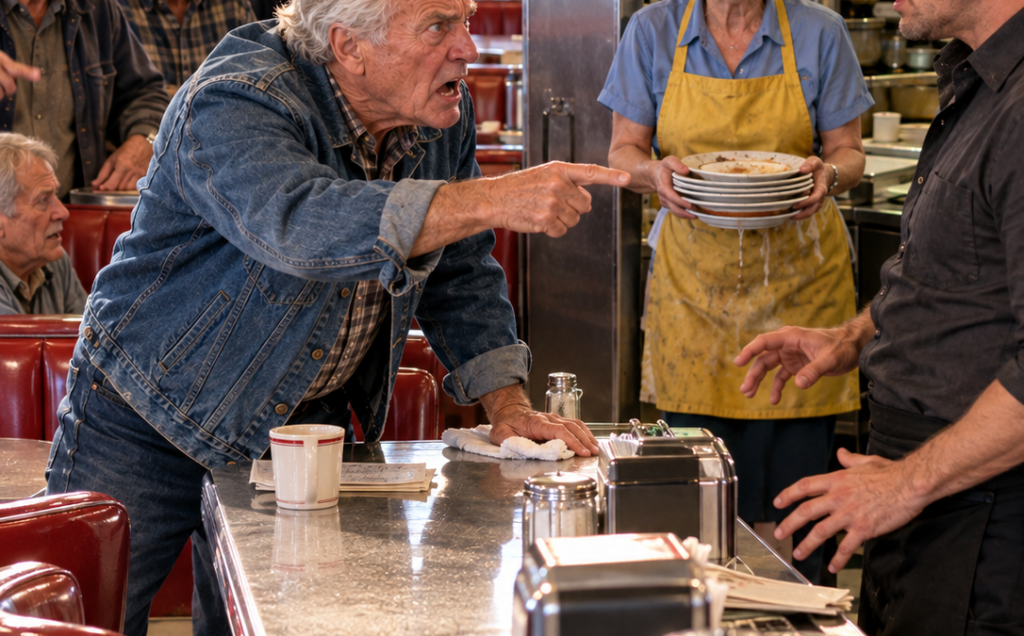
After 38 years of serving coffee, remembering birthdays, and treating every customer like family, 62-year-old Bev was told by the diner’s new owner that she was “too old” to work out front. He handed her a rubber apron and sent her to wash dishes in the back. She swallowed her pride and obeyed. But when the longtime regulars walked in and discovered what he’d done, they were about to remind him of something he never understood…
At 6:20 on a Wednesday morning, seventy people crowded into a small Iowa diner, and every single one of them refused to order breakfast until a sixty-two-year-old waitress was brought out of the dishwashing room.
I was that waitress.
My name is Beverly Novak, although everyone in Millbrook calls me Bev. I’d worked at Gus’s Diner for thirty-eight years, serving coffee, remembering birthdays, and learning the little details about people that never show up on a receipt.
The new owner, Chad Whitmore, had decided I was too old to work out front.
“Customers want younger faces,” he’d told me the previous morning. “Madison can handle your tables. You’ll be more comfortable doing dishes.”
He called it a favor.
I called it something else, though I kept that opinion to myself.
Now I stood behind a swinging kitchen door, wearing a rubber apron, my arthritic hands aching from hours of hot water, while dozens of customers sat outside refusing to eat.
Every order ticket said the same thing.
“Whatever Bev’s making.”
Chad was standing in the middle of the dining room, trying to understand what was happening, when seventy-four-year-old Ed Kessler walked through the front door wearing a dark suit and carrying a manila folder.
Ed had eaten breakfast at our counter every morning for twenty-eight years. I’d never seen him wear anything fancier than a clean flannel shirt.
That morning, he’d even polished his shoes.
He walked straight up to Chad.
“Morning, young man,” he said. “I believe we need to discuss your lease.”
Chad gave him a confused smile.
“My lease?”
Ed placed the folder on the counter.
“Yes, sir. Specifically, the part that says you can’t remove Beverly Novak from her position without her written consent.”
Chad stopped smiling.
And from the kitchen doorway, I realized something extraordinary was about to happen.
But to understand why an old farmer would come into a diner wearing his Sunday suit and carrying legal documents, you need to understand what Gus’s Diner meant to our town.
And what happened there thirty-eight years earlier.
I first walked into Gus’s in the spring of 1988.
I was twenty-four, recently separated from a husband who believed his paycheck gave him the right to control everything in our house. I had a four-year-old daughter named Carrie, forty-one dollars in my purse, and a battered Pontiac that wouldn’t drive in reverse.
We’d spent two nights at my cousin’s place outside Sioux City before I decided we needed a fresh start somewhere nobody knew our troubles.
I found Millbrook almost by accident.
The diner had a crooked wooden sign, red vinyl booths, and a handwritten notice taped to the front window.
HELP WANTED.
I walked inside and asked for the owner.
Gus Petros came out from behind the grill, wiping his hands on a white apron. He was a large man with thick forearms, a bald head, and the kind of face that looked permanently annoyed even when he was happy.
“You ever waited tables?” he asked.
“No, sir.”
“Know how to pour coffee?”
“I think I can manage that.”
“Got reliable transportation?”
I thought about the Pontiac.
“Reliable enough if I don’t have to back up.”
He stared at me.
Then he laughed.
“Well, at least you’re honest.”
Through the window, he noticed Carrie sitting in the car, clutching her stuffed rabbit.
“That your little girl?”
I nodded.
“She’s waiting while I ask about the job.”
Gus looked at her for a moment, then headed outside.
He opened the car door and crouched beside her.
“Young lady, how do you feel about chocolate-chip pancakes?”
Carrie looked at me for permission.
I nodded.
Five minutes later, she was sitting at the end of the counter, eating a pancake shaped like a mouse’s head.
Gus handed me an apron.
“You can start tomorrow. Doris, my sister, will keep an eye on the girl until you arrange childcare.”
My eyes filled with tears.
He pointed toward the coffee machine.
“Save the crying for after breakfast. We’ve got customers coming.”
That was Gus.
He didn’t give speeches about kindness. He simply did what needed doing.
Over the years, he became the closest thing to a father I’d ever known.
He watched Carrie grow up, graduate from high school, and become a nurse. When she got married, Gus showed up wearing a suit that looked twenty years too old and slipped five hundred dollars into her wedding card.
When I tried to thank him, he waved me away.
“She’s family, Bev. Don’t make a production out of it.”
That was the thing about Gus’s Diner.
People didn’t just come for breakfast.
They came because somebody remembered them.
Dale Lindgren wanted his eggs over medium, with hash browns extra crispy. His wife Joanne preferred scrambled eggs and always claimed she wasn’t hungry enough for toast before eating half of his.
Walter Haugen ordered pancakes every morning for thirty-one years, but still studied the menu carefully before making his decision.
Marlene and Bonnie, two sisters who owned the flower shop, had been arguing since 2003. They sat together every Friday but usually spoke to each other through me.
“Tell my sister she’s wearing too much lipstick.”
“Tell my sister she needs glasses.”
I delivered the messages, even though we all knew the sisters loved each other more than either would admit.
And then there was Ed Kessler.
Ed sat on the third stool from the register.
Black coffee. Wheat toast without butter.
Every morning at 6:15.
He paid exactly one dollar and eighty-five cents, carefully stacking his coins on the counter.
