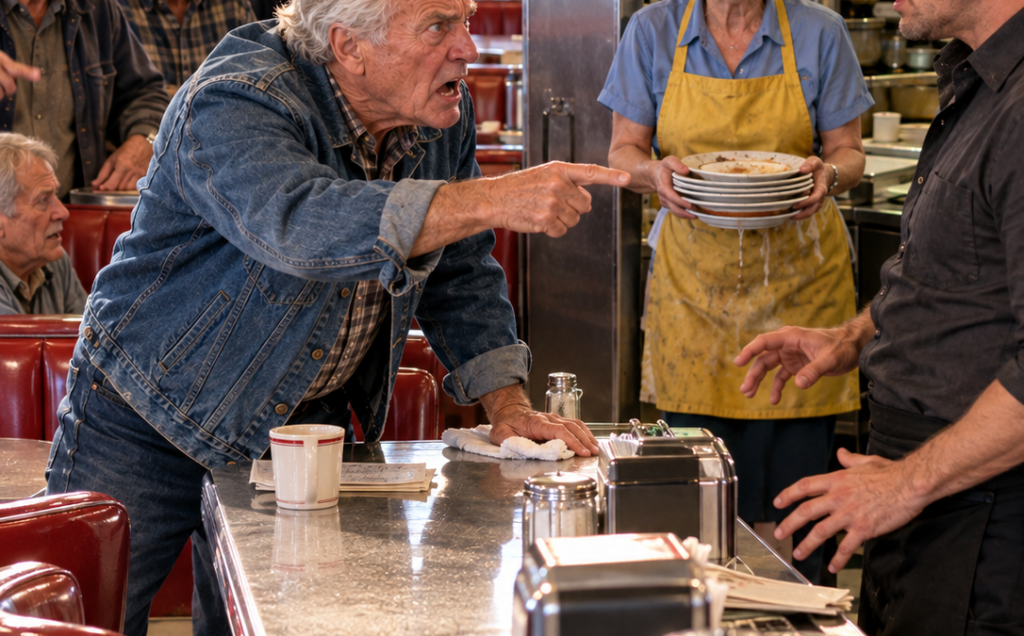
Later, he helped organize a community fundraiser after the farmer agreed to accept help.
Gus would’ve been proud.
At least, I like to think so.
By autumn, sales had recovered.
Some younger customers came for Tanner’s new breakfast specials. The old regulars returned because the diner once again felt like home.
And one Saturday morning, Chad asked me to meet him outside.
The sleek black sign was gone.
In its place hung the old wooden one.
GUS’S DINER.
GOOD FOOD. FAIR PRICES.
The paint was faded, and the last letter was slightly crooked.
Chad had found it in storage.
He’d cleaned it, repaired the frame, and put it back himself.
Underneath, he’d added a smaller plaque.
ASK FOR BEV.
I stared at it.
“Chad, you didn’t have to do that.”
“I know.”
He looked toward the dining room.
“But I think I finally understand what I bought.”
The following spring marked my thirty-ninth anniversary at the diner.
When I arrived at 5:15, the lights were already on.
Chad was behind the counter.
Madison stood beside him.
And sitting near the register was a chocolate cake with thirty-nine candles.
The frosting read:
BEV — THE HEART OF GUS’S DINER.
I looked around.
“What is all this?”
Chad smiled.
“An anniversary party.”
“At five in the morning?”
“That’s when you always show up.”
Before I could answer, the bell rang.
Dale and Joanne entered.
Then Walter.
Then Marlene and Bonnie, actually talking to each other for once.
The Miller boys arrived with their father.
Farmers, teachers, shopkeepers, and neighbors followed.
And finally, Ed Kessler walked in wearing his old green cap.
He took his place on stool three.
Someone began singing.
Within seconds, the whole diner joined in.
The song was terribly off-key.
It was also the most beautiful sound I’d heard in years.
When the singing ended, Chad stepped forward.
He looked nervous.
“Bev, there’s something I want to say.”
I folded my arms.
“If you’re sending me back to those dishes, we’re going to have a problem.”
Everyone laughed.
Chad shook his head.
“No, ma’am.”
He reached out his hand.
“As long as there’s a Gus’s Diner, you’ll have a place out front. You’re the heart of this place.”
I stopped breathing.
Those were Gus’s words.
The exact words he’d said fifteen years earlier.
Chad smiled gently.
“Ed told me about the promise.”
My eyes filled.
“I wanted you to know I mean it too.”
He held out his hand.
“Shake on it?”
I looked down.
His hands weren’t smooth anymore.
There were little burns from the grill and rough patches from washing dishes and carrying boxes.
Working hands.
A little like Gus’s.
I shook his hand.
Then I turned toward Ed.
He was sitting quietly, watching.
I picked up the coffee pot and walked toward him.
“Morning, Ed.”
“Morning, Bev.”
“Coffee?”
“Please.”
But instead of pouring it myself, I handed the pot to Madison.
Ed looked surprised.
For twenty-eight years, nobody else had poured his coffee.
I touched his shoulder.
“Ed, I’m not going to be here forever. Someday, I’ll want to sleep late or take a trip to see my grandchildren.”
He looked at Madison.
She was holding the pot carefully.
“I’ve taught her everything she needs to know,” I said. “Including how you like your coffee.”
Ed studied her for a long moment.
Then he moved his hand away from the cup.
Madison poured.
Black coffee.
Right to the top.
Not a drop spilled.
“Thank you,” Ed said.
Her eyes brightened.
“See you tomorrow, Mr. Kessler.”
Ed swallowed.
Then he smiled.
“Tomorrow.”
He reached into his pocket and counted his coins.
One dollar and eighty-five cents.
He stacked them neatly on the counter.
Chad rang up the order.
After Ed left, I noticed the receipt.
It said:
ED’S BREAKFAST — $1.85.
I looked at Chad.
He shrugged.
“Some traditions are worth keeping.”
I smiled.
Later that day, after the last customers had gone, I stood outside beneath the old wooden sign.
The sun was setting over Millbrook.
Inside, Madison was wiping tables. Tanner was cleaning the grill. Chad was balancing the register.
Ordinary people doing ordinary work.
And somehow, all of it felt extraordinary.
I thought about the frightened young mother who’d walked through those doors in 1988 with forty-one dollars and a little girl waiting in a car.
I thought about Gus making that little girl pancakes.
I thought about his handshake.
And I thought about Ed, who had once needed someone to believe he’d come back tomorrow.
For thirty-nine years, I’d believed my job was serving breakfast.
I understand now that it was something more.
I was helping people feel that they belonged somewhere.
And when I was the one who needed help, those same people showed up for me.
They didn’t arrive because I was important or wealthy or powerful.
They came because I’d remembered their names.
Because I’d listened when they were worried.
Because I’d noticed when they stopped eating their eggs.
Because I’d treated them as people long before they ever had a reason to do something for me.
That morning when Chad sent me to the dishwashing room, I thought the world had decided I was no longer useful.
But I was wrong.
Age hadn’t erased my worth.
A new owner simply hadn’t understood it yet.
And sometimes, the greatest things we leave behind aren’t buildings, bank accounts, or important titles.
Sometimes they’re the quiet promises we keep.
The coffee we pour.
The kindness we offer when nobody is watching.
And the simple words we say to someone who’s struggling to face another day.
“See you tomorrow.”
Because you never know.
