“Who?” I asked.
“An old friend,” he answered.
He wouldn’t say more.
I never imagined that handshake would matter again.
Until Chad sent me into the dishwashing room.
That first day nearly broke me.
Steam clouded my glasses. The sprayer hose jerked against my aching fingers. Water soaked my shoes.
By lunchtime, my hands were swollen.
Through the kitchen window, I could see Madison struggling.
She brought Dale the wrong eggs and gave Walter toast instead of pancakes.
At noon, she hurried into the dishwashing room.
“Bev, I’m sorry. I keep messing everything up.”
“You’re learning, honey.”
“Everybody asks for you.”
“They’ll learn your name too.”
She looked miserable.
“Do you hate me?”
I stopped washing.
“Why would I hate you?”
“Because I got your job.”
I took off one rubber glove.
“Madison, you didn’t make this decision. And you deserve a chance to work just like I did at your age.”
She nodded, though she didn’t look convinced.
At three o’clock, I removed my apron and walked into the dining room.
Ed Kessler was sitting on stool three.
That alone was unusual.
He’d already eaten breakfast that morning.
He looked at my swollen hands, damp hair, and exhausted face.
“Bev?”
“Afternoon, Ed.”
He stared toward the kitchen.
“They got you washing dishes?”
“Just helping where I’m needed.”
His expression changed.
He looked at Chad’s office.
Then he reached into his pocket, counted out his familiar coins, and stacked them on the counter.
One dollar and eighty-five cents.
He left without another word.
I thought he was angry about the changes.
I had no idea how angry.
The following morning, I arrived at 5:15, soaked my hands briefly in warm water, and started loading the dishwasher.
At six, the bell over the front door began ringing.
Once.
Twice.
Then so often I stopped counting.
Through the pass window, I watched people entering.
Dale and Joanne.
Walter Haugen.
The Miller family.
Marlene and Bonnie.
Farmers still wearing muddy boots.
Teachers, shopkeepers, mechanics, retired nurses.
People I hadn’t seen in years.
Every booth filled. Then every counter stool.
Those who couldn’t find seats waited outside, where someone had begun passing around takeout coffee.
Madison hurried into the kitchen.
“Bev, something’s happening.”
She showed me her order pad.
Every customer was asking for the same thing.
“Whatever Bev’s making.”
I stared at the words.
“But I’m not making anything.”
“I know.”
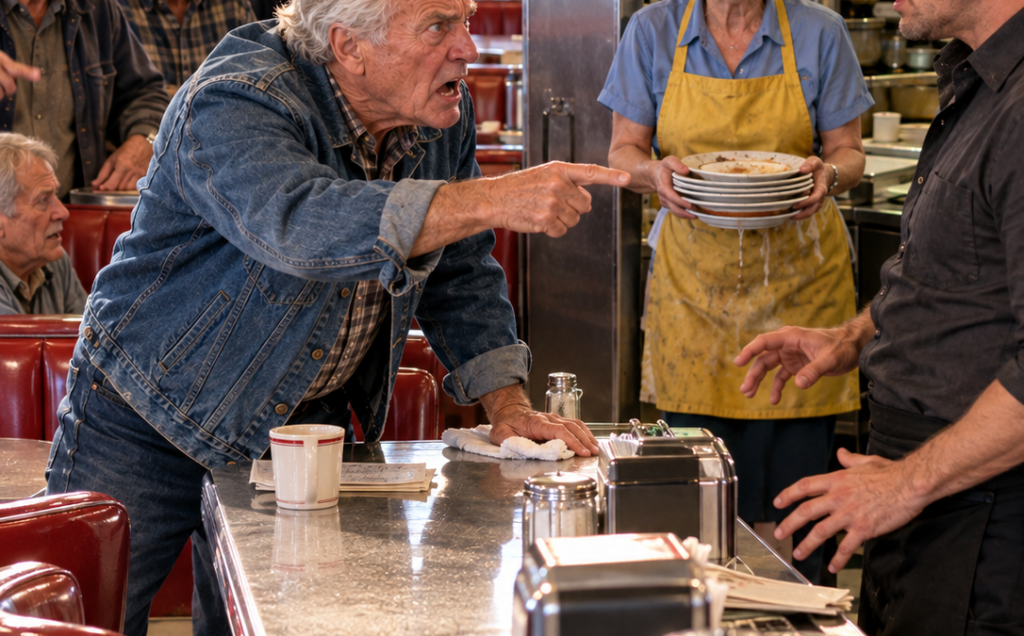
Chad appeared from his office, straightening his vest.
“What’s going on out here?”
Nobody answered him immediately.
Then Dale stood.
“We’d like Bev back.”
Chad smiled nervously.
“She’s still employed here, folks.”
“Then bring her out front.”
“She’s been reassigned.”
“We know,” Joanne said.
Chad looked around.
“Look, I understand you all appreciate Beverly, but businesses have to evolve.”
Walter Haugen raised his cane slightly.
“Then evolve without getting rid of the people we came to see.”
A ripple of agreement passed through the room.
Chad’s smile disappeared.
And then Ed arrived.
Dark suit.
Polished shoes.
Manila folder.
He walked past his usual stool and stopped at the counter.
“Chad, we need to talk about the building.”
Chad frowned.
“What about it?”
“I’m the owner.”
Silence fell across the diner.
Even I stopped breathing.
Ed opened the folder.
“I bought this property in 2011 when Gus was having financial trouble. I’ve leased it to the business ever since.”
Chad swallowed.
“You’re Kessler Holdings?”
“That’s right.”
Ed adjusted his glasses.
“When you bought the diner, you assumed the existing commercial lease. There was an attachment to that agreement.”
He slid a copy across the counter.
“Section Nine.”
Chad read.
His face changed.
Ed continued.
“Gus and I agreed that Beverly Novak would remain the head waitress unless she chose otherwise. That provision was part of the lease you signed.”
Chad looked up.
“I didn’t know about that.”
“Then you should’ve read what you signed.”
Chad scanned the page again.
Ed’s voice remained calm.
“My attorney reviewed everything yesterday. You’ve got an opportunity to correct this. But if you refuse, we’ll need to discuss the consequences under the lease.”
Chad stared at the document.
I stepped out of the kitchen.
“Ed?”
He turned toward me.
“Morning, Bev.”
“You own this building?”
“Have since October 2011.”
I looked at the old counter, the booths, the photographs of Gus.
“You’re the one who saved it?”
Ed shrugged.
“Gus needed help. I had some money from leasing farmland for wind turbines.”
“Why didn’t you tell me?”
He glanced at the document.
“Because Gus wanted you to keep doing your job without feeling you owed anyone anything.”
My throat tightened.
“Gus knew about this agreement?”
“Was his idea.”
Ed tapped the page.
“He said a handshake was good between friends, but he wanted his promise to protect you even after he was gone.”
I covered my mouth.
For fifteen years, I’d remembered that handshake.
I never knew Gus had done anything more.
Chad stood motionless.
“Mr. Kessler, please understand. I’ve invested everything I have in this business.”
Ed nodded.
“Then you’ve got good reason to learn how it works.”
Chad’s voice cracked.
“I thought the changes would help. Sales are down almost thirty percent.”
Dale spoke from his booth.
“Because you started charging me for coffee refills.”
Walter added, “And you took away the menus.”
“And somebody put weeds in the gravy,” Hank Olson complained.
“It’s fennel,” Tanner called from the kitchen.
“Well, stop doing it!” Hank replied.
A few people laughed.
But Ed remained serious.
“You sent Bev into a hot kitchen because you thought your customers didn’t want to see an older woman. Did you ever ask those customers?”
Chad looked around the room.
Nobody answered for him.
I could have enjoyed his humiliation.
Part of me wanted to.
My hands were still sore. My pride was wounded. And I had spent the previous night wondering whether nearly four decades of work had meant anything.
But looking at Chad, I saw something beneath the arrogance.
Fear.
He was young, inexperienced, and terrified of losing the money his family had helped him invest.
