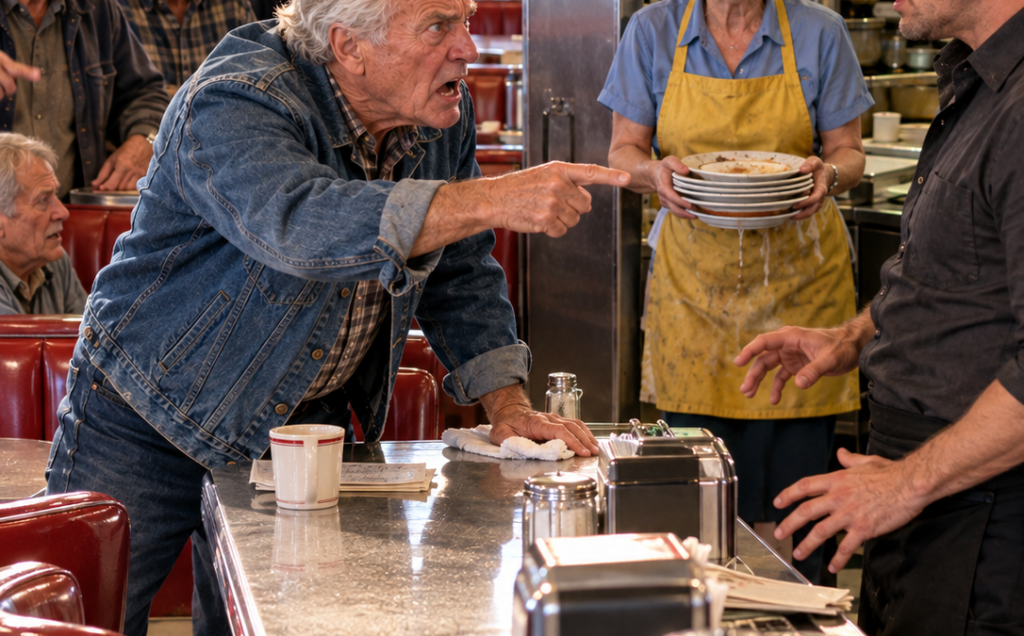
He’d mistaken a town full of people for a spreadsheet full of customers.
“Chad,” I said.
He turned toward me.
“I want my job back.”
He nodded quickly.
“Of course.”
“And I want you to understand why.”
I pointed toward the tables.
“These people aren’t against change. They’re against being treated like they don’t matter.”
I gestured toward Walter.
“That man has ordered pancakes here for thirty-one years. He looks at the menu every morning because he enjoys making the choice. You took away that little pleasure.”
Walter nodded.
I pointed toward the Miller family.
“Those boys lost their mother. Their dad brings them here every birthday because this is where she used to take them. We put candles in their pancakes because she isn’t here to do it anymore.”
Their father lowered his eyes.
“That’s not a transaction, Chad. That’s a memory.”
I looked at Dale and Joanne.
“Some people come here to celebrate. Others come because they’re lonely. Some are having the worst year of their lives, and breakfast is the one hour they don’t have to pretend everything’s fine.”
The room grew quiet.
“You saw old booths, outdated menus, and customers who weren’t spending enough money.”
I took a breath.
“But Gus saw people. And he taught me to see them too.”
Chad looked down at the floor.
Then he said something I hadn’t expected.
“I don’t think I know how to do that.”
For the first time since he’d bought the place, he sounded sincere.
I considered his words.
“Then learn.”
He raised his head.
“Would you teach me?”
I glanced toward the kitchen.
“First, you can spend a shift washing dishes.”
Several people chuckled.
Chad looked uncertain.
“Seriously?”
“Seriously. And then we’ll talk about what customers actually need.”
He nodded.
“All right.”
I untied the rubber apron and handed it to him.
He took it.
When he disappeared through the kitchen door, the room erupted in applause.
But before I returned to the counter, Ed touched my arm.
“Bev, there’s something else.”
He reached into his jacket and removed a small envelope.
I frowned.
“What’s that?”
“Something I’ve owed you for a long time.”
I opened it.
Inside was a cashier’s check for eleven thousand two hundred dollars.
My knees nearly gave out.
“Ed, what on earth?”
He looked toward stool three.
“The breakfast money.”
I stared at him.
“I don’t understand.”
“Yes, you do.”
His voice softened.
“Gus noticed years ago that you were paying the difference between what I gave you and what breakfast actually cost.”
My cheeks burned.
“I told him not to say anything.”
“He didn’t. Not until I noticed you putting money from your tip jar into the register. Then he explained.”
I shook my head.
“Ed, you weren’t supposed to know.”
“I know.”
“Then why’d you keep letting me do it?”
His eyes filled with tears.
“Because for a long time, Bev, that little breakfast was how I knew somebody cared whether I came back tomorrow.”
He swallowed.
“You helped me through the hardest years of my life. And you never once made me feel like a burden.”
I tried handing the envelope back.
“I don’t want your money.”
“I know that too.”
He gently pushed it toward me.
“But you’ve got a daughter and grandchildren. And maybe there’s somebody else who could use a little help.”
I held the envelope with trembling fingers.
All those mornings.
All those cups of coffee.
I’d never considered that a small kindness might matter so much.
Ed took my hand.
“When Lorraine died, I couldn’t imagine getting through another day. You didn’t fix my grief. You didn’t give me some grand speech. You just fed me and asked me to come back tomorrow.”
He wiped his cheek.
“So I did.”
I hugged him.
He stood stiffly for a second, then wrapped his arms around me.
Behind us, someone began clapping again.
I laughed through my tears.
“Would you people stop that? You’re going to make me ruin my makeup.”
The diner laughed with me.
That morning was the beginning of something none of us expected.
Chad kept his promise.
He spent the day in the kitchen helping with dishes, learning how exhausting the work could be.
Madison showed him how to operate the dishwasher.
Tanner taught him where the cleaning supplies were stored.
And I returned to the dining room.
I served coffee until my feet ached.
I made sure Walter got his pancakes.
I brought the Miller boys chocolate milk.
And when Ed finally sat on stool three, I poured his coffee myself.
Black.
Right to the top.
He took one sip.
“That’s better.”
Over the following weeks, Chad began changing.
Not overnight.
Real change rarely happens that way.
He asked questions.
He listened to customers.
He started arriving early enough to help Tanner prepare breakfast.
He brought back printed menus, while keeping the digital version for people who preferred it.
He stopped charging for coffee refills.
The Farmer’s Breakfast returned, although we had to adjust the price carefully to keep the business profitable.
And the gravy went back to tasting like gravy.
Tanner complained at first.
Then he started experimenting with new dishes that customers actually enjoyed.
We kept his avocado toast on the menu.
It turned out that some of our older customers liked it too.
Including Dale, who made me promise not to tell Joanne.
Madison became a wonderful waitress.
She learned the regulars’ names, remembered their orders, and discovered that the most important part of the job wasn’t carrying plates.
It was paying attention.
One afternoon, she told me she was considering a career in social work.
“Why?” I asked.
She shrugged.
“I think I like helping people more than I realized.”
I smiled.
“Then don’t let anyone tell you that’s not valuable work.”
Chad changed in quieter ways.
When one farmer mentioned he was struggling to keep up with equipment payments, Chad sat with him after the lunch rush.
He didn’t offer advice.
He listened.
