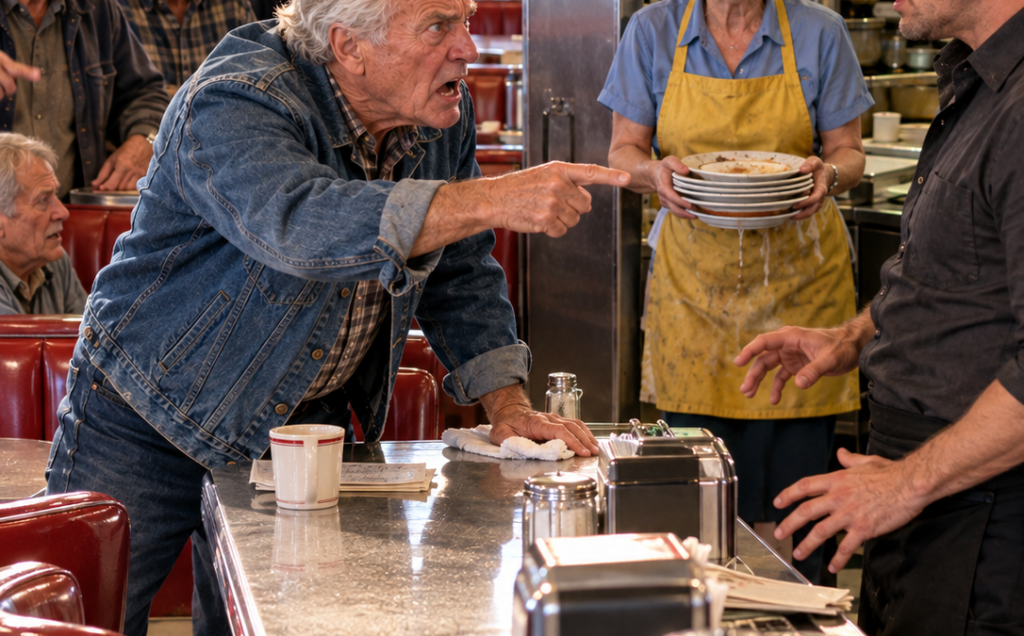
Nobody questioned the routine.
Nobody except me knew how it started.
In November 1998, Ed had walked into the diner looking like a man who’d forgotten how to live.
His wife, Lorraine, had died after a long illness. They’d been married twenty-five years, and losing her had left him hollow.
He hadn’t been eating properly. His farm was falling behind. His friends had tried calling, but he rarely answered.
That morning, he sat on stool three and stared at the counter.
“Coffee, Ed?”
He barely nodded.
I poured it.
Then I brought him two slices of dry wheat toast.
“I didn’t order that,” he said.
“I know. Eat something anyway.”
He stared at the plate.
Finally, he took a bite.
When he finished, I said something ordinary.
“See you tomorrow, Ed.”
He looked at me strangely.
“Tomorrow?”
“Six-fifteen. I’ll have the coffee ready.”
And he came back.
The next morning, and the next.
Years later, Ed admitted that he’d been in a very dark place after Lorraine died. He’d struggled to imagine any future worth living through.
That simple invitation had given him one small reason to face another morning. Eventually, he began accepting help from friends and his doctor, and slowly found his way back to ordinary life.
But he never forgot the breakfast that started it.
Neither did I.
By 2026, Ed had been sitting on that stool for twenty-eight years.
The price of breakfast had risen considerably.
Ed never changed his payment.
I never asked him to.
Instead, I quietly covered the difference from my tips.
Some mornings it was only a little.
Other mornings, more.
It became our private arrangement.
Or at least, that’s what I believed.
Then everything changed.
Gus died in January.
He was eighty-one.
I found him in his apartment above the diner when I arrived for work and discovered the grill was cold.
For thirty-eight years, he’d always been there before me.
Seeing that dark kitchen frightened me more than I can explain.
His children flew in from Arizona for the funeral.
They were decent people, but the diner had never meant much to them. They had careers, families, and their own lives.
Within a month, they sold the business.
That’s how Chad Whitmore arrived in Millbrook.
Chad was thirty-two, handsome, ambitious, and absolutely certain he understood the restaurant business because he’d spent four years helping manage a successful breakfast café in Des Moines.
He had a business degree, polished shoes, and a laptop filled with charts.
He also had an unfortunate habit of explaining things to people who already understood them.
“This place has tremendous potential,” he announced during his first staff meeting.
I remember looking around at the cracked vinyl booths, old coffee mugs, and faded photographs covering the walls.
To me, it already had tremendous value.
But Chad had a different vision.
He replaced the hand-painted Gus’s Diner sign with a sleek black one.
RISE & GRIND.
He removed the laminated menus and replaced them with QR codes.
Walter Haugen spent ten minutes trying to scan one with his old flip phone before giving up.
“Bev,” he finally asked, “can I still get pancakes?”
“Of course, Walter.”
“Same ones?”
“Same ones.”
“Then why’d he make it so hard to order them?”
I didn’t have an answer.
Chad increased prices, started charging for coffee refills, and renamed our Farmer’s Breakfast the Heartland Harvest Plate.
He hired Tanner, a talented young cook who insisted on putting fennel in sausage gravy.
“It’s a modern interpretation,” Tanner explained.
“Well, the farmers don’t want their gravy interpreted,” I told him. “They want it on their biscuits.”
Chad didn’t appreciate my observations.
Sales started falling.
Several regulars stopped coming.
Instead of asking why, Chad decided the problem was our customer base.
“We need younger people,” he told me.
Then he hired Madison, a nineteen-year-old community college student with a bright smile and almost no waitressing experience.
I liked Madison immediately.
She worked hard, listened carefully, and asked questions without pretending she knew the answers.
One morning, she came to me holding an order ticket.
“Bev, what does ‘Adam and Eve on a raft’ mean?”
“Two poached eggs on toast.”
She blinked.
“Why not just say that?”
“Because diners have their own language, sweetheart.”
She laughed.
An hour later, Chad summoned me to his office.
He didn’t invite me to sit.
“Bev, I appreciate everything you’ve done here, but we need a fresher image.”
I looked at him.
“A fresher image?”
“Young faces out front. More energy. Madison will take over your tables.”
“And me?”
“I need you washing dishes.”
For a moment, I thought I’d misunderstood.
“After thirty-eight years?”
He shifted his weight.
“Same hourly rate. It’s not a punishment.”
I looked down at my hands.
Arthritis had settled into every knuckle. Some mornings, I couldn’t close my fingers until I’d soaked them in warm water.
Chad knew that.
The dishwashing area was the hottest, most physically demanding room in the building.
He called it easier work.
I thought about telling him to take his job and put it somewhere unpleasant.
Instead, I said, “All right.”
Why?
Because I needed the paycheck.
Because I was sixty-two, not twenty-two, and starting over frightened me.
And because fifteen years earlier, Gus had made me a promise.
In October 2011, Gus nearly lost the diner.
Medical bills and mounting debt had pushed him toward foreclosure. One afternoon, I found him standing in front of the grill, staring at nothing.
“I think we’re finished, Bev,” he whispered.
“What do you mean?”
“The bank wants the building. I can’t save it.”
I asked what would happen to the employees.
He looked at me for a long time.
Then he reached across the counter.
“As long as there’s a Gus’s Diner, you’ll have a place out front. You’re the heart of this place.”
He held out his hand.
“Shake on it.”
I did.
And somehow, a week later, the foreclosure disappeared.
Gus said a local investor had bought the building and agreed to lease it back at an affordable rate.
