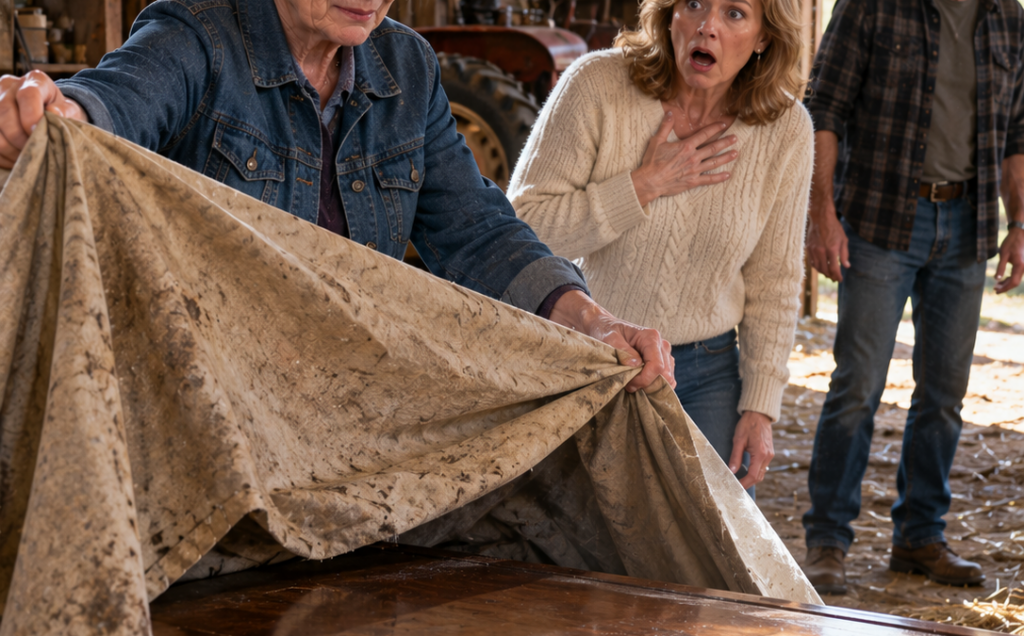
“Dad’s dead. He won’t know the difference,” my brother snapped, choosing a $95 cremation box. Mom, silent after fifty-eight years of marriage, simply folded the paperwork and asked me to drive her home. But when she entered Dad’s old barn and pulled back a dusty tarp, I froze…
“Direct cremation. Basic container. Ninety-five dollars.”
The funeral director slid the paperwork across his desk, and I stared at the number until the ink began to blur.
My father had been dead for barely twenty-four hours, and my brother had already decided what kind of box he was worth.
“Ninety-five dollars?” I repeated.
Kevin leaned back in his chair and crossed his arms.
“It’s a perfectly good container, Julie. Dad isn’t going to know the difference.”
I turned toward him.
“Did you even ask Mom?”
He glanced at our mother, who sat silently beside the window, her black purse resting on her knees.
“Mom doesn’t need to spend thousands on something that’s going to be burned,” he said. “Somebody has to be practical.”
Our mother had been married to our father for fifty-eight years.
She had washed his work clothes, packed his lunches, raised his children, and sat beside his hospital bed through the final six weeks of his life.
And now, apparently, somebody had decided she didn’t need a voice in how we said goodbye.
“Kevin,” I said, trying to control my temper, “you cannot make this decision without her.”
He shook his head.
“Dad was the cheapest man in Pope County. You think he’d want us wasting money on a fancy coffin?”
Before I could answer, Mom reached across the desk.
She picked up the paper, examined the price, and carefully folded it in half.
Then she stood.
“Julie,” she said, “take me home.”
Kevin threw his hands into the air.
“Mom, we have to make arrangements!”
She looked at him.
Her expression was so calm it frightened me.
“Your father made his arrangements thirty-eight years ago.”
Neither of us understood what she meant.
Not until we got home, and my seventy-nine-year-old mother walked straight past the house, unlocked the old red barn, and pulled a dusty canvas tarp from something my father had built in 1988.
What stood beneath it made my brother stop breathing for a moment.
And what we eventually discovered inside changed the way we understood our father, our mother, and each other.
My name is Julie Sorensen. I’m fifty-one years old, a registered nurse, and the oldest child of Arthur and Helen Sorensen of rural Glenwood, Minnesota.
My father died on a Thursday morning in early November.
He was eighty-two.
His heart had been weakening for years, but until the previous summer, he had refused to let it interfere with his life.
Dad was a carpenter by trade and a farmer by temperament.
He repaired tractors for neighbors who couldn’t afford a mechanic, made wooden toys for children at Christmas, and believed that anything held together with screws could eventually be fixed.
He was also stubborn enough to make a mule look cooperative.
When his doctor told him to stop climbing ladders, Dad waited until Mom went grocery shopping before cleaning the gutters.
When he was told to give up salt, he hid a shaker in the drawer beside his recliner.
But when the doctor finally explained that his heart was failing and there was nothing more surgery could offer, Dad didn’t argue.
He simply asked to go home.
We brought him back to the farmhouse in September.
For six weeks, Mom cared for him with help from hospice nurses, Kevin, and me.
Most mornings, I arrived before seven to help with medications and breakfast.
Kevin came when he could, usually after closing the used-car dealership in Alexandria where he worked.
Our younger brother had never been particularly good at hospitals or sickrooms.
He could talk to complete strangers for an hour about truck engines, but put him beside a hospital bed and he seemed to forget how words worked.
I used to resent that.
I thought he was avoiding the hard part while Mom and I handled everything.
It took me a long time to understand that Kevin wasn’t indifferent.
He was terrified.
Dad had always been his hero.
Watching that hero struggle to lift a glass of water was more than Kevin knew how to bear.
On the night before Dad died, I found my brother standing outside the bedroom door.
He’d been there nearly ten minutes.
“Are you going in?” I asked.
He shook his head.
“Not sure what to say.”
“Just sit with him.”
Kevin looked down.
“What if he doesn’t know I’m there?”
“He knows.”
My brother finally went inside.
I left them alone.
The next morning, Dad passed quietly with Mom holding his hand.
She didn’t cry.
She simply pressed her forehead against his and whispered something I couldn’t hear.
Then she straightened the blanket, smoothed his hair, and asked me to call the hospice nurse.
It was the most heartbreaking display of composure I’d ever witnessed.
The trouble began the following afternoon at Nygaard Funeral Home.
Gary Nygaard had known our family for decades.
His father had handled both my grandparents’ funerals, and Gary had once played high school basketball with Kevin.
He greeted us with genuine sympathy.
Then he started explaining our options.
Dad had expressed a preference for cremation years earlier, and Mom had agreed.
That much wasn’t in dispute.
The question was how we would say goodbye before the cremation took place.
Gary showed us several caskets suitable for cremation.
The least expensive finished wooden model cost almost three thousand dollars.
The nicer ones cost considerably more.
Then Kevin asked whether something cheaper was available.
Gary explained that a simple combustible container could be used for direct cremation without a traditional service.
That was the ninety-five-dollar container.
Kevin immediately requested the least expensive option and signed a preliminary arrangement worksheet listing himself as the family contact.
Gary hadn’t accepted final authorization.
