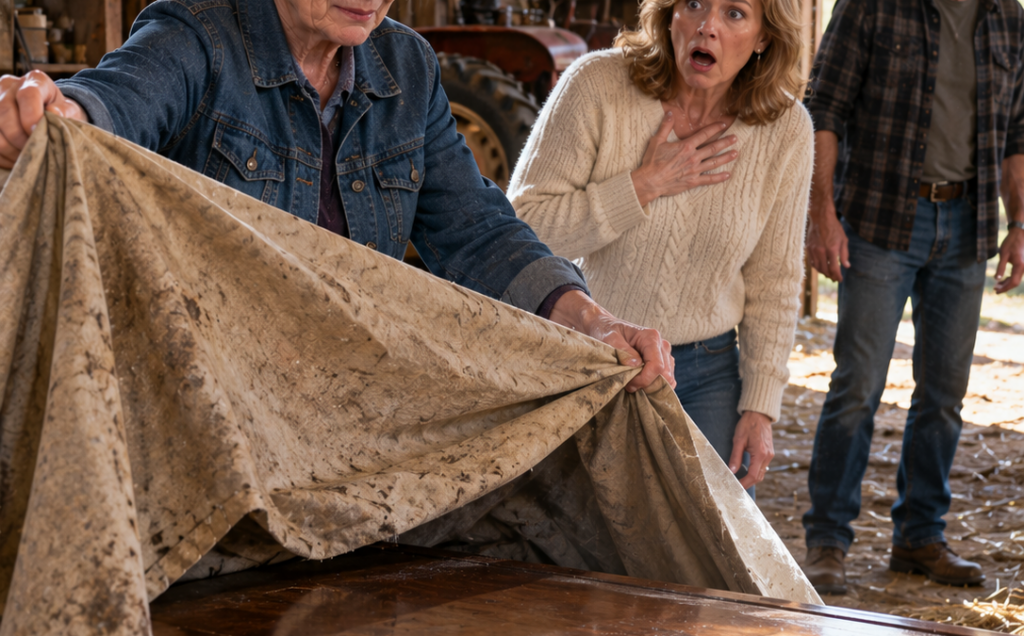
I opened my mouth.
Then closed it.
She continued.
“Kevin thinks I can’t handle funeral expenses. Julie thinks I can’t handle grief. Neither of you asked what I wanted.”
The barn grew very quiet.
Mom’s eyes filled for the first time.
“I buried my parents. I buried two brothers. I’ve spent sixty years making hard decisions with your father. I know how to make another one.”
She looked at the casket.
“But this is the first time I’ve had to make one without him beside me.”
Her voice finally broke.
And then my mother cried.
I went to her.
Kevin stood and wrapped his arms around both of us.
We remained that way for a long time, surrounded by my father’s tools, while the first real snowfall of the season drifted past the barn windows.
The next morning, we returned to the funeral home.
This time, Mom sat at the center of the desk.
She brought Dad’s letter and photographs of the handmade casket.
Gary listened carefully.
Then he asked several practical questions.
What kind of wood had Dad used?
Were there metal fittings?
Had the finish been treated with any chemicals?
Would the dimensions fit the cremation equipment?
Gary explained that a funeral provider couldn’t accept a homemade container without inspecting it and confirming that it met the crematory’s requirements.
Mom understood.
“I don’t want to create any problems,” she said. “Arthur specifically wrote that he didn’t want that.”
Gary smiled.
“That sounds like Art.”
He arranged to visit the farm that afternoon.
When he saw the casket, he removed his glasses.
“Well,” he said softly, “I’ll be darned.”
He examined the construction.
He checked the handles, joints, dimensions, and lining.
Then he called the crematory operator to discuss the materials and the planned arrangements.
After reviewing the construction details and arranging an appropriate inspection, they confirmed that Dad’s casket could be used.
There was one condition.
The facility needed to replace the old interior lining with an approved combustible material.
Mom agreed immediately.
Gary turned to her.
“Mrs. Sorensen, your husband certainly thought ahead.”
She smiled.
“Not always, Gary. But occasionally.”
We arranged a small visitation and farewell gathering before cremation.
There would be no elaborate decorations.
No expensive display.
Just Dad’s handmade casket, a few photographs, and a table where people could leave handwritten memories.
Mom chose the date.
She chose the music.
And she decided that afterward, everyone would come back to the farmhouse for coffee and sandwiches.
Kevin and I stopped trying to take charge.
We asked what she needed.
It was a small change.
But it mattered.
The day before the service, Kevin came to the farm early.
I found him in the barn, standing beside Dad’s workbench.
He was holding the unfinished birdhouse.
“Think Dad would’ve finished this?” he asked.
“Eventually.”
Kevin smiled.
“He would’ve complained about the price of the screws first.”
I laughed.
Then we stood together in silence.
After a while, my brother said, “I owe you an apology.”
I looked at him.
“For what?”
“The way I talked at the funeral home. Saying Dad was dead and wouldn’t know the difference.”
I leaned against the bench.
“You were scared.”
“That’s not an excuse.”
“No. But it’s the truth.”
He turned the birdhouse over in his hands.
“I keep thinking about the last time I talked to him.”
“When was that?”
“Wednesday night.”
I remembered seeing Kevin outside Dad’s bedroom.
“What did you say?”
“Not much. Mostly sat there.”
He swallowed.
“Dad asked whether I’d fixed the transmission on my truck. I told him I couldn’t afford it yet.”
I waited.
“He said, ‘Bring it over when I’m feeling better. We’ll take a look.’”
Kevin stared at the floor.
“He could barely breathe, Julie. And he was still trying to fix my truck.”
I felt tears gathering.
“That was Dad.”
Kevin nodded.
“Then he told me something.”
“What?”
“He said, ‘Son, don’t spend your whole life being ashamed of what you don’t have. You’ll miss what you do have.’”
My brother wiped his eyes.
“I didn’t understand him until yesterday.”
I touched his arm.
“You’ve got time to figure things out.”
“Not with him.”
“No,” I said quietly. “Not with him.”
Kevin looked around the barn.
“Maybe I can finish the birdhouse.”
“I think he’d like that.”
He gave a small smile.
“Probably tell me my corners weren’t square.”
“Definitely.”
And for the first time since Dad died, we laughed together without feeling guilty.
Nearly two hundred people came to say goodbye.
I hadn’t expected so many.
Farmers Dad had helped thirty years earlier stood beside former coworkers, neighbors, friends, and people whose names I didn’t recognize.
An elderly man approached Mom holding a small wooden toy truck.
“Art made this for my grandson when he was sick,” the man said. “That boy’s thirty-five now. He’s got children of his own.”
A woman told us Dad had repaired her porch steps for free after her husband died.
Another remembered how he plowed her driveway every winter without being asked.
Then Gary approached me.
“Julie, there’s a gentleman who wants to speak with your mother.”
Standing beside him was a tall man in his fifties.
He introduced himself as Daniel Erickson.
Leonard Erickson’s youngest son.
The little boy whose father’s death had inspired Dad to build his own casket.
Daniel stepped toward Mom.
“Mrs. Sorensen, I wasn’t sure you would remember me.”
She smiled immediately.
“Danny Erickson. Of course I remember you.”
He took her hands.
“I wanted to tell you something about your husband.”
Mom nodded.
Daniel looked toward the casket.
“When Dad died, we were in bad shape financially. My mother never told us how bad until years later.”
His voice grew thick.
“Your husband came over the day after the funeral and told her he needed help fixing a tractor.”
Mom listened.
“He paid her to sort parts, clean the workshop, and keep records for him. Every week for almost a year.”
I had never heard this story.
