As Dad’s surviving spouse, Mom still had decisions to make.
But Kevin acted as though the discussion was over.
“Dad wouldn’t want a fuss,” he insisted.
I understood his concern about money.
Kevin had been divorced for three years, his car sales had slowed, and he’d fallen behind on his mortgage.
He was raising two teenagers half the time and struggling to keep his finances together.
I knew he was worried about what the funeral would cost.
But money wasn’t the only consideration.
“Kevin, we’re not buying Dad a sports car,” I said. “We’re trying to give him a proper goodbye.”
He gave a bitter laugh.
“Proper according to whom? The funeral industry?”
“That’s not fair.”
“What’s not fair is expecting Mom to pay ten thousand dollars because everyone wants to feel better for an afternoon.”
Mom remained silent.
She watched the first snowflakes drift past the funeral home’s window.
Then she took the paper.
Folded it.
And asked me to take her home.
Gary gently assured us that nothing would move forward until Mom had decided what she wanted.
Kevin followed us into the parking lot, muttering under his breath.
I was furious with him.
But what happened next made our argument seem very small.
Mom didn’t speak during the twenty-minute drive home.
The countryside had turned gray beneath the November sky.
Cornfields stood empty.
The lakes were dark and restless.
Dad’s old red barn appeared through the trees as we turned into the gravel driveway.
I parked beside the porch.
“Mom, why don’t you go inside?” I said. “I’ll make some coffee.”
She unbuckled her seat belt.
“Get your brother.”
“What?”
“Tell Kevin to come here.”
He pulled into the driveway a few minutes later, his pickup tires crunching over the gravel.
Mom was waiting beside the barn.
She held a ring of keys in her hand.
Kevin climbed out.
“Mom, if this is about the funeral—”
“It is.”
She unlocked the barn.
The hinges groaned as the heavy door swung inward.
Inside, the familiar smells of sawdust, motor oil, and old hay washed over us.
Dad had spent thousands of hours there.
His tools still hung in careful rows above the workbench.
An unfinished birdhouse sat beside his favorite plane.
And at the far end, behind an old tractor and several stacks of lumber, stood a long rectangular object beneath a gray canvas tarp.
I had seen it hundreds of times.
As children, we’d been told not to climb on it.
Over the years, we’d piled things around it.
I assumed it was some abandoned piece of furniture.
Mom walked toward it.
“Kevin, help me with this.”
He stepped forward reluctantly.
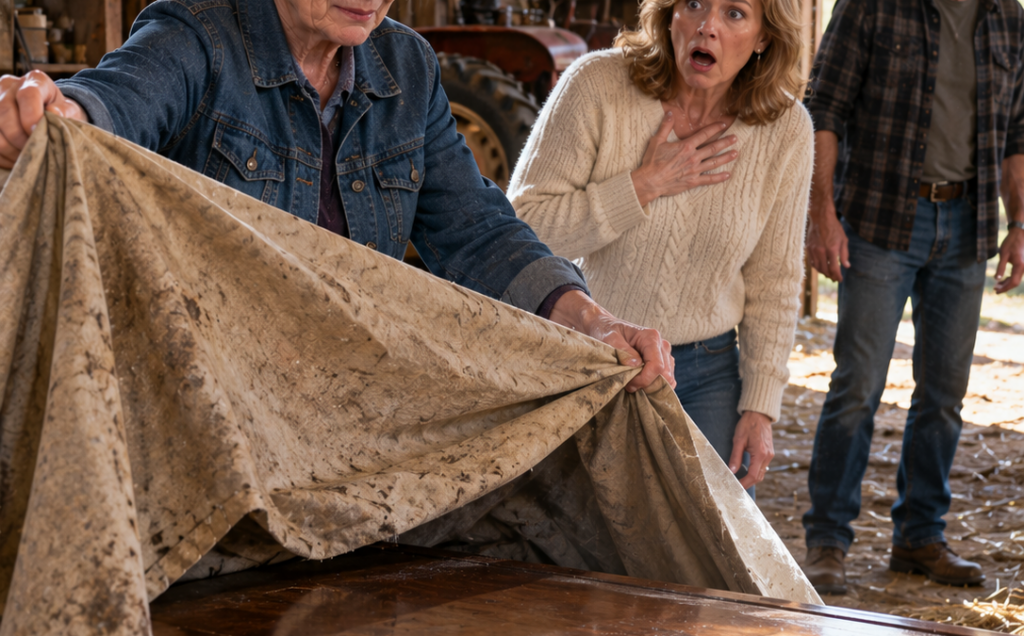
Together, they pulled away the tarp.
Beneath it was a wooden casket.
Not a crude box.
Not a rough collection of boards.
A beautifully crafted, full-sized casket made of honey-colored pine, with smoothly rounded edges, carefully fitted corners, and six sturdy wooden carrying handles.
The wood had darkened with age.
Each board fit perfectly against the next.
There was no elaborate decoration.
Just a simple carved border around the lid and a small design at the head: three stalks of wheat beneath a rising sun.
My brother stared.
“What in the world?”
Mom rested her hand on the lid.
“Your father made this.”
I stepped closer.
“When?”
“1988.”
I looked at her.
“Dad built his own coffin?”
She nodded.
“And he made me promise not to tell you children until the time came.”
Kevin ran a hand through his hair.
“Why would he do something like that?”
Mom smiled faintly.
“Because your father was Arthur Sorensen. Once he made up his mind about something, he didn’t see much reason to ask permission.”
She took a folded cloth from her coat pocket and wiped a little dust from the pine.
“Thirty-eight years ago, he decided he wasn’t going to leave me with a big funeral bill.”
I felt my throat tighten.
Mom turned toward us.
“Now, if you two are finished arguing about what your father would have wanted, perhaps you’d like to see what he actually wanted.”
The story began in January 1988.
I was thirteen. Kevin was six.
Dad had just buried his closest friend, Leonard Erickson.
Leonard had owned a dairy farm three miles from ours.
He and Dad had grown up together, played baseball together, and helped each other through droughts, blizzards, and years when milk prices barely covered feed.
Leonard died suddenly of a heart attack at forty-six.
His wife, Carol, was left with three children, a struggling farm, and a mountain of bills.
“Your father went with Carol to make the funeral arrangements,” Mom told us. “He watched her try to find something she could afford.”
I remembered Mrs. Erickson.
She was a gentle woman who always brought homemade jam to church suppers.
But I hadn’t known about the financial trouble.
“Carol wanted something nice for Leonard,” Mom continued. “She was ashamed she couldn’t afford it. Your father told her Leonard wouldn’t care if they buried him in a cardboard box.”
Kevin gave a small nod.
“Sounds like Dad.”
“But when he got home, he was upset. Not because Carol wanted something beautiful. Because she’d been made to feel she was failing her husband if she couldn’t buy it.”
Mom looked down at the casket.
“That winter, your father bought a load of clear pine from a sawmill outside town.”
“He bought lumber in the middle of winter?” I asked.
“He said he was building a storage chest.”
She smiled at the memory.
“He worked on it every evening after supper. Some nights until midnight.”
I looked at the intricate joints.
Dad had always been an excellent carpenter, but this wasn’t ordinary workmanship.
It was the kind of work someone did when they expected it to matter for a very long time.
“He finished it in April,” Mom said. “Then he showed it to me.”
“What did you say?” Kevin asked.
“I told him he’d lost his mind.”
