For the first time since Dad’s death, we laughed.
Mom’s eyes softened.
“He told me, ‘Helen, I’ve spent my whole life building things other people will use. This is the last thing I need, and I might as well build it myself.’”
She went quiet.
“Then he told me he didn’t want me standing in a funeral home someday, trying to figure out how much money proved I loved him.”
Kevin lowered his head.
I looked at the carved wheat.
Dad had designed it after the fields behind our house.
The same fields he’d worked for almost fifty years.
“Why didn’t he tell us?” I asked.
“He knew you’d think it was morbid. He said children shouldn’t have to picture their parents dying before they needed to.”
Mom touched the lid.
“And he wasn’t in any hurry to use it.”
Kevin walked around the casket twice.
Then he crouched and examined the joints.
“No nails?”
“Almost none,” Mom answered. “He used wooden joinery wherever he could.”
Kevin shook his head.
“Unbelievable.”
I knew what he was thinking.
Dad had taught him woodworking when he was little.
They’d built a bird feeder together when Kevin was eight, a toolbox when he was twelve, and a cedar bench for Mom’s fiftieth birthday.
But Dad had never mentioned this.
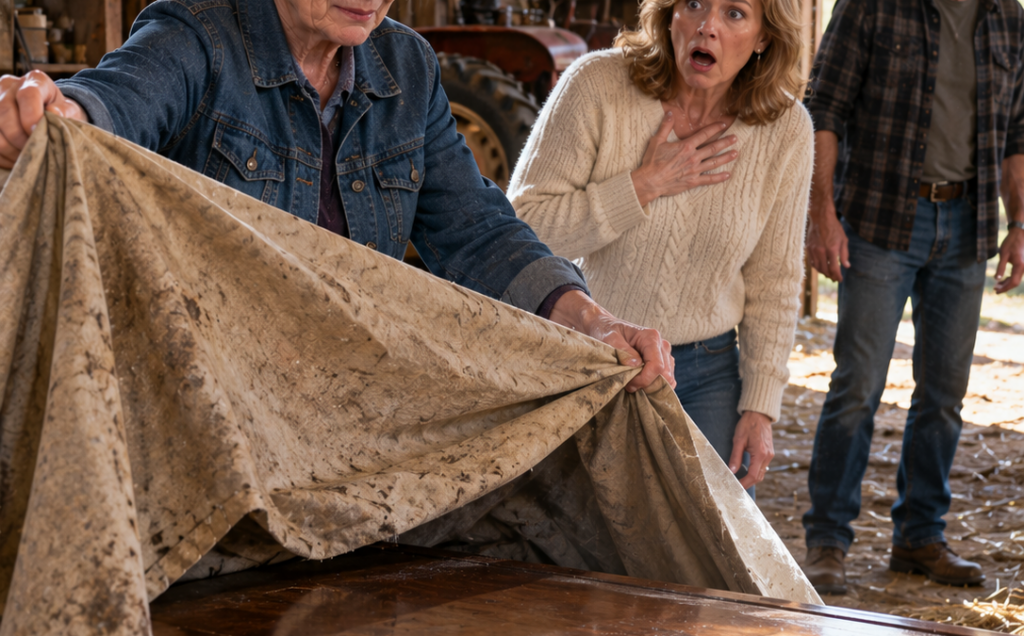
For thirty-eight years, his most personal woodworking project had sat beneath a tarp.
Waiting.
“There’s something else,” Mom said.
She pointed to the inside of the lid.
“Help me open it.”
Kevin and I lifted the lid carefully.
Inside was a lining of faded blue cotton, folded neatly across the bottom.
There was also a small wooden box, no larger than a shoebox.
Mom picked it up.
“Your father made this later, when he decided he wanted to be cremated.”
She opened the lid.
Inside was a handwritten note and a smaller wooden container designed to hold his ashes.
I recognized Dad’s handwriting immediately.
Large block letters.
Black ink.
The same handwriting that had appeared on birthday cards, school permission slips, and little notes he’d leave beside the coffee maker.
Mom unfolded the paper.
Her hands trembled.
“Would you read it, Julie?”
I took the letter.
At the top, Dad had written:
For Helen and the kids, whenever the day comes.
I began reading aloud.
If you’re holding this, I suppose I’ve finally run out of things to fix.
Kevin made a sound somewhere between a laugh and a sob.
I built this casket in 1988 because I wanted one decision taken off your mother’s shoulders. She has carried more than her share for most of our marriage.
I know some people will think this is a strange thing for a man to build. But making it never frightened me. The thing that frightened me was leaving Helen with bills, confusion, or the feeling that she had to spend money to show the world how much she cared.
I would like to be placed in this for a small farewell before cremation, if the funeral home can safely accommodate it. If it cannot be used, please don’t argue or make trouble. I won’t be needing it for long.
I paused.
My eyes were filling.
The next paragraph had been added in different ink.
I want my ashes placed in the smaller box I made in 2009. Helen knows where I asked her to keep them.
No fancy service. No fancy flowers. Just the people who loved me, some coffee, and a few stories that make everybody laugh.
Then came the final lines.
And children, don’t mistake a man’s thrift for a lack of love. I saved where I could because the things that mattered most were never for sale.
Take care of your mother.
Love, Dad.
I couldn’t continue speaking.
Kevin took the letter from me.
He read the last few lines silently.
Then he sat down on an overturned bucket beside the workbench.
For the first time since Thursday morning, my brother began to cry.
Not the quiet kind of crying where a person politely wipes away a tear.
He bent forward, covered his face, and sobbed.
Mom went to him.
She placed one hand on his shoulder.
And for a moment, I saw him not as a struggling forty-four-year-old salesman, but as the little boy who used to follow Dad around the farm, carrying nails in his pockets.
“I thought I was doing what he wanted,” Kevin whispered.
Mom sat beside him.
“You were trying to protect me.”
He nodded.
“I’ve seen your bank statements, Mom. The medical bills, the property taxes, everything.”
She looked surprised.
“How have you seen my bank statements?”
“Dad showed me some things when he was still feeling better. He was worried about the bills.”
Mom’s expression changed.
“Your father worried about everything.”
Kevin wiped his face.
“I couldn’t stand the thought of you paying thousands for a casket. And I knew I couldn’t help much.”
His voice broke again.
“I’ve already borrowed so much from you.”
That was news to me.
I looked at Mom.
She didn’t seem surprised.
Kevin stared at the floor.
“Dad helped me with my mortgage last spring. Twelve thousand dollars. He told me not to say anything to Julie because she’d think I was taking advantage of him.”
My first reaction was anger.
Twelve thousand dollars.
Our parents had spent decades saving carefully, and Kevin had accepted money while Dad was seriously ill.
But before I could speak, Mom raised her hand.
“I knew about the money.”
Kevin looked up.
“Dad told you?”
“Of course he told me.”
“But he said—”
“He said you needed help. We discussed it together.”
I sat down on the wooden bench.
“Mom, why didn’t you tell me?”
“Because it wasn’t your money to manage, Julie.”
The words stung.
She hadn’t spoken unkindly.
She’d simply stated a fact I’d apparently forgotten.
Mom looked from Kevin to me.
“I love you both. But somewhere along the way, you’ve started treating me as though I’m incapable of making my own decisions.”
