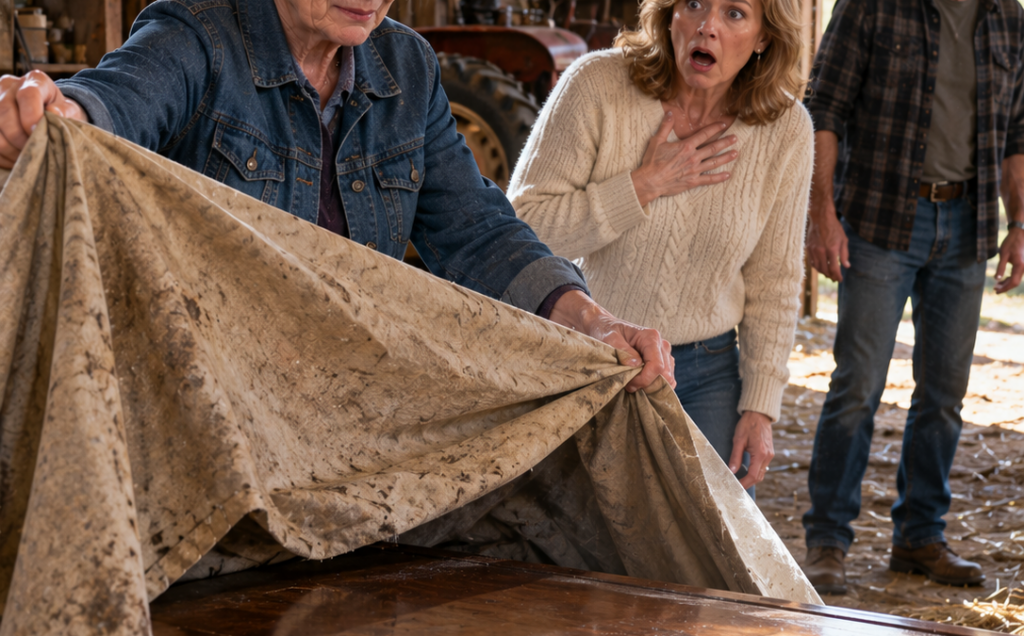
But she insisted on keeping Dad’s workbench exactly where it stood.
One afternoon, while cleaning beneath it, Kevin discovered a narrow drawer we hadn’t noticed before.
Inside were carpenter’s pencils, spare hinges, and a small notebook.
On the first page, Dad had written:
Things worth fixing.
We laughed when we saw it.
The pages contained sketches of fences, chair legs, window frames, and repairs he’d intended to make.
But near the back was a different kind of list.
Take Helen to see the North Shore again.
Teach Kevin how to make dovetail joints.
Ask Julie to tell me more about her work.
Plant another apple tree.
The final entry was written in unsteady handwriting.
Tell Helen she’s done enough. Let her rest.
I stared at those words.
Mom had spent nearly every day of her adult life caring for someone.
Her husband.
Her children.
Her parents.
Then her husband again.
She had rarely allowed herself the luxury of needing anything.
I brought the notebook into the kitchen.
“Mom,” I said, “would you like to take that trip to the North Shore?”
She looked up from her knitting.
“Your father always wanted to go back.”
“I know.”
She was quiet for a moment.
Then she smiled.
“Yes,” she said. “I think I would.”
So that June, on what would have been their fifty-ninth wedding anniversary, Kevin and I took Mom to Lake Superior.
We stayed in a small inn overlooking the water.
We walked along the shore.
We ate too much pie at a roadside café.
And one evening, as the sun disappeared behind the trees, Mom told us stories about Dad we’d never heard.
She told us about their first date, when he’d run out of gas because he was too embarrassed to admit he couldn’t afford a full tank.
She told us about the Christmas he’d secretly worked overtime to buy her a sewing machine.
And she told us about the night in 1988 when he’d finished building his casket.
“He came into the kitchen covered in sawdust,” she remembered. “Sat down beside me and said, ‘Well, Helen, that’s one thing you won’t have to worry about.’”
She laughed softly.
“I told him he’d better not be planning to use it anytime soon.”
“What did he say?” I asked.
Mom looked out across the lake.
“He said, ‘Don’t worry, honey. I’ve still got plenty of living to do.’”
She smiled.
“And he did.”
I used to think the greatest thing my father left us was the farmhouse.
Or the land.
Or the tools he spent a lifetime collecting.
Now I know better.
The greatest thing he left was an example of how love can be expressed without grand speeches or expensive gestures.
Sometimes love looks like an old man repairing a neighbor’s porch without sending a bill.
Sometimes it looks like a father sitting beside his frightened son, talking about a broken truck because neither knows how to say goodbye.
Sometimes it looks like a husband spending cold winter evenings in a barn, building something he hopes his wife won’t need for another forty years.
And sometimes it looks like a seventy-nine-year-old widow standing up in a funeral home and refusing to let anybody else decide how she will honor the man she loved.
Dad’s handmade casket served its purpose.
But the lesson he left behind continues to work on us.
Kevin still comes over on Saturdays.
Mom still insists on making coffee even when we tell her to sit down.
And every spring, we plant something new near the barn.
This year, it was an apple tree.
Kevin dug the hole.
I carried the water.
Mom chose the spot.
When we finished, she stood back and studied the little tree.
“Your father would’ve put it six feet farther east,” she said.
Kevin grinned.
“Probably.”
Then Mom picked up the shovel.
“Well,” she said, “he can complain about it when I see him.”
We laughed.
All three of us.
And for a moment, standing there in the warm Minnesota sunshine, I could almost hear Dad laughing with us.
I still remember that ninety-five-dollar form sitting on Gary Nygaard’s desk.
I remember how angry it made me.
How insulted I felt on my father’s behalf.
But I understand something now that I didn’t understand then.
A person’s worth cannot be measured by the price of the box that holds them.
Kevin wasn’t wrong to worry about money.
I wasn’t wrong to want a beautiful farewell.
But we were both wrong to forget that our mother had a voice, and that our father had spent his life teaching us the difference between price and value.
Thirty-eight years before his death, Dad built a simple pine casket with his own hands.
He wasn’t preparing to leave us.
He was making one final effort to take care of us.
And in a strange, beautiful way, even after he was gone, he was still doing exactly that.
