He had seen me.
The real me.
Not the useless daughter.
Not the disappointing sister.
Not the woman who missed holidays.
A soldier.
An officer.
A person whose work had mattered.
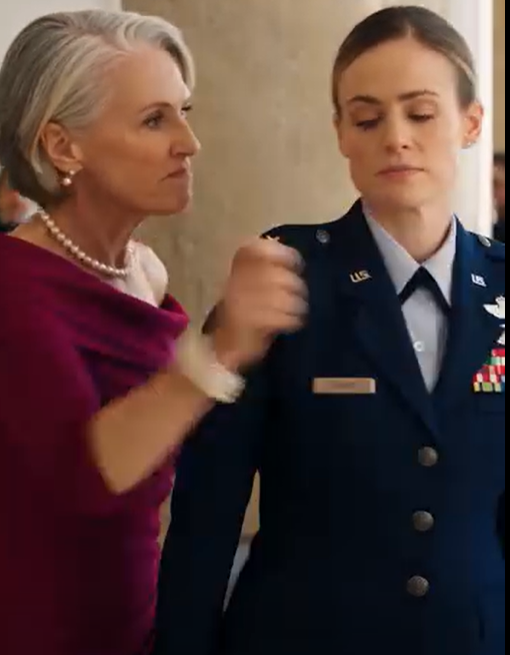
My mother stood nearby, holding the silent microphone.
She looked toward me again.
“Claire, perhaps we can talk afterward.”
I considered her request.
Part of me wanted to agree immediately.
Another part remembered decades of conversations that ended with me apologizing for being hurt.
I couldn’t know whether this evening had changed her.
Public embarrassment sometimes produced temporary kindness.
I had seen that before.
So I chose my words carefully.
“We can talk when you’re ready to listen.”
Mother’s expression shifted.
She seemed surprised by the condition.
But she didn’t argue.
“All right,” she said quietly.
I nodded.
Then I reached for my uniform jacket, which I had draped neatly over the back of my chair.
Natalie touched my arm.
“Are you leaving?”
“Soon.”
“Will you be okay?”
I looked at her.
For years, that question would have made me cry.
Tonight, it felt different.
“Yes,” I said.
And I realized I meant it.
The program resumed a few minutes later.
My mother returned to the stage.
Her voice sounded less certain.
She thanked the donors once more.
She spoke briefly about service and sacrifice.
She didn’t mention me again.
For the first time, I was grateful for that.
I didn’t need my name added to her foundation’s speeches.
I didn’t need her to rewrite the evening around my career.
I only needed her to understand that her cruelty had never made me worthless.
Whether she could accept that truth remained uncertain.
But I no longer needed her permission to believe it.
When the final applause began, I walked toward the windows overlooking the Potomac.
The water reflected the city’s lights.
A distant aircraft moved slowly across the dark sky.
I watched it for several seconds.
Behind me, the ballroom buzzed with subdued conversation.
I could hear glasses touching tables.
I could hear chairs moving.
I could hear guests preparing to leave.
Somewhere nearby, my mother was speaking quietly with Natalie.
I didn’t turn around.
Instead, I thought about Adrian.
I remembered the creek behind our childhood home.
I remembered the birthday cake.
I remembered him laughing when I told him I wanted to fly.
And I remembered his voice telling me not to let anyone define the kind of officer I should become.
I wished he had been there.
I wished he could have seen the six lives connected to a name he never knew.
I wished he could have stood beside me without becoming another reason for our mother to hurt me.
My eyes filled.
This time, I allowed the tears.
There was nobody I needed to impress.
Nobody I needed to defeat.
Only a brother I missed.
And a life I was finally willing to value without comparison.
Behind me, footsteps approached.
I expected my mother.
Instead, Natalie stopped a few feet away.
She didn’t speak immediately.
Neither did I.
We stood together, looking across the river.
Then she whispered, “He would have been proud of you.”
I looked at her.
She wasn’t smiling.
She wasn’t trying to please anyone.
For once, she seemed to mean exactly what she said.
I felt my throat tighten.
“I hope so.”
Natalie shook her head gently.
“He would.”
I turned back toward the water.
The aircraft disappeared behind the clouds.
For years, my mother had made me feel that surviving was something I needed to apologize for.
That night, twenty-four officers had stood in silence.
One colonel had raised his hand in respect.
And six men were alive somewhere in the world.
I pressed my fingers against the edge of the window and took a slow breath.
Adrian was still gone.
My family was still fractured.
My mother had not become a different person overnight.
But the shame I had carried for so long no longer belonged to me.
I had never been the daughter who should have died.
I was the woman who had helped bring six soldiers home.
Comments (0)
