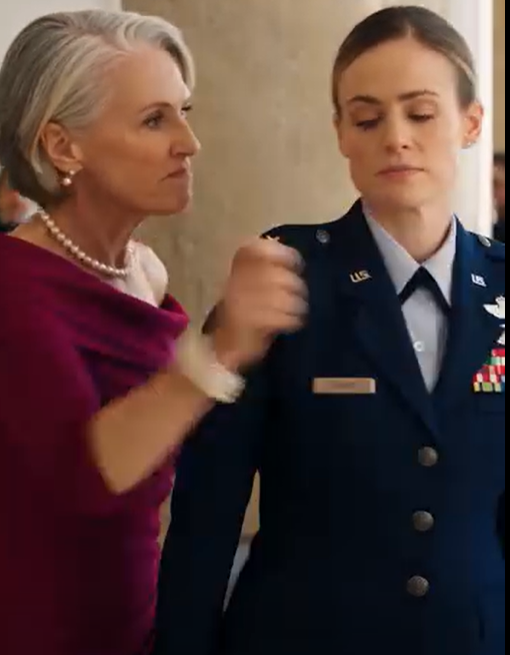
“I’m not trying to start an argument,” I said.
“Then stop challenging me.”
She returned to her chair beside Natalie.
The evening continued.
Dinner arrived on white porcelain plates.
Servers poured wine.
The quartet shifted into softer music.
Around us, conversations turned toward retirement plans, military assignments, and Washington politics.
I answered questions politely whenever someone addressed me.
But my mother kept finding reasons to interrupt.
When an officer asked about my aviation work, she laughed.
“Claire never talks about anything interesting.”
When I declined wine, she rolled her eyes.
“Always following some ridiculous rule.”
When Natalie described a successful fundraising campaign, Mother praised her intelligence.
Then she glanced toward me.
“See, Claire? That’s what meaningful work looks like.”
I had survived more difficult environments than a ballroom.
I had worked through exhausting deployments.
I had made decisions while people shouted over radios.
I had learned to function when fatigue narrowed the world into immediate responsibilities.
Yet my mother’s voice still reached places those experiences never touched.
It was strange.
A complete stranger could question my competence without shaking me.
One remark from Vivian Sterling could return me to adolescence.
I hated that about myself.
More accurately, I hated how easily she used it.
Natalie leaned toward me during a break in conversation.
“Please don’t make tonight difficult.”
I stared at her.
“I’m sitting quietly.”
“You know what Mom means.”
“Then tell me.”
She glanced toward our mother.
“She’s under enormous pressure.”
“So am I.”
Natalie looked uncomfortable.
“This foundation means everything to her.”
“I know.”
“Then why can’t you just let things go?”
I lowered my voice.
“Which things, Natalie?”
She hesitated.
“The comments.”
“You heard them?”
“Of course.”
“And you think I should ignore them?”
She looked down at her champagne.
“That’s usually easier.”
“For whom?”
Natalie didn’t answer.
The conversation might have ended there.
Instead, she surprised me.
“You know she doesn’t talk about Adrian when you’re not around?”
I turned toward her.
“What?”
Natalie kept her eyes on the tablecloth.
“Not like she does here.”
I waited.
“She barely mentions him at home anymore.”
That unexpected admission struck harder than I expected.
For years, I had assumed Adrian’s name filled every quiet room in my mother’s house.
I imagined photographs being polished.
I imagined stories repeated over morning coffee.
I imagined grief following her through the empty hallways.
Natalie’s words suggested something different.
“Then why does she talk about him this way?” I asked.
Natalie swallowed.
“Because everyone listens.”
We sat silently.
Across the room, my mother accepted another donation pledge.
She smiled for a photograph.
Then she moved toward a group of guests who seemed eager for her attention.
Natalie watched her.
“Please forget I said anything.”
“Why?”
“Because I don’t want another fight.”
I studied my sister.
For the first time that evening, her perfect composure seemed fragile.
She wasn’t defending Mother.
She wasn’t defending me either.
She was trying to survive between us.
That realization didn’t excuse her silence.
But it made the silence more complicated.
A silver bell sounded near the stage.
Dinner plates were cleared.
An event assistant announced that the memorial portion would begin.
Natalie immediately straightened.
“That’s our cue.”
She rose to join our mother.
I remained seated near the column.
The ballroom lights dimmed slightly.
Photographs appeared on a large screen behind the podium.
Adrian’s face filled the room.
He was smiling in his military uniform.
The photograph had been taken several years before his death.
I remembered the day.
He had complained about how stiff the collar felt.
Mother insisted that he stand straighter.
He made a ridiculous face after the photographer lowered the camera.
I had laughed so loudly that someone told me to leave the room.
That memory came back without warning.
For a few seconds, I could almost hear his voice.
Then the screen changed.
Another photograph appeared.
Adrian stood beside our parents outside our childhood home.
Natalie was smiling at the edge of the frame.
I wasn’t there.
I had been deployed when the picture was taken.
My mother had used it repeatedly ever since.
Sometimes I wondered whether she preferred that photograph because I was missing.
The audience watched respectfully.
Some guests lowered their heads.
Others folded their hands.
My mother approached the microphone.
For once, her confidence seemed to weaken.
She touched the small photograph beside the podium.
“My son believed service was larger than any individual.”
Her voice trembled.
I believed that tremor.
Whatever else she had become, she had loved Adrian.
Her grief was real.
That made everything harder.
Cruelty would have been easier to understand if it came from someone incapable of love.
But my mother possessed love.
She simply distributed it according to rules I had never understood.
She continued describing Adrian.
His generosity.
His discipline.
