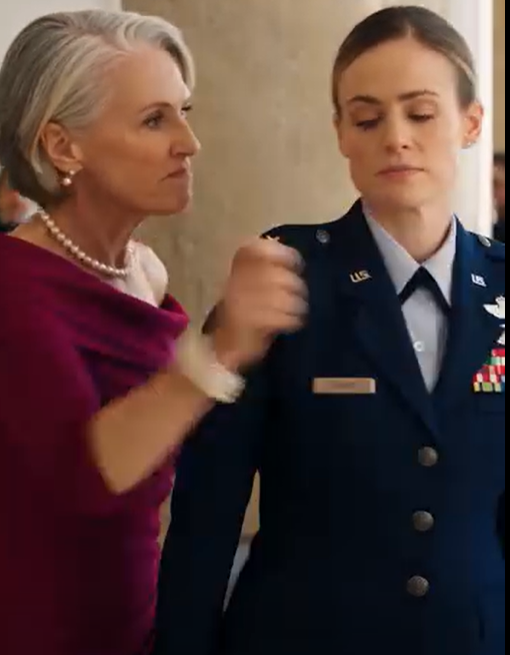
The nearest officer pushed back his chair.
Another followed.
Then Reed raised his voice.
“On your feet. Now.”
The command broke through the room.
Twenty-three officers rose around him.
Chairs scraped against the floor.
Napkins fell.
One guest knocked against a water glass while standing.
The sound echoed beneath the chandeliers.
My mother stepped backward.
“Marcus, what is happening?”
He ignored her.
The photographers had stopped moving.
The event assistant lowered his clipboard.
Even the servers stood motionless.
The room that had laughed at me moments earlier now seemed afraid to breathe.
Reed faced me.
His shoulders squared.
His heels came together.
He looked older than he had before.
Not weaker.
Simply burdened by something powerful.
Then he raised his right hand.
His fingers reached the edge of his brow.
And Colonel Marcus Reed saluted me.
For several seconds, I couldn’t move.
I knew that salute.
I had received many professional courtesies during my career.
But this was different.
It wasn’t a routine greeting.
It wasn’t a ceremony.
It wasn’t a gesture performed for photographs.
Reed looked at me with unmistakable respect.
His hand remained steady.
His eyes did not.
“Falcon-07,” he said.
His voice trembled.
“Six men are alive today because of you.”
Nobody spoke.
The sentence seemed to suspend the entire ballroom.
I saw my mother turn toward the officers.
Then back toward me.
Her lips parted.
For once, Vivian Sterling had nothing prepared to say.
Reed slowly lowered his salute.
He kept his attention on me.
“I never expected to meet you here.”
I stood.
My chair moved softly against the floor.
For a moment, the marble column beside me seemed strangely insignificant.
I had spent the evening partly hidden behind it.
Now every person in the ballroom was watching the space where I stood.
“Colonel,” I said quietly.
He nodded once.
“Major Sterling.”
His voice steadied.
“I know what that call sign means.”
I glanced toward the cameras.
“Some things aren’t appropriate for public discussion, sir.”
“I understand.”
He looked at the surrounding officers.
“Then we’ll leave those details where they belong.”
No one questioned him.
He turned back toward me.
“But this much can be said.”
His expression tightened with emotion.
“Six service members came home because Falcon-07 did her job when it mattered.”
The words reached me with unexpected force.
I had never needed strangers to know.
I hadn’t come to Washington seeking applause.
I hadn’t worn my uniform to prove anything to my family.
For years, I had carried memories that rarely entered ordinary conversation.
Some were difficult.
Some were painful.
Some remained private for reasons larger than myself.
And some belonged to people whose names I never spoke outside the proper channels.
That was part of the work.
You did what the situation demanded.
Then you returned to the next assignment.
You didn’t always receive explanations.
You didn’t always receive thanks.
Sometimes the only reward was knowing that someone else had another morning.
I had accepted that long ago.
But hearing Reed speak about six living men made the years feel suddenly close.
Six families.
Six futures.
Six lives continuing somewhere beyond this ballroom.
I lowered my gaze briefly.
“I’m glad they made it home,” I said.
Reed swallowed.
“So are a lot of people, Major.”
My mother finally found her voice.
“I’m sorry,” she said. “What exactly is going on?”
Reed looked at her.
He didn’t appear angry.
That almost made his response more powerful.
“Your daughter served with extraordinary distinction.”
Mother blinked.
“Well, naturally, we’re proud of Claire’s service.”
The words were automatic.
I nearly laughed.
Not because anything was funny.
Because I had waited forty-one years to hear her say something like that.
And now she said it only after another person forced her to reconsider me.
Reed looked toward my chair near the column.
Then he looked at the officers standing around the table.
His silence seemed deliberate.
My mother followed his gaze.
For the first time, she appeared to notice where I had been sitting.
She looked at the cramped space.
The partially hidden name card.
The water pitcher blocking the view.
Her face changed.
I couldn’t tell whether she felt shame.
Or embarrassment.
Or simple fear that the donors had witnessed something damaging.
Those possibilities had always been difficult to separate.
Natalie stood beside her.
She was staring at me.
The champagne glass remained untouched in her hand.
I had never seen my sister look so uncertain.
“Claire,” she whispered.
I turned.
“What?”
She looked toward Reed.
Then back at me.
“Why didn’t you tell us?”
The question could have wounded me.
Instead, I felt strangely calm.
“You never asked.”
Natalie’s mouth opened.
Nothing came out.
I wasn’t trying to punish her.
I was answering honestly.
For years, my family had treated my service as a collection of inconveniences.
