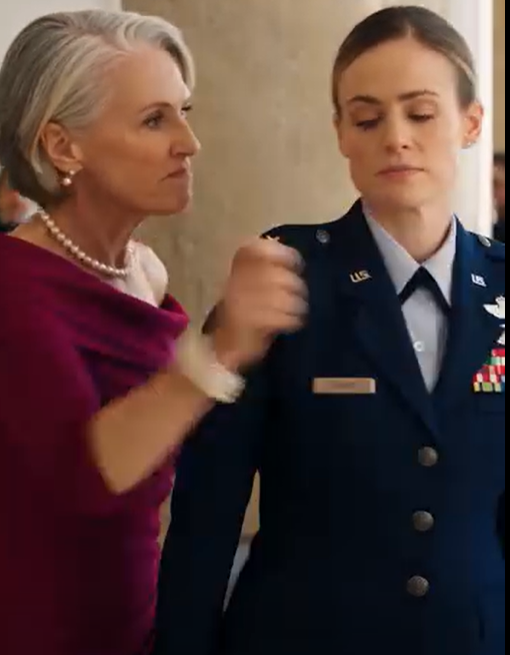
“It’s an important evening,” I answered.
The waiter nodded and moved away.
His question remained with me.
Your family must be proud.
People said that often when they saw a uniform.
They imagined proud parents.
They imagined framed photographs above fireplaces.
They imagined mothers waiting at airports with homemade signs.
I had learned not to correct them.
Across the table, Colonel Marcus Reed was speaking quietly with another officer.
He was tall, broad-shouldered, and silver-haired.
His formal uniform sat neatly across a frame that suggested decades of military discipline.
He wore several decorations, but he seemed uncomfortable whenever someone mentioned them.
I recognized his name from the program.
We had never been properly introduced.
At one point, his gaze moved toward me.
He paused.
Then he looked away.
I thought little of it.
Officers noticed other officers at formal gatherings.
It was almost instinctive.
Still, something about his brief expression unsettled me.
He hadn’t looked dismissive.
He had looked thoughtful.
Before I could consider it further, my mother tapped her glass.
“Ladies and gentlemen, we’ll begin shortly.”
The room gradually quieted.
A photographer moved toward the stage.
Two event assistants adjusted the microphones.
My mother stood beneath the enormous silver foundation emblem.
She looked perfectly comfortable.
Public attention had always suited Vivian Sterling.
She knew how to hold a room.
Her posture remained elegant.
Her voice carried warmth when she wanted it to.
People who met her only at events often described her as gracious.
They never saw her afterward.
They never heard the comments made behind closed doors.
They never watched her measure her daughters against each other.
From the stage, she gestured toward Natalie.
“My beautiful daughter has been invaluable throughout these preparations.”
Applause followed.
Natalie stood, smiling modestly.
Mother continued.
“She’s organized volunteers, coordinated donations, and helped maintain our family’s commitment to service.”
More applause.
Natalie touched her chest and nodded.
I joined the applause.
She really had worked hard.
My mother’s praise didn’t make that untrue.
But the next sentence arrived exactly as I expected.
“And my other daughter, Claire, managed to join us despite her unpredictable schedule.”
A few people chuckled.
Mother smiled toward my corner.
“She’s always off somewhere.”
I felt several guests turn.
One officer glanced at my shoulder boards.
Another studied my ribbons.
Mother continued before anyone could respond.
“Some children are born organizers. Others prefer excitement.”
The audience laughed politely.
I lowered my hands.
Natalie sat down.
The contrast had been delivered.
My mother moved smoothly into her prepared remarks.
She spoke about national duty.
She thanked donors.
She praised military families who endured separation and loss.
Every word sounded sincere.
Perhaps some of them were.
That was what made her difficult to understand.
She could display genuine compassion for strangers.
She could comfort grieving parents with extraordinary tenderness.
But when her own daughter entered the room, compassion became a limited resource.
Apparently, there wasn’t enough left for me.
After the opening remarks, my mother returned to the table.
Guests approached to congratulate her.
A retired officer’s wife stopped beside my chair.
“Major Sterling, I don’t believe we’ve met.”
I stood.
“Claire Sterling, ma’am.”
“Eleanor Whitcomb.”
She extended a hand.
“My husband served in aviation years ago.”
We exchanged a few words about military life.
She noticed my insignia.
“Army aviation?”
“Yes, ma’am.”
“That must involve tremendous responsibility.”
“It does.”
She smiled.
“Your mother must be proud of both her daughters.”
I opened my mouth.
Before I could answer, Mother appeared.
“Eleanor, there you are.”
Eleanor turned brightly.
“I was just getting acquainted with Claire.”
“How lovely.”
“Your daughter has quite an impressive career.”
My mother gave a delicate laugh.
“Claire has always been very good at keeping herself busy.”
Eleanor looked surprised.
“I meant her service.”
“Yes, of course.”
Mother touched my shoulder.
“She’s never been particularly interested in ordinary family life.”
I remained still.
“Mother.”
“What?”
“That’s not what Mrs. Whitcomb asked.”
The conversation stopped.
Eleanor looked between us.
My mother removed her hand.
“I’m simply explaining your choices.”
“They don’t require an explanation.”
Her smile hardened.
For a moment, the friendly social mask slipped.
Then she turned back toward Eleanor.
“Military people can be terribly sensitive about their schedules.”
Eleanor didn’t laugh.
Instead, she looked at me.
“I imagine your work demands a great deal.”
“It does, ma’am.”
She squeezed my hand.
“Well, thank you for doing it.”
My mother watched her walk away.
Then she leaned close enough that nobody else could hear.
“That was unnecessary.”
“I answered a question.”
“You corrected me in front of a guest.”
“I told the truth.”
“You always think the truth excuses bad manners.”
I studied her face.
She seemed genuinely offended.
Not because I had insulted anyone.
Because I had refused to accept her description of me.
