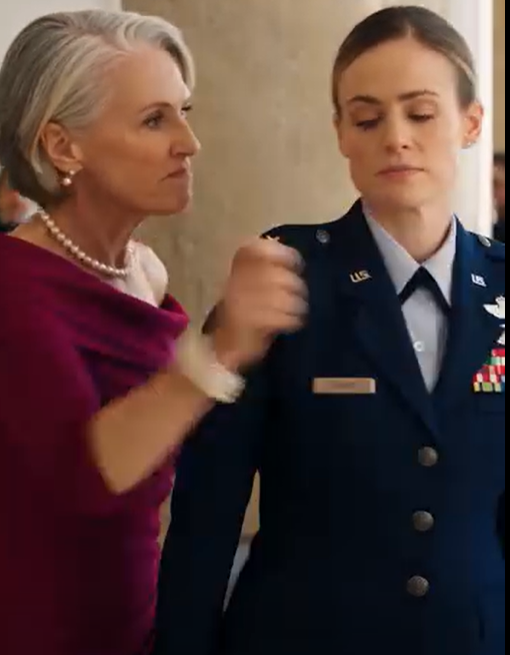
Missed dinners.
Unanswered calls.
Canceled holidays.
They had never asked what the responsibilities meant.
They never asked what kept me awake after returning home.
They had never wondered whether my work mattered to anyone beyond our family.
And I had stopped trying to explain.
The silence between us felt longer than it was.
Natalie looked down at her glass.
Her fingers trembled slightly.
“I didn’t know,” she said.
“I know.”
My mother stepped toward me.
“Claire, sweetheart.”
The word sounded unfamiliar.
She had used it earlier as a joke.
Now she seemed to be searching for something that might repair the moment.
I looked at her.
She stopped.
Around us, the officers remained standing.
None of them laughed.
None looked amused.
The weight of their attention had shifted.
My mother could feel it.
“Perhaps,” she began, “we should continue the program.”
I glanced toward Adrian’s photograph.
His familiar face still filled the screen.
For a moment, the ballroom seemed divided between two memories.
One belonged to a brother who had died.
The other belonged to six soldiers who had survived.
My mother had spent years treating those truths as competitors.
But they weren’t.
Adrian’s sacrifice mattered.
So did the lives Reed had mentioned.
One did not diminish the other.
And neither gave my mother permission to decide which child deserved to live.
“Mother,” I said.
She looked at me immediately.
“I came tonight for Adrian.”
Her expression tightened.
“I know.”
“I didn’t come to embarrass you.”
She lowered her eyes.
“I understand.”
I wasn’t sure she did.
So I continued.
“I loved him too.”
For the first time that evening, her face lost its careful polish.
She looked suddenly older.
Tired.
Almost frightened.
I thought about the years since Adrian’s death.
The angry telephone calls.
The empty holiday chairs.
The birthday messages that began with criticism.
The way she had repeated the same cruel comparison until it seemed ordinary.
I couldn’t undo those years.
Neither could she.
But I could refuse to carry her judgment any longer.
“I wish Adrian were here,” I said.
My throat tightened.
“I always will.”
Mother pressed her lips together.
I waited before speaking again.
“But wishing he had survived doesn’t mean I should have died.”
The words settled between us.
Simple words.
Words I had needed to say for years.
Mother glanced toward Natalie.
My sister looked away.
Then Mother looked toward the standing officers.
There was no audience willing to laugh this time.
No comfortable joke waiting to rescue her.
She lowered the microphone.
“Claire,” she whispered.
I watched her carefully.
For a moment, I thought an apology might follow.
Perhaps she wanted to offer one.
Perhaps she didn’t know how.
Her lips moved.
Then stopped.
I understood that silence too.
Reed remained beside us.
He didn’t interrupt.
He had already said what mattered.
The other officers slowly resumed their seats after he gave a small nod.
The room began breathing again.
A few guests whispered.
Someone quietly moved the broken crystal away.
The stage assistant adjusted the microphone stand.
Ordinary sounds returned, but nothing felt ordinary.
My mother looked toward the podium.
The evening’s schedule was waiting.
Her donors were waiting.
Her carefully arranged public image had been damaged in ways she couldn’t immediately repair.
For once, those concerns belonged to her.
Not me.
Natalie moved closer.
“Claire?”
I looked at her.
Her eyes were wet.
“I should have said something.”
I didn’t answer immediately.
I could have comforted her.
That was what I had done throughout our childhood.
Whenever Mother frightened Natalie, I stepped between them.
Whenever an argument ended badly, I offered reassurance.
Whenever Natalie remained silent, I made excuses for her.
Tonight, I was too tired to pretend that her silence hadn’t mattered.
“Yes,” I said gently. “You should have.”
She nodded.
A tear slipped down her cheek.
There was no dramatic embrace.
No sudden promise that everything would change.
Only my sister standing beside me, hearing a truth she had avoided for years.
It was a beginning.
Perhaps a small one.
But it belonged to us.
Colonel Reed stepped forward.
“Major Sterling.”
“Yes, sir?”
He extended his hand.
I took it.
His grip was firm.
“It’s an honor.”
I felt emotion rise unexpectedly.
“Thank you, Colonel.”
He held my gaze.
“I mean that.”
I nodded.
“I understand.”
He released my hand.
For a moment, neither of us spoke.
There were questions I could have asked.
Questions about the six men.
Questions about the years since that operation.
But the ballroom wasn’t the place.
And the answers weren’t necessary to understand what his recognition meant.
He had already given me something I never expected.
Not a medal.
Not a promotion.
Not another official commendation.
He had allowed my family to witness something they had refused to imagine.
