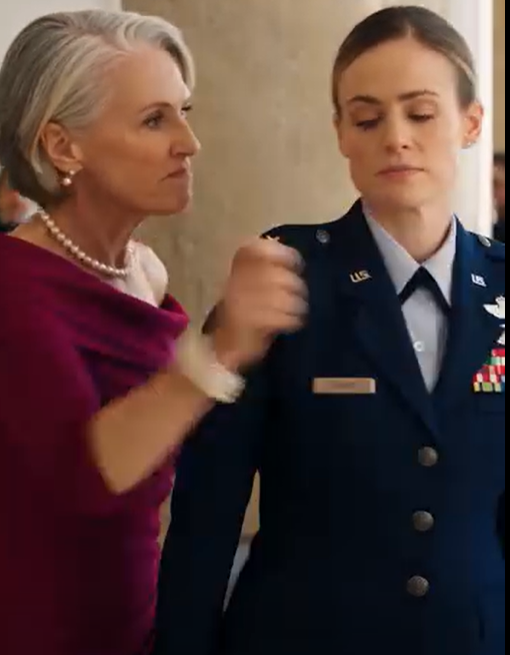
“Then why are we discussing it?”
The young woman glanced at me apologetically.
I gave her a small nod.
“It’s fine.”
Mother smiled without warmth.
“See? Claire understands.”
She took the seating card and pointed toward the far end of the main table.
A thick marble column stood beside the chair.
From that position, I could barely see the small stage.
More importantly, the stage cameras would have difficulty seeing me.
My mother had thought of everything.
“That’s your place,” she said.
Natalie’s place was immediately beside our mother’s chair.
Her name card stood between two silver candleholders.
Mine rested near a water pitcher, partly hidden behind folded napkins.
The difference was subtle enough to look accidental.
That was my mother’s favorite kind of cruelty.
A man in a dark tuxedo approached and extended his hand.
“Vivian, everything looks magnificent.”
Mother immediately became someone else.
“Richard, darling. You’ve been too generous.”
He kissed her cheek.
“Your foundation deserves every dollar.”
Then he noticed me.
“And who is this?”
Mother’s smile tightened.
“My daughter Claire.”
He looked at my uniform.
“Major Sterling. Thank you for your service.”
“Thank you, sir.”
Before he could continue, Mother touched his arm.
“Now, you must meet Natalie. She’s been the heart of this entire event.”
He followed her toward my sister.
I watched them go.
The coordinator remained beside me.
“Major, I’m sorry about the confusion.”
“You didn’t create it.”
She studied my expression.
“Would you like me to bring your chair forward slightly?”
I glanced toward the column.
It would have been easy to accept.
A few inches would have allowed me to see the stage.
But moving the chair would start another conversation.
And conversation was exactly what my mother wanted.
“No, thank you.”
The coordinator seemed disappointed.
“You’re sure?”
“I’m sure.”
She left with the seating chart.
I took my place.
The chair was close enough to the column that my shoulder nearly brushed the stone.
I shifted slightly and folded my hands in my lap.
Across the table, Natalie caught my eye.
For a moment, she looked uncomfortable.
Then my mother whispered something.
Natalie smiled.
Whatever sympathy might have existed vanished behind her champagne glass.
Twenty-four decorated military officers had been invited to the foundation’s principal table.
They represented different branches and generations of service.
Some wore Army dress blues.
Others wore Navy or Marine Corps uniforms.
Their decorations reflected years of assignments, deployments, and sacrifice.
Several were accompanied by spouses seated at neighboring tables.
The atmosphere around them remained friendly and conversational.
They shook hands, exchanged stories, and praised the foundation’s work.
My mother loved being surrounded by decorated uniforms.
She loved the prestige.
She loved photographers capturing her beside important men.
Most of all, she loved reminding people that her family had sacrificed for the nation.
The foundation carried my brother’s name.
Adrian Sterling.
Seeing those words across the ballroom still hurt.
They appeared on enormous banners beside the stage.
They appeared on donation envelopes.
They appeared beneath the foundation’s silver emblem.
Adrian had been dead for years.
My mother had built a public identity around preserving his memory.
I had never questioned the importance of remembering him.
I questioned what she had done with that memory.
Every speech became another opportunity to praise the perfect son.
Every gathering became another reminder that the wrong child had survived.
I had loved Adrian.
That truth remained untouched by everything my mother said.
He was my older brother.
When we were children, he always saved the corner piece of birthday cake for me.
He knew I liked the extra frosting.
He taught me to skip stones across the creek behind our suburban Virginia home.
When I received my first assignment, he called before anyone else.
“Don’t let anybody tell you what kind of officer you’re supposed to be,” he said.
I remembered laughing.
“You mean including Mom?”
“Especially Mom.”
That had been Adrian.
He understood our mother’s moods without allowing them to define everyone around him.
He wasn’t perfect.
He could be stubborn, competitive, and impossible during family arguments.
But he never made me feel that I had to earn permission to exist.
After his death, everything changed.
My mother stopped speaking about him as a complicated human being.
She turned him into a flawless symbol.
Natalie learned to repeat that version.
I continued remembering the man who stole fries from my plate and hated being photographed.
Those memories belonged to me.
I refused to surrender them.
A waiter approached with sparkling water.
“Can I get you anything else, Major?”
“No, thank you.”
He placed the glass beside my untouched bread plate.
His eyes moved toward the far side of the table.
“Beautiful turnout tonight.”
“Yes.”
“Your family must be proud.”
I looked toward my mother.
She was laughing beside Natalie while accepting another compliment.
