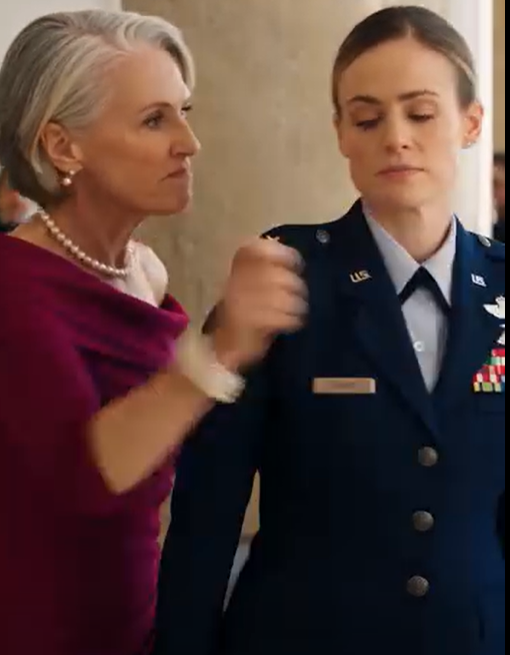
“I wish he were.”
She stared directly into my eyes.
“Then why wasn’t it you?”
The room became unnaturally quiet.
My mother raised the microphone again.
“If anyone in this family had to die, it should have been you instead of Adrian.”
The sentence crossed the ballroom clearly.
It reached the officers.
It reached the photographers.
It reached the young volunteers standing beside the stage.
For a moment, nobody seemed to understand what they had heard.
Then everyone understood.
A fork slipped against a plate.
Someone drew a sharp breath.
The quartet had stopped playing.
I remained seated.
My body felt strangely distant.
I could see my mother’s face.
I could see the small crease between her eyebrows.
I could see the pearls resting against her collarbone.
Every detail appeared painfully sharp.
I had imagined hearing those words privately.
I had feared them during the years after Adrian’s death.
But I had never expected her to say them in front of strangers.
Especially not in front of military officers who understood what death actually meant.
I looked toward the nearest colonel.
He lowered his eyes.
Another officer stared at the tablecloth.
Someone farther away adjusted his cuff.
Nobody spoke.
Their silence wasn’t approval.
I knew that.
But silence could still hurt.
Twenty-four decorated officers sat around my mother’s table.
They knew the language of courage.
Yet they seemed unable to confront the cruelty directly in front of them.
I wondered whether any of them realized what that silence was doing.
Natalie stood beside Mother.
Her face was pale.
For one brief moment, I thought she might say something.
She looked at me.
Our eyes met.
Then she lowered her gaze and smiled into her champagne glass.
It was a small, nervous smile.
The kind people use when they want a humiliating moment to end without involving them.
I had seen it before.
At birthday dinners.
At holidays.
During family gatherings where my mother’s jokes became increasingly vicious.
Natalie had learned that remaining agreeable kept the attention away from her.
I couldn’t even hate her for it.
But I couldn’t forget it either.
Mother waited.
She expected tears.
Or anger.
Or a public argument that would allow her to become the wounded parent.
She wanted me to prove that I lacked discipline.
She wanted the room to see an unreasonable daughter and a grieving mother.
I understood the trap.
My hands remained folded.
I took one slow breath.
Then another.
“Adrian mattered to me too,” I said.
My voice was quiet.
The microphone captured it anyway.
My mother blinked.
“Of course he did.”
“Then please don’t use his memory to hurt me.”
The words seemed to strike her harder than an accusation.
She stared.
A faint flush spread across her cheeks.
“Don’t you dare lecture me about my son.”
“He was my brother.”
“You weren’t there.”
I looked at her.
“I was serving.”
“And isn’t that convenient?”
The silence deepened.
My mother seemed to realize that the room wasn’t responding as she expected.
So she changed tactics.
She laughed.
It was a light, practiced sound.
The laugh she used to rescue uncomfortable conversations.
“Oh, Claire. Always so serious.”
Nobody joined her immediately.
She looked toward the officers.
“Forgive us. Family emotions can be terribly complicated.”
A few guests shifted.
Mother smiled more broadly.
“Perhaps we need something cheerful.”
I knew that expression.
She had found another direction.
Another way to make me smaller.
She looked down at my uniform.
“Tell me something, sweetheart.”
I said nothing.
She tilted her head.
“What did those helicopter boys used to call you?”
The question reached me slowly.
I felt the old familiar tension return.
Not because I feared the answer.
Because I understood what she intended to do with it.
“Mother,” I said.
“Oh, come on.”
She turned toward the officers.
“Every military person has some ridiculous nickname, don’t they?”
A few men exchanged amused looks.
My mother seized the response.
“Surely Claire had one.”
She leaned toward me.
“Go ahead, princess.”
I held her gaze.
“There’s no need.”
“Don’t be shy.”
She spoke more loudly.
“Tell these gentlemen your cute little call sign.”
One officer gave an uncertain chuckle.
Mother laughed with him.
“She probably had something adorable.”
Her eyes shone with satisfaction.
“Maybe Butterfly. Or Sunshine.”
More laughter followed.
Natalie looked down.
My mother continued.
“Something sweet for our little Army princess.”
I felt the room shifting around me.
People who had been uncomfortable a moment earlier now seemed relieved.
A joke was easier than confronting what had happened.
They could pretend the cruel remark was part of ordinary family teasing.
They could laugh and move forward.
My mother understood that instinct.
She had used it for years.
Whenever someone questioned her behavior, she called it humor.
Whenever I objected, she accused me of being sensitive.
