His sense of duty.
I listened carefully.
Some details were familiar.
Others sounded polished by years of public repetition.
She described him as a man who never complained.
I remembered his furious complaints about Army paperwork.
She said he never questioned authority.
I remembered an argument about a foolish order that kept him awake for days.
The audience heard an ideal.
I remembered my brother.
Both versions occupied the same room.
Only one had been allowed onto the stage.
My mother reached the final portion of her speech.
“Sacrifice has meaning only when we remember the people willing to make it.”
Applause followed.
She held up a hand.
“Tonight, we honor that willingness.”
The officers at our table sat straighter.
Their faces became solemn.
Military gatherings often changed when fallen service members were mentioned.
Casual conversation disappeared.
Old memories surfaced.
Everyone understood that an empty chair could represent an entire life.
I felt that familiar weight.
I also felt my mother’s eyes searching for me.
She found me beside the column.
Her expression shifted almost imperceptibly.
The grief remained.
Something colder joined it.
I recognized the change.
I had seen it after Adrian’s funeral.
I had seen it during family holidays.
Whenever his absence became unbearable, Mother looked for somewhere to place the pain.
Usually, she placed it on me.
She stepped away from the podium.
Instead of returning directly to her chair, she approached the officers’ table.
The microphone remained in her hand.
An assistant followed at a respectful distance.
Mother spoke warmly to the senior guests.
She thanked them for supporting military families.
She praised their leadership.
She mentioned how honored Adrian would have been by their presence.
Then she looked at me.
“And of course, service means different things to different people.”
The words seemed harmless.
Her tone wasn’t.
A few officers shifted in their seats.
I kept my gaze steady.
“Some understand commitment naturally,” she continued.
“Others spend their lives chasing assignments because they never learn where they belong.”
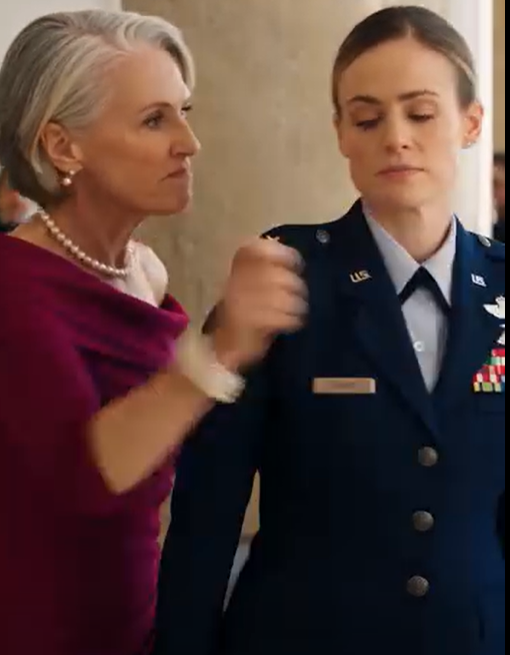
Natalie moved slightly beside her.
“Mom,” she whispered.
Mother ignored her.
I could feel attention gathering around my chair.
One officer stopped lifting his water glass.
Another looked toward the stage assistant.
The microphone had transformed a private family insult into public entertainment.
Mother smiled.
“Claire has always been a free spirit.”
I said nothing.
“She prefers uniforms and excitement to anything resembling a stable home.”
A nervous laugh sounded nearby.
I looked toward the windows.
The Potomac moved beyond the glass.
Traffic lights crossed the distant bridge.
Somewhere outside, ordinary families were finishing dinner.
Children were arguing over homework.
People were washing dishes.
The world remained normal while my mother turned my life into a joke.
“Mother,” I said quietly.
She leaned toward me.
“Yes?”
“Please finish your remarks.”
Several guests heard me.
Mother’s eyebrows lifted.
“Excuse me?”
“This evening is about Adrian.”
Her expression sharpened.
“Don’t tell me what my son’s evening is about.”
“He was my brother.”
For an instant, she looked genuinely startled.
Perhaps she had forgotten that simple relationship.
Perhaps she remembered and resented it.
Either way, the room felt smaller.
My mother lowered the microphone slightly.
“You always have to make yourself important.”
“I haven’t mentioned myself.”
“You’re doing it now.”
I looked around the table.
Twenty-four officers sat close enough to hear every word.
They had faced difficult decisions throughout their careers.
Some had commanded thousands of people.
Others had endured deployments that lasted longer than most political careers.
Yet nobody seemed willing to interrupt a grieving mother.
I understood their hesitation.
A charity gala was not a battlefield.
No regulation told them how to respond when a civilian insulted her adult daughter.
They were guests.
My mother controlled the event.
And the most uncomfortable thing about cruelty was how easily politeness could protect it.
The stage assistant approached.
“Mrs. Sterling, we’re ready for the next presentation.”
Mother didn’t look at him.
“One moment.”
He stopped.
She studied me with an expression I remembered from childhood.
It appeared whenever I failed to provide the apology she expected.
“Your brother knew what sacrifice meant,” she said.
“I know.”
“Do you?”
I felt my fingers tighten beneath the table.
“Yes.”
“Because I sometimes wonder.”
Natalie stepped forward.
“Mom, maybe we should—”
“Not now, Natalie.”
My sister fell silent.
Mother turned back toward me.
“You’ve spent your entire life doing whatever pleased you.”
I held her gaze.
“You know that’s not true.”
“Do I?”
Her voice rose slightly.
Several nearby conversations stopped.
I could hear the faint hum of the microphones.
Mother glanced toward Adrian’s photograph on the screen.
Her mouth trembled.
For one moment, I thought grief might finally soften her.
Instead, she spoke the cruelest words I had ever heard from her.
“My son should be alive, Claire.”
I swallowed.
