She never forgave me.
I never asked her to.
Over pot roast, she smiled at me with her mouth only.
“Still the expert, Harleen.”
“Still retired, Twila.”
Then she asked about my trip.
Twila never asked about anything of mine.
“Flying out of Columbus?”
“What time?”
“Six-fifty. Phoenix first, and then Neva picks me up.”
“Carry-on only?”
“At my age, you learn.”
“Smart,” she said.
Christa was sweet all evening, too.
Sweet.
She offered to drive me to the airport at four in the morning.
I thanked her and said I’d park in the long-term lot for $12 a day.
Garrick ate two helpings and fell asleep in the recliner before the pie.
At the door, Twila buttoned her coat and looked straight at me.
“Some of us sell honest things, Harleen.”
On Saturday, I packed.
I own one good suitcase, a navy carry-on with four wheels that Neva bought me in 2019 when she decided I was too old to wrestle a duffel bag.
It has an inner pocket with its own zipper, meant for a passport.
I’ve never used it.
My license and my boarding pass live in my purse with my gloves.
Christa leaned in my bedroom doorway around six.
“Which bag are you carrying on, Harleen?”
“The navy one. It’s my only one.”
“Just checking in case you need help with it.”
Garrick left for his night shift at 9:30.
He’s the maintenance supervisor at a distribution center out by the interstate, and he works Saturday nights because they pay $1.50 more an hour.
He kissed the top of my head on the way out, the way he did when he was nine and I was still the tall one.
At 9:40, I stood in the kitchen doorway.
Christa was wiping a counter that was already clean.
“I have an early flight,” I said. “I’m going to bed.”
“Sleep tight, Harleen.”
My house was built in 1924.
The bedroom doors have brass knobs and old keyholes, and nobody has seen the keys since Eisenhower.
I set my alarm for 3:30 and turned out the lamp.
I didn’t sleep much.
Old houses talk all night, and I know every word mine says.
The furnace ticked.
Around eleven, I heard Christa in the kitchen, talking very quietly on the phone.
I couldn’t make out the words, only the shape of them.
And the shape was worried.
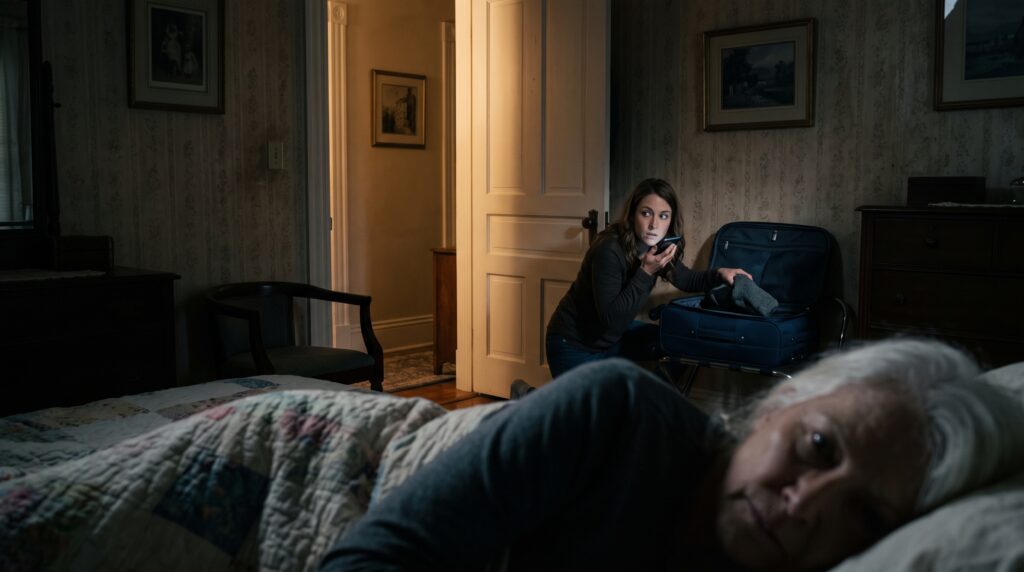
At 11:58, by the red numbers on my clock, the brass knob on my door turned.
Scene 5: The Setup Revealed
A stripe of hall light fell across the rug and stopped at the edge of my bed.
I lay on my side, facing the window, with my eyes not quite closed.
Through my lashes, I could see the luggage rack, my navy suitcase on it, and Christa’s shadow moving toward both.
She was in her socks.
She held her phone face down against her leg, and the screen glowed between her fingers.
She knelt by the rack.
I heard the main zipper first, slow, one tooth at a time.
Then a pause.
Then the smaller zipper, the inner pocket.
It made a small, dry sound, like someone tearing paper very carefully so nobody would hear.
Something went in.
It was heavy for its size. I heard it settle against the lining.
Zip.
Zip.
She stood and went back to the doorway, and she lifted the phone to her ear.
Her voice was barely a voice.
“It’s in her carry-on. Tip off airport security at six.”
A pause while someone answered.
“Not before six. She has to be through security first.”
Another pause, longer.
“Use the shop phone. Say it came from the museum.”
Then, softer:
“I know. Me too.”
The door closed.
The latch clicked.
Her socks whispered away down the hall, and the line of light under my door went out.
My clock said 12:09.
I didn’t move.
In 35 years, I’d been lied to by donors, by dealers, and once by a bishop who wanted his grandmother’s quilt back.
I knew how to lie still.
I counted my breaths in and out, and I didn’t stop until I reached 400.
Here’s what I knew.
At 12:09 that Sunday morning, my daughter-in-law had put something in my bag.
Someone was going to call the airport police about it at 6:00.
And whoever that someone was, they had a shop.
At 12:50, I sat up and turned on the little reading lamp.
Scene 6: Documenting the Evidence
Its neck was bent toward the rug so the glow wouldn’t show under the door.
Then I took my white cotton gloves out of my purse and put them on.
If my fingerprints ended up on whatever was in that pocket, I’d be doing her work for her.
I unzipped the inner pocket.
Inside was a gray work sock, a man’s sock.
On the cuff, in black laundry marker, were two letters: G E.
I wrote them.
I labeled the work socks in my house so they would come back to the right drawer.
Inside the sock was a small pistol.
It was a two-shot pocket pistol, about four and a half inches long, with a walnut grip and a brass frame gone brown with age.
It was made around 1866.
On the bottom of the grip, there should have been a number in white paint.
Somebody had sanded that spot down to bare wood.
Nobody sands off a number by accident.
I tilted the lamp.
Inside the trigger guard, on the inner curve where no finger ever rests, were three tiny characters in red ink.
44.2.
My own handwriting from 1988.
This was the small curved shape from drawer 14.
I didn’t pick it up, and I didn’t touch the mechanism.
I set a six-inch sewing ruler beside it for scale and took six photographs with my phone.
The first one was stamped 12:58 a.m.
Then I sat on the rug and thought it through.
Christa had taken it.
Christa needed it found at an airport, in my bag, with a phone call telling the police where it came from.
A 71-year-old woman caught leaving the state with a museum pistol.
