I didn’t argue in the post office, and I didn’t write a letter to the paper.
Twila was spending her words, and I was saving mine.
I’ve sat in a lot of rooms with people who talk first, and they usually run out of words before the end.
Silence costs something.
And that week, it cost me most of my town.
On Friday at 7:40 p.m., my tablet chimed.
It was Kaye.
She’s nine, and she types the way she talks, with no punctuation at all.
“Grandma did you steal the gun”
I typed slowly so I’d get every word right.
“No, sweetheart. I found it in my bag. I gave it to the police.”
The three little dots appeared, disappeared, and appeared again.
“Okay I miss you”
I sat with the tablet in my lap until the screen went dark.
The inventory happened on Monday the 21st, the day it had been scheduled all along.
Scene 13: Full Inventory Findings
Elwood brought in two board members and borrowed a registrar from the museum one county over so that nobody could ever say the count had been manipulated.
I wasn’t allowed in the building.
I spent the day at home cleaning an oven that was already clean.
At 5:40 p.m., Elwood called.
“Nineteen,” he said.
He said it like a doctor reading a result.
Nineteen objects were missing from the study collection, which meant nineteen empty silhouettes in the gray foam.
Three were in drawer 14, counting the pistol sitting in the evidence room.
Sixteen more were scattered through other drawers.
“Were any of them signed out?”
“Not one.”
Then he told me about the board members.
One of them, a retired banker who had always called me “our Harleen,” had looked down at all that empty foam and said:
“Well, she had keys for 39 years.”
The other one hadn’t disagreed with him.
The museum’s insurance company wanted the police report, and it wanted to interview me separately as a matter of routine.
I understood.
I’d have done the same thing in Elwood’s chair.
Then he surprised me.
“Harleen, I need you to look at this list. Not as a suspect. As a registrar.”
“Elwood, the board—”
“I know what the board thinks. Nobody alive knows this collection like you do.”
“Send it.”
He emailed it at 5:52.
There were nineteen lines, each with an accession number, an object name, a drawer, and the date the object was last handled.
I read it once as a woman whose town had turned its back on her.
Then I read it again as a registrar.
Here’s what a registrar sees in nineteen lines.
Every object on that list was small enough to slip into a coat pocket, and every one of them would sell.
There was a mourning brooch, a spectacle case, a silver pocket watch, and a powder horn.
There was a tintype in a leather case, a child’s pewter cup, and a cast-iron toy fire engine that had been missing one wheel since 1912.
Nothing was large, nothing was ugly, and nothing was made of paper.
And every single one came out of drawers 9 through 16.
In the spring of 2025, the museum rehoused drawers 9 through 16 into new foam, a five-month project.
I remembered it clearly because I’d been so proud of who did it.
On Tuesday morning, I called Elwood and asked him one question.
“Who was assigned to rehouse drawers 9 through 16 from March through July of 2025?”
He pulled the project file while I waited.
He was quiet for a long time.
“Christa,” he said. “Only Christa.”
She’d had those eight drawers to herself for five months.
She had cut every piece of the new foam.
She knew exactly which objects nobody would look for until the next full inventory.
Scene 14: Uncovering the Motive
There was something else I knew.
And I’d already told the detective the night before, right after Elwood’s call.
Twila Truax had kept booth 41 at the County Fall Antique Show for 20 years.
It’s the one by the kettle corn.
I checked the date that same night on the flyer stapled to the bulletin board at the hardware store.
The show was Saturday the 26th, five days away.
“Then we’ll need someone,” the detective had said. “Who knows what’s ours?”
On Wednesday at 4:30, Garrick’s truck pulled into my driveway.
He’d come for the rest of the kids’ things.
Christa came with him, and I suspect he wished she hadn’t as much as I did.
Garrick carried boxes and didn’t look at me.
He went up and down my stairs eleven times and said six words in all, and three of them were:
“Where’s the tape?”
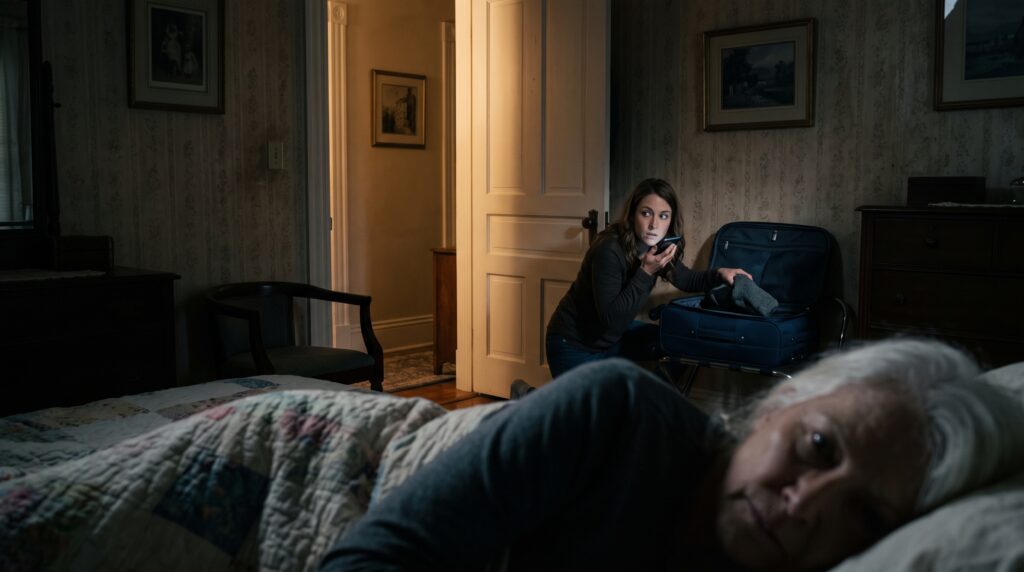
Christa found me in the garage, where I was pretending to sort Christmas lights in September.
“You’ll be charged by Friday,” she said. “Mom has a friend at the courthouse.”
“Then I’ll see you Friday.”
She stood there with her arms crossed.
Then, for one second, something gave way in her face.
Her chin went the way Kaye’s chin goes right before she cries.
“Do you know what $41,000 is?” she said. “To people like us?”
“The boutique,” she said.
Secondstory Vintage, which she and Twila opened on Main Street in April of 2023, in the old shoe store.
It closed in May of 2024, and the landlord sued them for the rest of the lease.
In September of 2024, a judge awarded him $41,500.
Christa never told Garrick a word of it.
That was the real reason they moved in with me.
It wasn’t to save for a house.
It was to keep him from seeing the letters.
“They were going to take it out of my paycheck,” she said. “Every two weeks, Garrick would have seen.”
For that one second, she wasn’t a villain to me.
She was a frightened woman who had turned one bad lease into a hole she couldn’t climb out of.
Then she wiped her eyes with the heel of her hand, and the second was over.
