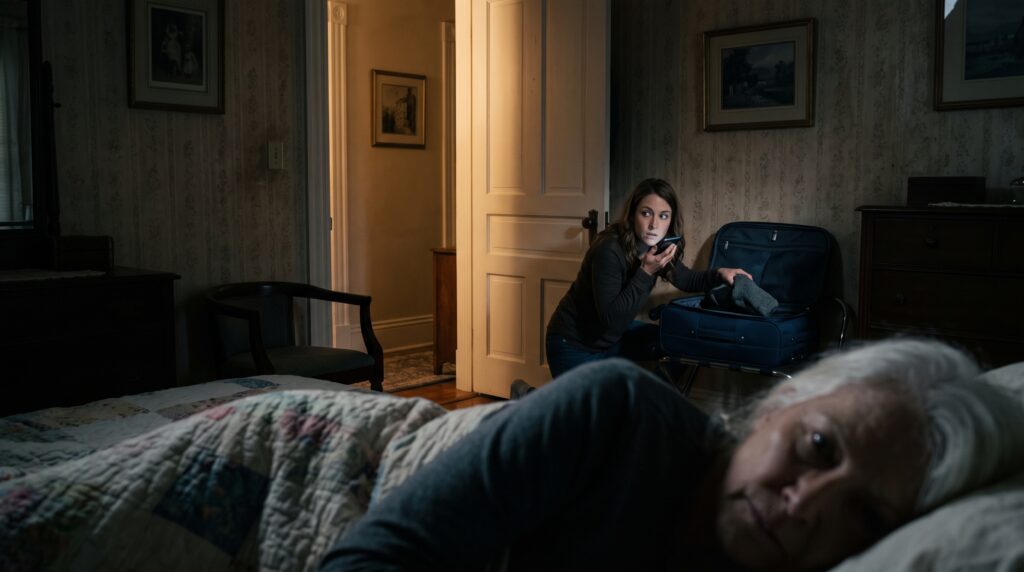
And on Monday the 21st, every empty silhouette in that building would have my name on it.
I thought about calling 911 right then.
But Kaye and Chase were asleep across the hall, and a shouting match at one in the morning would prove nothing.
Christa might even take it back before a deputy ever saw it.
So I did what I’d done for 35 years.
Leave the object where it is.
Record it.
Hand it in person to the people whose job it is.
I zipped the pocket closed, lay back down, and watched the ceiling until 3:30.
At 4:00, I rolled my suitcase down the hall.
There was a line of light under Christa’s door.
I didn’t look at it twice.
Scene 7: The Sheriff’s Intervention
I drove to the end of Fourth Street, where you turn east for Columbus.
I turned north.
Hasket, the county seat, is 22 minutes from my house.
The Tolbert County Sheriff’s Office keeps its front lobby open all night, with a pane of thick glass and a speaker you have to lean into.
At 4:41 a.m., I leaned into it.
The deputy at the desk was young, with a crew cut and a mug that said “World’s Okayest Uncle.”
His name tag said Garrison.
“There’s a firearm in my suitcase that isn’t mine,” I said. “It belongs to the county museum.”
He looked at me for a long moment.
Then he looked at the suitcase.
Then he came around through the side door with gloves on, which raised him considerably in my estimation.
He laid the suitcase on a bench under the lobby lights and unzipped the inner pocket.
In that bright, empty room, the sound was louder than it had been at midnight.
He opened the sock with two fingers and looked inside for a long time.
“It isn’t loaded,” he said. “You found this when, ma’am?”
“At 12:50. I didn’t touch it. I’d like that written down.”
I showed him my six photographs.
I told him about the door, the zipper, the whisper, and the shop phone.
He gave me a statement form, and I filled both sides in block capitals, the way I used to fill out loan agreements.
At the top, I wrote the pistol’s full accession number: 1979.44.2.
He gave me a case number.
“One more thing,” I said. “Someone is going to call the airport at six.”
He frowned.
“How would you know that?”
“Because I heard her say it.”
The lobby had a vending machine that sold coffee for a dollar and a quarter.
I bought one and didn’t drink it.
I sat on a plastic chair under a bulletin board full of lost dogs and waited.
At 6:31, Deputy Garrison came back through the side door.
His face had changed.
“The airport police just called us,” he said. “Seven minutes ago.”
At 6:04, someone had phoned the airport police in Columbus.
An older woman on the 6:50 flight to Phoenix, the caller said, had a stolen pistol from the county museum in her carry-on.
She was leaving the state with it.
The airport police checked their list.
No such passenger had checked in.
Because the caller named our county, they passed it along to the sheriff’s office at 6:24.
“It’s in her carry-on,” I said quietly.
“That’s almost exactly what the caller said.”
He glanced at the clock over the door.
“Your report is stamped 4:41.”
“Eighty-three minutes early,” I said. “I’m usually early.”
At 6:50, my plane left Columbus without me.
I called Neva and told her I wouldn’t make it, though not why.
She was quiet for a second, and then she said:
“Oh, Harley, are you safe?”
I said I was.
Scene 8: Investigating the Conspiracy
At 7:15, a woman came through the side door with reading glasses on a beaded cord.
Detective Sergeant Mercy Havamp was 46, with a farm-girl handshake and no small talk at all.
She read my statement twice and looked at every photograph.
Then she asked me to do one thing.
“Don’t talk to your family today. Not one word about this.”
At 9:02, my phone buzzed.
It was a text from Christa.
“Did you make your flight?”
After the question mark, she’d added a little yellow heart.
I didn’t answer her.
I drove eight miles out Route 9 to Velma Shup’s farmhouse, and she opened the door in her robe before I could knock.
Velma taught fourth grade for 34 years.
She has been my friend since 1986, the year Lanny left, when she brought over a casserole and stayed until Garrick fell asleep.
She doesn’t ask questions she can see the answers to.
She put the kettle on, and her old beagle laid his chin on my shoe.
I sat at her table and thought about February of 2024.
Christa had come to me in tears that winter.
Her boutique was struggling, she said, and she needed something steady.
“Nobody’s ever trusted me with anything real,” she told me.
I believed her.
I walked her résumé into Elwood’s office myself.
I taught her everything I could.
How to lift a teacup by its body and never by its handle.
How to cut a cavity into foam so an object sits in it like a hand in a glove.
She was good with a knife.
She had patient hands.
I trained the hands that emptied my drawers.
That was the part I couldn’t put down.
The pistol I could hand to a deputy.
The phone call I could hand to a detective.
But nobody takes the foam off your hands.
At 11:40, Detective Havamp called.
“Your museum director has something you need to hear. Can you be somewhere at one?”
“Velma’s kitchen,” I said. “She’ll make sandwiches.”
If someone in your house has ever gone through your things while you were sleeping, tell me in the comments what you did the next morning, and subscribe, because what Elwood told me at 1:00 is the reason I’m telling you this story at all.
Elwood Frell arrived at 12:58 in a bow tie because it was Sunday, and he’d come straight from church.
He is 58.
