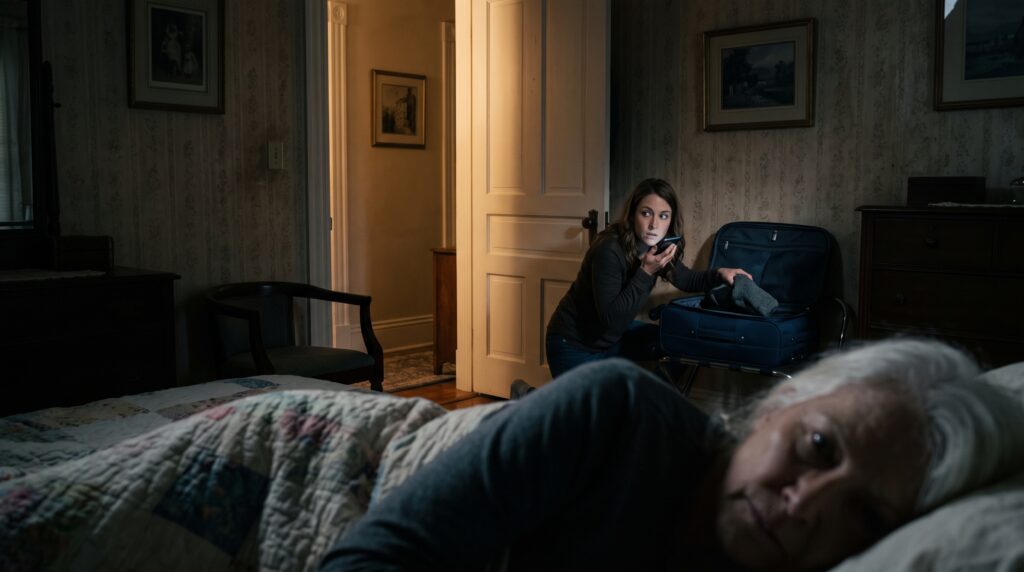
“You’ll never prove a thing,” she said. “You’re a volunteer. Nobody listens to volunteers.”
On Thursday morning, the marketplace answered the court order the detective had gotten on Monday.
Twila’s shop was closed, but her records weren’t gone.
They never are when someone asks properly and early.
Detective Havamp gave me a borrowed desk in Hasket, a pot of terrible coffee, and a stack of paper four inches thick.
Since April of 2025, Twila’s Back Porch had sold eleven objects from our museum.
Every payout went into Twila’s checking account.
$14,860 in all.
There were 312 listing photographs, and I went through every one of them.
For most of them, I didn’t even need the second number.
I know the dent in our brass sleigh bell the way you know a scar on your own child’s knee.
But wherever I could, I found the red ink anyway.
In one photo of a match safe, it showed at the hinge.
In another, of a carved bone needle case, it was a pink smudge in the shadow under the lid.
Twila’s camera had a better eye than she did.
By three that afternoon, I had matched all eleven.
Each one got its own sheet, with our catalog photograph on the left, her listing photograph on the right, and a circle around the second number.
Scene 15: Preparing for the Show
The detective came and stood behind my chair, counting the sheets with one finger.
“Eleven sold,” I said. “One in your evidence room. Seven left to find.”
She leaned on the desk.
“Somewhere with a booth by the kettle corn.”
The next morning, she told me she’d driven past Twila’s storage unit that evening, on a long row of orange doors out on the state route.
Twila was there with a hand truck and a stack of boxes marked “SHOW.”
Garrick called me at 10:15 that Thursday night.
I could hear the warehouse behind him, the beep of a forklift backing up and a radio playing country music.
“Mom, I’m on break. I’ve got ten minutes.”
“I’m listening.”
“Christa talked to her mom’s friend. If you confess, the museum won’t press charges.”
His voice cracked right down the middle.
“Just say you took it, Mom. Please. For the kids.”
I’d waited eleven days for my son to ask me one question.
He still hadn’t asked it, so I asked it for him.
“Garrick, what was the pistol wrapped in?”
“What? How would I know?”
“A gray work sock. Men’s size. G on the cuff in black marker.”
There was nothing on the line but the radio.
“I wrote those letters. Honey, I wash your socks. I don’t hide pistols in them.”
I heard him breathe in, and then I heard him not breathe out.
Somewhere behind him, a man was shouting about a pallet.
“Anybody could have taken a sock,” he said finally.
“Anybody could have,” I said. “Who had a reason to?”
He hung up.
He didn’t say goodbye, and he didn’t say anything else.
I sat in my dark kitchen and told myself what I used to tell young registrars when a crate arrived broken.
You don’t fix it by wishing.
You document what you see, and you let the pieces tell you what happened.
My son was one of the pieces now.
I had to let him find his own way to the edges.
The next evening, Detective Havamp called with news a judge had signed.
That Friday was September 25th.
At two in the afternoon, Twila loaded her van at the storage unit while a deputy in an unmarked car watched.
Then he followed her to the fairgrounds.
Dealers set up on Friday evenings from four to nine.
At 6:10 p.m., a judge in Hasket signed a search warrant for booth 41 and the white van.
That should have been the end of it.
It wasn’t.
And the reason was me.
Scene 16: The Antique Show Confrontation
A warrant lets officers look.
It doesn’t teach them what they’re looking at.
A deputy can’t tell a museum’s mourning brooch from a flea-market one.
Neither could Elwood, who’d been with us less than three years.
Neither could the insurance adjuster, a lovely man from Toledo who mostly handled hailstorms.
Even the location file couldn’t do it alone.
A file can show you where to look.
It can’t swear that the red ink is mine and 38 years old, and it can’t tell a museum brooch from its twin.
“When this gets to court, a judge will want the hand that wrote those numbers,” the detective said.
At seven, Elwood came up my porch steps with a letter on museum letterhead.
It asked me formally to serve as the museum’s identifying witness.
He’d brought a second piece of paper, too: the last page of my own report from 1989.
When the rehousing was finished, he read one line of it out loud.
“6,412 objects, each numbered twice.”
“I found it in the file today,” he said. “I had no idea.”
“Nobody did. That was the point.”
The detective had three conditions.
Identification only.
Gloves on.
And not one word to Twila or Christa.
“I haven’t spoken to them in two days,” I said. “I can manage one more.”
The woman they’d suspended was the only person who could prove what belonged to the county.
Everyone on my porch knew it, and nobody said it.
That’s how you know something is true in a small town.
That night, I laid my things out on the kitchen table the way I used to lay out a condition report.
There was a new pair of white cotton gloves, still creased from the package, and a brass-rimmed magnifying glass that had belonged to the registrar before me.
There was a pen flashlight.
