Before he came to us, he ran the registration department at a big museum in Cleveland, and he still says “object” instead of “thing,” even about sandwiches.
Detective Havamp nodded at him to begin.
“At 7:30 this morning, the sergeant called me at home,” he said. “She read me a number. 1979.44.2.”
“It’s ours,” I said.
“That’s what I told her. She said a firearm had been turned in to the sheriff’s office. She asked me to keep it to myself, and I did.”
He folded his hands on Velma’s tablecloth.
“At 8:34, Christa called my cell phone.”
Christa had never called Elwood on a weekend, not once in two and a half years.
He’d emailed the detective her exact words at 8:41, seven minutes after he hung up, because that’s the kind of man he is.
He read them to me from his phone.
“Elwood, I’m so sorry. Harleen got caught at the airport with the little pistol from drawer 14.”
Velma set down the mustard.
Nobody had been caught at any airport.
Nobody had been arrested anywhere.
The list of the three missing objects had gone to Elwood alone, and Elwood had told no one.
The sheriff’s office had told Elwood about a firearm and nothing more.
They hadn’t said anything about an airport, and they hadn’t said anything about an arrest.
Detective Havamp took off her reading glasses and let them drop on their cord.
“So who told her it was a pistol?”
Nobody at the table answered her.
“Guilty people love to get there first,” the detective said. “Tomorrow I’ll talk to her. Today, you say nothing.”
Scene 9: Confronting the Family
My phone kept buzzing all afternoon.
At 2:15, it was Christa.
“Haven’t heard from you. Everything okay?”
At 4:40, Christa again.
“Garrick’s worried. Please call us.”
At six, Garrick called himself.
He’d slept most of the day after his shift, and his voice was thick with it.
“Mom, where are you?”
“At Velma’s. I’m fine. I didn’t fly.”
“You didn’t fly? Why not?”
“I’ll explain tomorrow, honey. I promise.”
He let out a long breath.
“Christa’s been crying all day. She thought you got arrested.”
I watched Velma’s beagle chase something in his sleep.
“Why would she think that, honey?”
There was a silence on the line.
It went on long enough that I could hear the hum of his refrigerator, which was technically my refrigerator.
“She said she had a feeling.”
I didn’t tell him what I knew.
I’d given my word to a detective, and my word is the one thing in my life I’ve never had to replace.
I told him I loved him and that I’d see him soon.
Then I sat on Velma’s back porch until the bats came out over her soybeans.
I slept in Velma’s spare room that night.
Before I turned out the light, I set an alarm for eight.
Monday was Neva’s 75th birthday.
I had already missed the cake. I wasn’t going to miss the call.
I lay there and thought about Christa’s feeling.
Feelings don’t know which drawer a pistol came from.
At 10:00 the next morning, Detective Havamp walked into the museum and asked for my daughter-in-law.
I wasn’t there, of course.
I was on Velma’s porch singing “Happy Birthday” to my sister badly while she laughed and told me to stop.
At 1:00, the detective called and told me what she could.
I’d made the report, she said, so I had a right to know where things stood.
Christa hadn’t seemed surprised to see her.
And Christa had a story, and it was tidy.
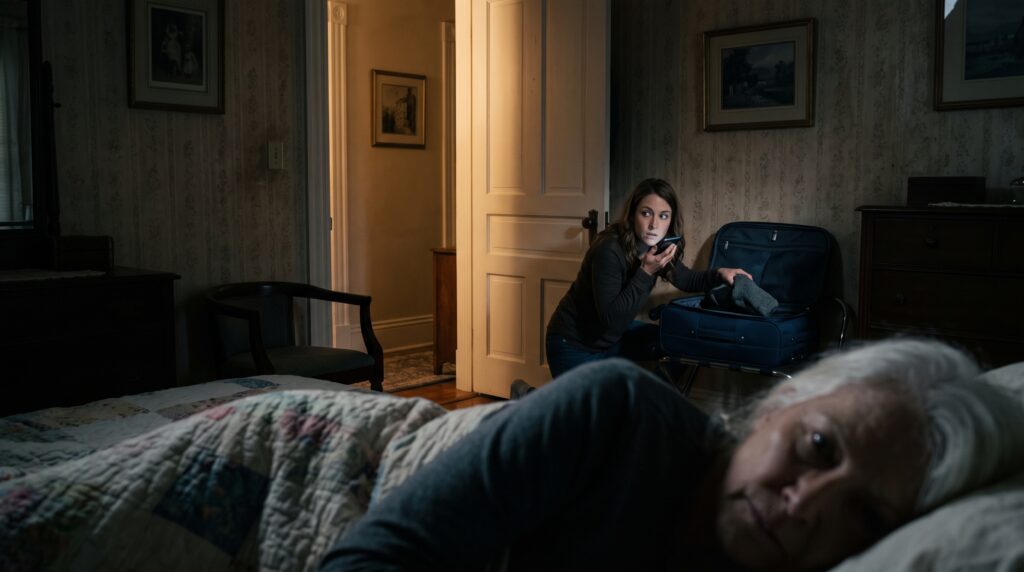
On Saturday at nine, she said she saw me slip something wrapped in a sock into my suitcase.
She thought nothing of it.
Then around midnight, she started to worry.
She checked my bag and found the pistol.
She panicked and called her mother, and her mother called the airport police to protect the museum.
And the words I’d heard in my doorway?
“It’s in her carry-on.”
Christa said she’d been warning her mother, not instructing her.
She called Elwood on Sunday morning, she said, because she wanted him to hear it from family.
“And the pistol?” I asked. “How did she know it was a pistol?”
“She says she saw it at midnight with her own eyes, and she called her mother instead of you. She says you’re family. She says she was scared.”
It was clever.
It was the kind of clever that holds up for about a week.
“Her story is tidy,” the detective said. “Tidy isn’t true, but it isn’t nothing either. Right now, it’s your word against hers, and she’s the one still working there.”
Scene 10: The Truth Exposed
So now I knew who had made the call at 6:04.
Christa had told the detective herself.
It was her mother, Twila Truax, on the phone in her garage shop.
“She went home at noon,” the detective added. “You’re home?”
“I believe I’ll go home at seven this evening.”
I’d promised Garrick an explanation, and I keep promises even when they’re going to cost me.
All three of them were at my kitchen table.
Garrick, Christa, and Twila, with her coat still on.
Christa stood when I came in.
Her eyes were red, and she let them be red.
“I covered for you for months,” she said. “I never told anyone.”
“Told them what?”
“Christa, you know what.”
Twila didn’t stand.
“Like the sword, Harleen. You always know what’s real, except when it’s you.”
I set my purse on the counter and didn’t sit.
I told my son the truth in four sentences.
The door at midnight.
The pocket.
The sheriff at 4:41.
The call at 6:04.
He looked at his wife.
She was crying again, very quietly, with her hand over her mouth.
He looked back at me, and I watched him decide.
He had two children upstairs and a wife crying at my table.
And he chose the version that kept his family under one roof.
