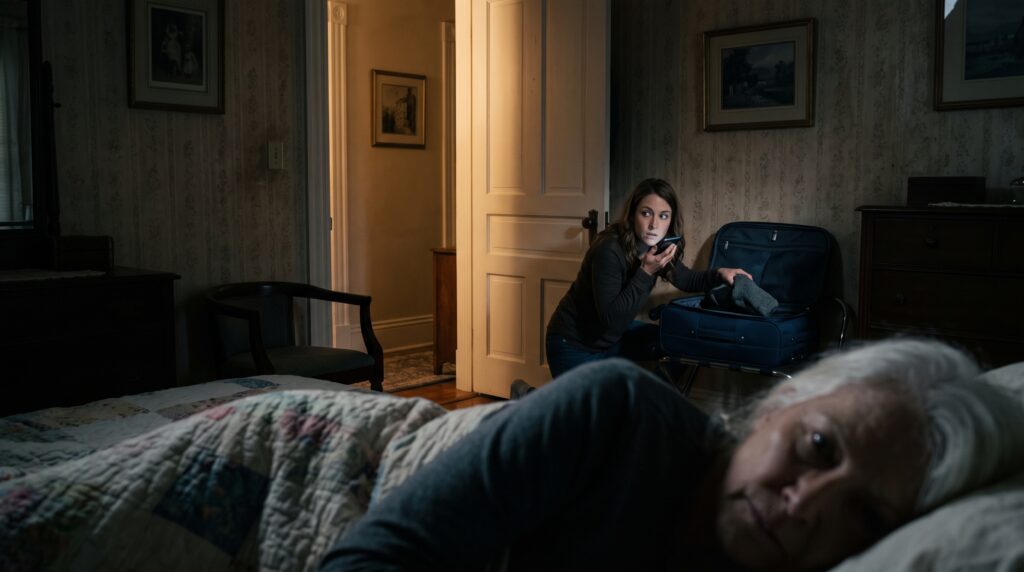
It took about three seconds.
They were the longest three seconds of my life.
And I once watched a crate of Civil War letters slide off a forklift.
“Mom,” he said, “they’ll go easy on you. You’re 71. You’ve never been in trouble.”
“Garrick—”
“Just say you took it, Mom.”
Upstairs, Chase was asking Kaye if they could watch one more show.
“I didn’t take it,” I said. “And I’m not going to say I did.”
“Then we can’t stay here.”
He said it to the table, not to me.
They packed for two hours.
I carried the kids’ backpacks out to the car myself.
Kaye held her stuffed rabbit by one ear.
Chase whispered to me very seriously to ask if Grandma was going to jail.
“No, bud. Grandma’s going to bed.”
At the car, I put my hand on Garrick’s arm.
“I’ll love you through anything,” I said. “I won’t lie for you.”
He didn’t answer.
He drove them to Twila’s.
On Tuesday at nine, Elwood called.
He sounded like a man reading from a policy manual because he was.
Scene 11: Tracking the Stolen Goods
“Until this is settled, I have to suspend your volunteer access. Keys and badge. I’m so sorry, Harleen. And Christa is on paid leave. Both of you. It’s the only fair way.”
He was right, and I told him so.
I drove to the museum and handed my key ring across the front desk.
Nine keys.
I’d carried some version of that ring for 39 years.
That night, the house was very quiet.
I sat at my kitchen table with my laptop and a cup of tea I forgot to drink, and I kept thinking about the sanded grip.
You sand off a number for one reason.
You’re getting something ready to sell.
And people who sell old things today sell them online with photographs.
So I searched one of the big online marketplaces where dealers sell antiques.
“Antique pocket pistol, two-shot, walnut grip, Ohio.”
I scrolled past sporting-goods reproductions and one very handsome fake.
At 11:50 p.m., I found it.
The seller’s name was Twila’s Back Porch.
“Estate fresh,” the listing said. “Ohio farm. Two-shot pocket pistol, circa 1866. Walnut grip. Lovely patina.”
The asking price was $1,450.
It was posted on Saturday, August 8th.
Then, in small gray letters underneath:
“Ended by seller, Friday, September 11th, 10:14 a.m.”
The morning after I found the empty silhouette.
There were six photographs, all on green velvet.
In the fourth, the pistol lay on its side with the trigger guard toward the camera.
I enlarged it until the pixels turned into squares.
Inside the curve of the guard was a tiny smear of red.
Three characters, if you knew to look.
I knew to look.
Twila had been selling that pistol a month before I ever noticed it missing.
She’d tried to sell it before she tried to pin it on me.
Her shop had 63 listings that night.
I counted them.
I saved every photograph of the pistol, printed them at 1:20 in the morning, and didn’t sleep at all.
Scene 12: The Registration Trail
On Wednesday at nine, I sat across a gray metal desk from Detective Havamp in Hasket with a manila folder in my lap.
She went through the printouts slowly.
When she got to the fourth photograph, she held it at arm’s length and then close to her nose.
“A red speck,” she said.
“A red number. Let me tell you how it got there.”
In 1988, the museum moved its whole collection into new steel cabinets, and I rehoused every object by hand.
All 6,412 of them, over eleven long months.
Every object already had a number painted somewhere you could see it.
But painted numbers get scraped, paper labels fall off, and sometimes people help them along.
So I gave every object a second number in red ink in a spot no one would think to look.
I wrote down where each one was in the registrar’s location file, and that file has lived in the registrar’s office ever since.
“Who knows where the second numbers are?” she asked.
“Me and the file. Not Christa.”
Christa learned the painted numbers.
I never taught her the second ones.
I never taught anyone.
She looked at me over her glasses.
“Why not?”
“A registrar plans for the day someone she trusts turns out wrong.”
She asked why I’d worn gloves at midnight.
I told her the truth.
“Cotton keeps skin oil off old metal. And it also means nobody can ever claim I left something of mine behind.”
She sent a preservation request to the marketplace before lunch, which meant the company had to keep its records exactly as they were.
At three, she called me.
“Twila’s Back Porch,” she said. “Sixty-three listings last night. You told me. Today the page says this shop is no longer active.”
They weren’t hiding.
They were cleaning up.
By Thursday, the whole town knew.
Not the truth, of course.
Twila’s version.
She told it at the Legion Auxiliary lunch on Thursday, somewhere between the chicken salad and the raffle.
She told it again that afternoon at the Cut and Curl, under a dryer, loud enough for the whole row of chairs to hear.
A friend from my church choir repeated it to me word for word that evening because she thought I ought to hear it from someone who loved me.
“Harleen’s been helping herself to those drawers for years. My Christa finally turned her in.”
My stylist of 22 years called on Friday morning and canceled my standing appointment, saying she was overbooked, which she has never once been in her life.
A woman I’d sat beside in church for a decade crossed Fourth Street to avoid me and then pretended to study a parking meter.
I didn’t call anyone back.
