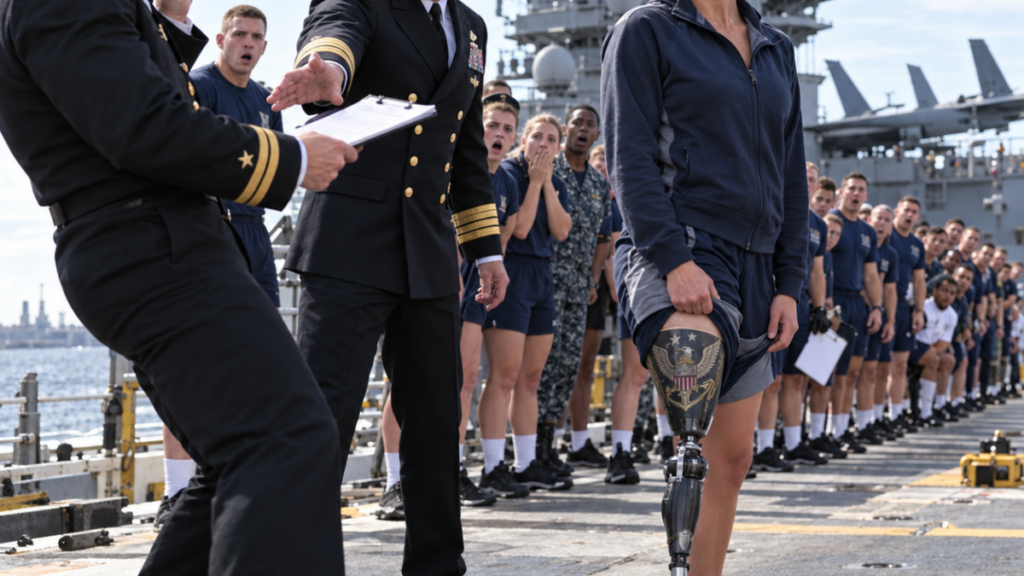
Sixty Sailors In Line. The Lieutenant Pulled Me Out By My Sleeve. “Not On That Blade. You’ll Fall, And I’ll Own It.” He Wrote “UNFIT” Across My Form. “Somebody Get The CO. I Want This On Record.” I Tugged My Warm-Ups Over The Socket. Too Slow. The CO Stepped In And Saw The Crest Painted On It. The Lieutenant Laughed. “Sir, Tell Her.” “Lieutenant. Hand Me That Form. Now.”
A lieutenant pulled me out of a Navy fitness line in front of sixty sailors, looked at the carbon-fiber blade where my left leg used to be, and wrote UNFIT across my form in black marker. Nobody knew I was reporting three days later as their new executive officer, and I decided not to tell them. By Monday, I had every reason to end his career. Then I opened an old investigation and found twenty-six pages that changed what I thought had happened on that track.
Part 1
At 0600 on Thursday, September 10, sixty sailors stood in a line inside the base fitness center pretending they would rather be anywhere else. The building smelled like rubber mats, disinfectant, and the faint sweat that never quite left the place no matter how often somebody mopped, while industrial fans turned over the basketball courts without actually moving much air. I wore the same navy-blue shirt and gray shorts as everyone around me, and below my left knee was a black carbon-fiber running blade that clicked lightly whenever I shifted my weight on the painted track.
Most people eventually stop staring at a prosthetic if you give them long enough, but a line of bored sailors at six in the morning does not give anybody long enough. The sailor ahead of me glanced down, looked back at my face, then snapped his eyes forward as though he had been caught reading somebody else’s mail. At the front stood Lieutenant Aaron Pike, the command fitness leader, late twenties, lean, sun-reddened across the nose, stopwatch hanging against his chest while he checked names with the tidy efficiency of someone who had been awake long before the rest of us.
When he reached me, his eyes dropped to the blade and stayed there.
“No.”
I waited, because sometimes the fastest way to learn what a person thinks is to make them finish the sentence.
Pike put one hand lightly against my upper arm and guided me sideways out of the line. “Not on that. You’ll fall, and I’ll own it.”
One nervous laugh came from somewhere behind me, sharp and embarrassed, then died almost immediately. I told him I had medical clearance, and instead of asking to see it, he uncapped a black marker and leaned over my paperwork. “Medical doesn’t run this track. I do.”
The sound of that marker against the paper reached someplace in me that I had spent years pretending no longer existed.
He wrote UNFIT across the top.
Then he underlined it.
“I’d like to run,” I said.
“I know you would.” His voice softened in the way people sometimes soften when they are about to take a choice away from you. “You can submit a waiver request. Maybe medical authorizes an alternate event. Maybe they excuse cardio. But I’m not letting you run a mile and a half on a blade and explaining afterward why I allowed it.”
“I already have authorization.”
“For the prosthetic. Not from me.”
Behind him, sailors were pretending to study the floor, stretch their calves, adjust shoelaces, anything except watch a woman get removed from a line because one part of her body looked different from theirs. A chief near the gym entrance, compact and gray-haired with a whistle hanging from one hand, stared at Pike for a long second before looking at me. Pike raised his voice and said, “Somebody get the CO. I want this on record.”
The chief sent a young seaman jogging through the side door.
Pike looked almost relieved. “Commanding officer’s in the building. He does PT Thursdays. He’ll be down in two minutes, ma’am, and he’ll tell you exactly what I’m telling you.”
Ma’am. He had guessed officer, probably from my age or posture. He had not guessed the rest.
Three days later, I was scheduled to report aboard as Lieutenant Commander Claire Rowan, the command’s new executive officer.
The physical readiness program he was running belonged to the executive officer.
I could have said it right then.
Instead, I looked down at my blade.
The gray warm-up pants I had worn over my shorts had ridden up when Pike moved me from the line, exposing the hard socket above the carbon curve. Painted on the side was a blue-and-gold crest: a shield, an anchor, and a mooring line wrapped around it. Underneath were two words in letters small enough that only someone standing close could read them.
HOLD FAST.
I tugged the fabric down.
Too late.
The hallway door opened.
But before I tell you what the commanding officer saw when he stepped into that gym, you need to understand why I was there without rank insignia three days before anyone expected me.
I learned the habit from Commander Frank Bishop, my first commanding officer sixteen years earlier. Before Bishop took over a command, he arrived early, wore plain PT clothes, and joined the first fitness test he could find. “You learn more in a mile and a half than you learn in thirty days of briefings,” he told me. “Watch who helps the slow runner. Watch who jokes with the junior sailors. Watch the person holding the clipboard.”
I adopted the habit, though I told myself I did it for humility.
By Thursday morning, I had already spent two days wandering the base in civilian clothes, eating in the galley and listening. Sailors said their commanding officer was strict but fair, remembered names, and ran with them most Thursdays. When they mentioned Pike, the comments were different.
“He runs the PRT like we’re launching missiles.”
