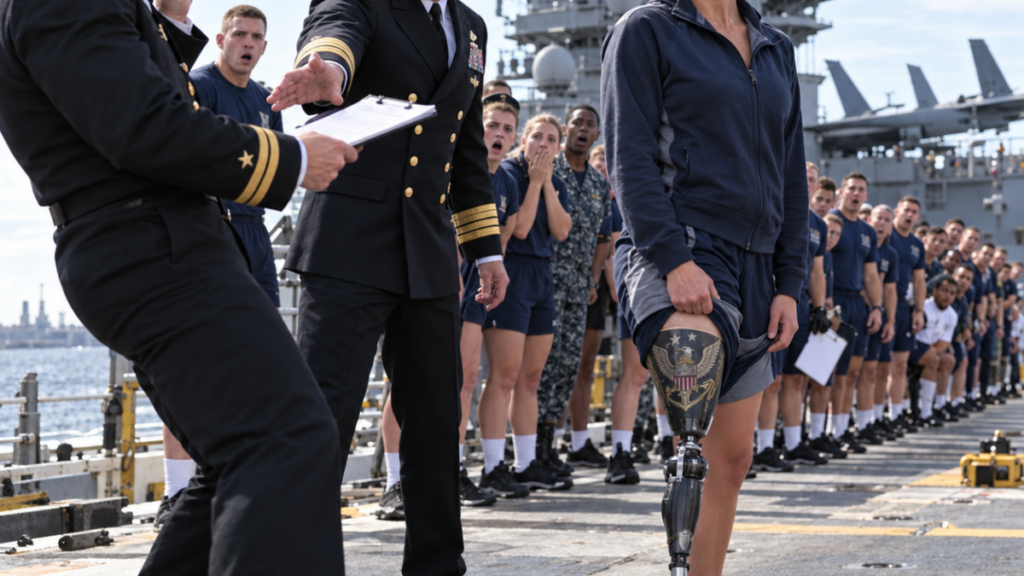
But sailors know holding fast is not the same as holding rigidly.
A line that cannot adjust under strain can part.
People can too.
One afternoon Hale came into my office and shut the door.
“Got something for you.”
He handed me an envelope.
Inside was my original fitness form.
The one Pike had marked UNFIT.
I looked at it.
Hale leaned against the wall.
“Personnel wanted to know whether you wanted it retained as part of the incident record.”
“No.”
“You sure?”
“There’s already documentation.”
“You want it destroyed?”
I ran my thumb across the black letters.
Once, that word had determined whether I could remain in the Navy.
This time it had lasted less than an hour.
Same word.
Different power.
“Give me a minute.”
Hale nodded and left.
I sat alone with the form.
Part of me wanted to keep it.
Proof.
Evidence.
A trophy from an argument I had won.
Then I realized that if I kept every object from every room where someone underestimated me, eventually I would need a warehouse.
I fed it through the shredder.
The machine hesitated at the folded paper, caught, then pulled it through.
Thin strips dropped into the bin.
I felt almost nothing.
That was how I knew I was ready.
A month later, the command held another official fitness test.
This time I attended as executive officer.
Khaki uniform.
Clipboard.
Walking prosthetic hidden under my trousers.
I stood near the wall while Pike briefed the sailors.
He covered hydration, event standards, medical modifications, emergency procedures.
Then he said, “If you have a waiver or adaptive equipment and we haven’t already spoken privately, come see me before your event. You do not need to explain medical details in front of the group.”
A few sailors nodded.
He continued.
No reference to me.
No dramatic confession.
No story about personal growth.
That mattered.
A system should not depend on people remembering the day one senior officer was embarrassed.
It should work for the sailor who arrives five years later after everyone involved has transferred.
When the running groups started, I noticed a chief standing near the finish.
He had a slight limp.
On his second lap, he slowed.
Pike moved from the timing table.
For one second I thought he had seen a medical emergency.
Instead, he stepped onto the track and ran beside the chief.
No announcement.
One lap.
Then he returned to the table.
Afterward I asked, “What was that?”
“He asked for a pacer before the test.”
“You remembered.”
Pike looked offended.
“Ma’am, it’s my procedure.”
I smiled.
“Fair point.”
That evening, Hale stopped me in the parking lot.
“You know he’s applying for department head school.”
“I know.”
“You going to endorse him?”
“Yes.”
Hale studied me.
“Strong endorsement?”
“Accurate endorsement.”
“Which means?”
I opened the car door.
“I’ll write that he made a serious error in judgment, accepted correction publicly, rebuilt a weak process, and became better at the job instead of running from it.”
Hale whistled.
“That’s either a great recommendation or a terrible one.”
“Depends what kind of officers the Navy wants.”
I got into the car.
He tapped the roof twice.
“Claire.”
I looked up.
“I’m glad you didn’t fire him.”
“So am I.”
He walked away.
I started the engine but did not drive.
Because in that moment I understood something I had missed since the beginning.
Pike’s consequence was not that I outranked him.
It was not that the commanding officer recognized me.
It was not embarrassment.
His consequence was having to remain in the room after being wrong.
To face the sailors.
To face medical.
To face the track.
To face lap four.
That was harder than punishment.
And far more useful.
Part 7
By winter, Thursday running had become crowded enough that Pike complained we were interfering with his private suffering.
“You created a club, ma’am.”
“I did nothing.”
“Castro made a sign.”
I stopped stretching.
“What sign?”
He pointed toward the bleachers.
A sheet of printer paper had been taped above a water cooler.
THURSDAY BORING RUN
Underneath, in smaller handwriting:
0600. ALL PACES. NO HEROICS.
Castro stood twenty feet away pretending intense interest in adjusting her knee brace.
I looked at her.
She looked at me.
Neither of us smiled.
Pike sighed.
“This is insubordination.”
“Probably.”
“You going to do anything?”
“No.”
“Figures.”
By 0600 we had eleven people.
Fast runners.
Slow runners.
Castro on the bike.
One chief who alternated jogging and walking.
Nobody asked why anyone was there.
That may have been the part I liked most.
For years, rehabilitation had made my body a subject.
How much did it hurt?
How far could I walk?
Could I climb?
Could I run?
Could I deploy?
Could I still be useful?
Every question had been necessary.
Together they made me feel like a machine being inspected after damage.
Thursday mornings were different.
Nobody cared unless I brought it up.
My blade was simply one of several pieces of equipment in the room.
That winter brought heavy rain.
Cold wet weather still made the residual limb ache in ways medical science could explain better than I could.
One Thursday I stopped after four laps.
Pike looked over.
“You good?”
“No.”
He waited.
That was new.
Old Pike would have interpreted my answer and made the decision for me.
New Pike waited for the next sentence.
“Socket feels bad. I’m done.”
He nodded.
“Bike?”
“No.”
“Coffee?”
“Now you’re practicing medicine again.”
“Coffee is morale.”
“Approved.”
We sat on the lowest bleacher while everyone else finished.
Pike stared across the track.
“I used to think being responsible meant preventing everything.”
“It doesn’t.”
“I know that now.”
“Do you?”
He considered it.
“Some mornings.”
“That’s about as good as anybody gets.”
He laughed.
Then his expression became serious.
“Can I ask something?”
“Sure.”
“If Commander Hale hadn’t recognized you, what would’ve happened?”
I had thought about that question more than once.
“I don’t know.”
“You would’ve filed a complaint?”
