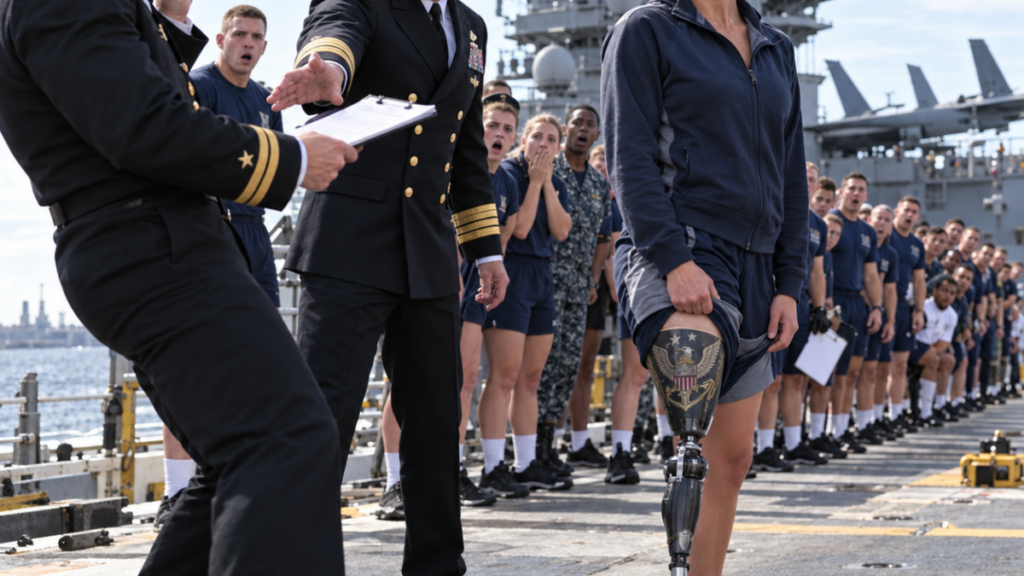
“After Gilliam, wouldn’t you?”
That name caught me.
Gilliam.
I wrote it in the pocket notebook where I kept names whenever I joined a new command.
I had no idea then that the name would matter more than the insult, the marker, or even the word written across my form.
Standing alone on that painted lane while the sailors flowed around me, I looked at Lieutenant Pike and saw something uncomfortable.
He did not look cruel.
He looked afraid.
And I knew that look because seven years earlier, I had watched it appear on the faces of officers deciding whether I was still useful to the United States Navy.
The door behind Pike swung wider.
Commander Marcus Hale stepped into the gym carrying coffee in a paper cup.
He took two steps.
Then he saw the crest on my prosthetic.
And stopped.
Part 2
Commander Hale was forty-four, tall, shaved head, runner’s shoulders, and wearing the same Navy PT gear as everyone else. He had selected me as his executive officer after two phone calls and a review of my service record, but we had never met in person; my official photograph showed me from the chest up, which meant he knew my face without ever having seen the missing portion of my left leg. For several seconds he stood in the doorway with his coffee halfway to his mouth, staring at the blue-and-gold crest Pike had accidentally exposed.
I watched recognition move through him.
Pike did not.
“Sir, thanks for coming down.” He lifted my clipboard over one shoulder. “I’ve got an officer here who wants to run the cardio portion using a lower-leg prosthetic. I’ve marked her unfit and recommended she go through medical for a waiver. She’s not taking it from me, so maybe she’ll take it from you.”
Hale lowered his coffee.
“Lieutenant,” he said quietly, “hand me that form.”
Pike finally turned.
Whatever he saw in Hale’s face erased the confidence from his own.
He handed over the clipboard.
Hale stared at UNFIT for several seconds, folded the paper twice, and slipped it into the pocket of his shorts. Then he walked toward me and stopped about an arm’s length away.
I spoke low enough that nobody else could hear.
“Monday, sir. Please.”
His eyes met mine.
He understood exactly what I was asking: do not identify me yet.
He gave the smallest nod and turned toward the room.
“Everybody runs today.”
Pike opened his mouth. “Sir, I—”
“Everybody medically cleared to run, runs. Start the clock when the first group is ready.”
The gym became so quiet I could hear one of the ceiling fans clicking on every rotation.
Hale looked at me. “Ma’am, mind if I run with you?”
“I’m slow, sir.”
He almost smiled. “So am I.”
He wasn’t.
We joined the third group. Pike stood at the starting line, stopwatch in one hand, fresh forms in the other because Hale had taken mine, and when he called “Go,” his voice sounded normal except for one slight break on the word.
Running on a blade is neither miraculous nor graceful. The carbon stores energy and gives it back, but it does not give you balance, coordination, lungs, pain tolerance, or permission to ignore the skin trapped inside the socket. My stride had a slight unevenness that experienced runners noticed immediately, and the hard track gave each contact a different sound from a shoe.
For the first two laps, people watched the blade.
By the third, they watched the clock.
On lap five, Hale asked, “You good?”
“Good.”
That was the only conversation we had.
Ahead of us, a young sailor began fading badly. His shoulders rose, his breathing went ragged, and he glanced toward the finish line in the way people do when they start negotiating with themselves about quitting. I came alongside him and slowed without saying anything.
He looked over.
His eyes dropped to the blade.
Something changed.
He straightened and accelerated.
He finished ahead of me.
Pike looked at his stopwatch when I crossed.
“12:44.”
Seven seconds faster than the fitness test that had helped keep me in uniform years earlier.
Nobody applauded. I was grateful for that. Sailors nodded, one petty officer lifted his water bottle an inch or two, and Pike wrote the time onto a new form with a hand that was not entirely steady.
Hale passed him on the way out.
“My office. 0800.”
“Yes, sir.”
Then Hale stopped in the same doorway where he had frozen minutes earlier and looked back at the socket beneath my raised pant leg.
The crest had once belonged to the USS Harrington, the destroyer where I lost my leg.
There was a case study about the Harrington used in Navy safety courses. Hale had seen it.
Seven years earlier, I had been the ship’s first lieutenant, which is a job title, not a rank. I ran deck division: anchors, small boats, line handlers, paint, rust, mooring stations, and the dozens of things that could kill you on the water if somebody got careless for thirty seconds.
We were mooring in a foreign port on a windy afternoon when a nineteen-year-old seaman named Mateo Alvarez stepped inside a marked snapback zone to retrieve a fender.
A mooring line under heavy strain is not just rope.
It stores energy.
When one begins to fail, you hear fibers separating, almost like ice cracking far away.
I heard it.
Mateo did not.
I was eight feet from him.
I shoved him backward over a cleat.
Then the line parted.
I remember a chief kneeling over me saying, “Ma’am, look at me. Stay with me.”
I remember looking.
I remember knowing from the chief’s face that something below my waist was very wrong.
Hospitals came afterward. Surgeries. Flights. A military medical center back in the States. Then parallel bars and an ugly training prosthetic that looked like plumbing pipe attached to a shoe.
My physical therapist, Tessa Grant, had one rule.
