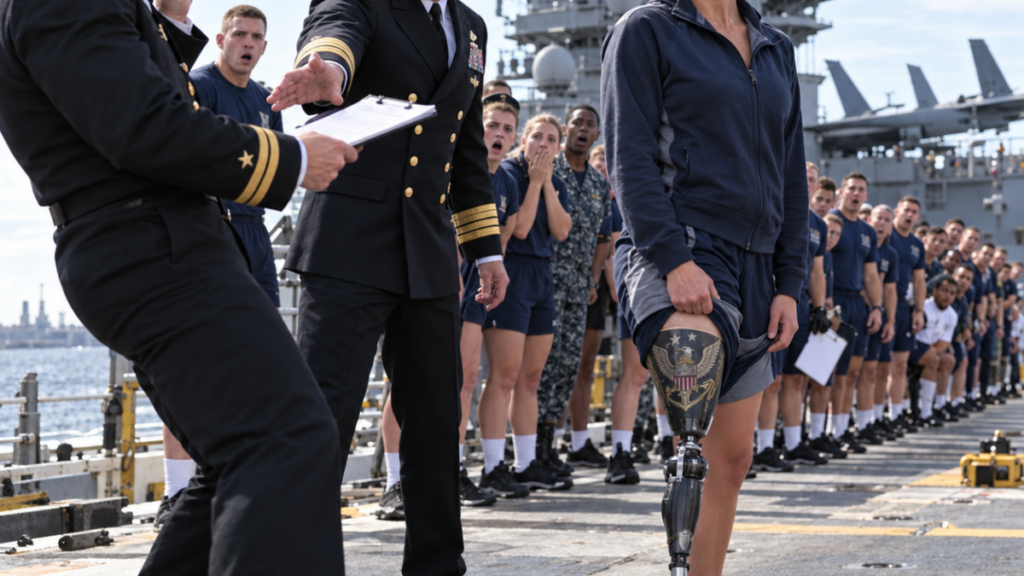
His face tightened. “I don’t think I should be responsible for the program.”
“I do.”
“With respect, ma’am—”
“Lieutenant, I haven’t finished telling you where I was wrong.”
That stopped him more effectively than rank ever could.
I explained Thursday from my side.
I told him about Bishop’s habit of entering a command anonymously and how I had used it for years. Then I told him that when Pike removed me from the line, I could have identified myself.
“I chose not to.”
He frowned.
“Why?”
“I wanted to see how far you’d go.”
His expression changed.
I did not look away.
“That made you take a test you didn’t know you were taking. I had good reasons, but it still wasn’t fair.”
“Ma’am, you’re apologizing to me?”
“Yes.”
“After what I did?”
“Two people can be wrong in the same room.”
He stared at me.
Senior officers do not apologize often enough. When we do, junior people sometimes react as though a chair has started speaking.
I opened my notebook and removed the index card.
“You’re going to do four things.”
Pike straightened instinctively.
“One: you remain command fitness leader.”
He nodded once.
“Two: your safety statement stays submitted.”
His eyes widened.
“I was going to withdraw it.”
“I know. You won’t.”
“But it’s wrong.”
“Then medical will explain why it’s wrong, in writing, and you’ll read their answer.”
He nodded more slowly.
“Three: you will rewrite our procedures for sailors using adaptive equipment or medical modifications. Prosthetics, braces, alternate cardio events, everything. You will write them with medical, not around medical.”
“Yes, ma’am.”
“And every sailor testing under a modification will be briefed privately. Nobody gets pulled out of a line and discussed like equipment.”
His face reddened.
“Understood.”
“Four: Thursdays, 0600.”
He waited.
“You run with me.”
That surprised him most.
“Why?”
“Because I want you to see what a running blade does on lap four.”
He looked at me for a long moment.
“Every Thursday?”
“Until it’s boring.”
Something almost like a smile reached one corner of his mouth.
“Yes, ma’am.”
Before leaving, Pike stopped at the door.
“I am sorry.”
This time, I let him say it.
“I know.”
“No, ma’am. I mean for the way I touched your arm and pulled you out. For writing that word before I looked at your paperwork. For doing it where everyone could see.”
I nodded.
“Good. Remember the specifics. General guilt isn’t useful.”
He left.
Ten minutes later Hale appeared in my doorway carrying coffee.
“Well?”
“He’s staying.”
“Of course he is.”
“He’s rewriting the procedures. Medical gets his statement. He’s running with me Thursdays.”
Hale took a drink.
“He agreed?”
“He tried to resign first.”
“Of course he did.”
Hale looked toward the hallway, then back at me.
“When I saw your crest Thursday, I remembered that safety slide. I sat through that class eight years ago thinking I hoped I’d never have somebody under my command forced to make that kind of decision.”
He shook his head.
“Then the woman from the slide walks into my gym three days early and my fitness leader writes UNFIT across her form.”
“He didn’t know.”
Hale’s expression turned serious.
“That’s the problem, isn’t it? Nobody ever knows.”
The hardest conversation that week did not happen with Pike.
It happened the next afternoon.
Petty Officer Renee Castro requested to see me.
She wore a rigid brace on her right knee and had used the stationary bike for the cardio portion of the fitness test for two years.
She stood at attention in front of my desk.
“Ma’am, sailors with waivers are talking.”
“I’m sure they are.”
“They heard Lieutenant Pike isn’t being removed.”
“He isn’t.”
Her mouth tightened.
“May I speak freely?”
“Please.”
“What are we supposed to take from that?”
No anger.
That would have been easier.
She looked disappointed.
I told her everything I could appropriately tell her: Gilliam, the investigation, Pike’s mistake, the medical review, the rewritten procedures, the Thursday runs.
Castro listened with her arms folded.
When I finished, she asked, “So you’re making him fix the system he ignored?”
“I’m making him own what he did.”
She considered that.
“That’s harder.”
“Yes.”
At the door she turned.
“Ma’am?”
“Yes?”
“Somebody said there’s writing on your running leg.”
“There is.”
“What does it say?”
“Hold fast.”
“What does that mean?”
I thought of Mateo’s napkin.
“It means when the line is under strain, you keep your grip.”
Nine days later, medical returned Pike’s safety statement.
Two pages.
Dry language.
Clear conclusion.
A medically cleared sailor with a lower-limb prosthesis was not automatically restricted from the running event.
Medical clearance was a medical determination.
A command fitness leader could raise safety concerns.
He could not substitute his judgment for medical authority.
Pike read the answer twice inside my office.
Then he looked up.
“Permission to post this?”
“Post what?”
“My statement and their response. Both.”
I studied him.
“You’re sure?”
“No, ma’am.”
That answer mattered.
“But I think people should see the question and the answer.”
The next morning, both pages appeared on the board outside the gym.
No spin.
No explanation.
His mistake in his own words.
Medical’s correction directly underneath it.
And three days later, during the next command fitness brief, Pike stood in front of almost the same sailors who had watched him remove me from the line.
He cleared his throat.
“Before we start, I made a decision during the last test that I was not qualified to make. I was wrong. My written concern and medical’s response are posted by the entrance.”
Eight seconds.
Then he moved on.
Nobody forced him.
I wasn’t even in the room.
That should have been the end of the incident.
Instead, it exposed something else.
Two sailors came forward with stories about previous fitness tests.
And both stories had one thing in common.
Nobody had written them down.
Part 5
The first sailor was Castro.
