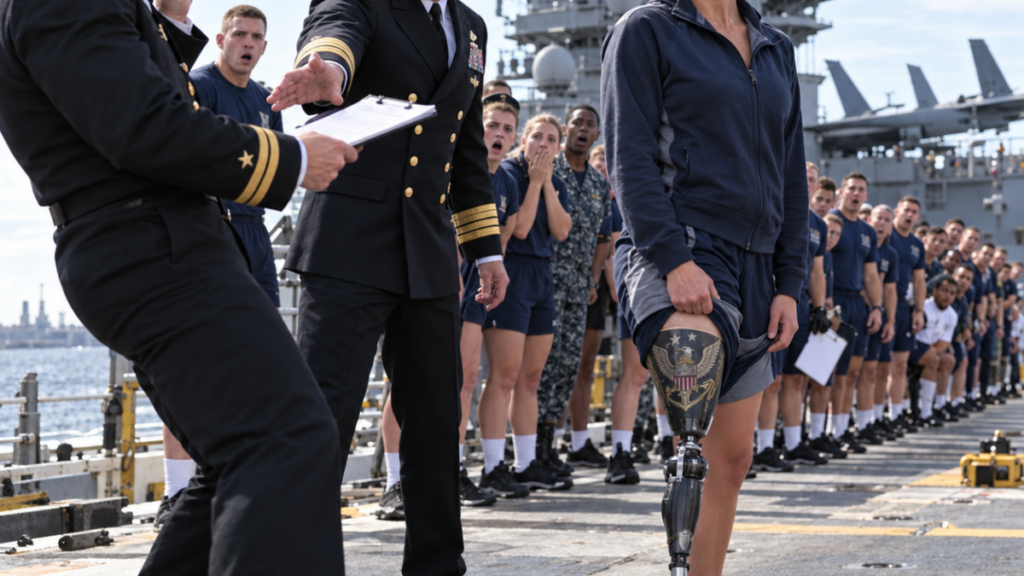
“You can say not yet. You cannot say can’t.”
The first day I walked nine steps, I sat down and cried.
She waited until I stopped.
“Ten tomorrow.”
Mateo visited me months later. He had driven eleven hours carrying a paper bag of hamburgers neither of us ate. He stood inside the doorway apologizing until I finally told him to sit down.
Before leaving, he drew our ship’s crest on a napkin.
Shield.
Anchor.
Mooring line.
HOLD FAST.
“So you have it,” he said, “in case you don’t go back.”
“I’m going back.”
Neither of us believed me.
The Navy initially did not believe me either.
My first medical evaluation found me unfit for continued service.
I appealed.
That became twenty-two months of doctors, hearings, evaluations, and polite people asking reasonable questions with devastating consequences attached.
At the formal hearing, the senior officer closed my file and said, “Lieutenant, I respect what you’ve done. But if I send you back to sea and you fall on a ladder, somebody gets hurt catching you, and the Navy owns it.”
Different room.
Different man.
Same sentence Pike had used.
You’ll fall.
I’ll own it.
I eventually convinced the board to let me demonstrate what I could do. In January 2021, under medical observation, I ran the full mile and a half on the same standard as every woman my age.
12:51.
A passing score.
Two months later, the Navy returned me to full duty.
Now, seven years after the Harrington, I sat inside my rental car outside Pike’s gym and stared at my hands on the steering wheel.
They were trembling.
Not from the run.
From the marker.
From seeing UNFIT again.
At 1000 my phone rang.
Commander Hale did not waste time.
“I had Pike in my office.”
I looked across the rented room at my running blade standing in the corner.
“And?”
“He submitted a written safety concern about prosthetic devices.”
I closed my eyes.
“He’s doubling down?”
“Looks that way.”
But Hale’s tone told me there was more.
“Sir?”
There was a pause.
“Claire, there’s something you need to read before Monday. Pike mentioned a sailor named Andre Gilliam.”
The name from the galley.
The one in my notebook.
“What about him?”
Hale exhaled.
“Last year, he collapsed on lap four.”
Part 3
The official investigation into Petty Officer Andre Gilliam’s collapse was forty pages long.
I read it Friday night sitting on the edge of the bed in my rented room with my walking prosthetic off, an ice pack wrapped around the end of my left leg, and the folded UNFIT form beside me. The document began with ordinary details—temperature, attendance, medical screening, event sequence—then reconstructed eleven minutes that had changed Aaron Pike without anyone apparently realizing how completely.
Gilliam was thirty-two, an electrician’s mate from Ohio with an undiagnosed heart condition.
He had passed his physical.
He had completed the strength events.
On lap four, he collapsed.
According to witness statements, Pike reached him in less than ten seconds, found no effective pulse, started compressions, ordered another sailor to retrieve the automated defibrillator, and continued until emergency medical personnel arrived eleven minutes later.
Gilliam survived.
The investigation found Pike had followed every required procedure.
Then it spent twenty-six additional pages examining whether he should have somehow prevented what happened.
Had the pre-test screening been adequate?
Had the sailor shown fatigue earlier?
Was the temperature appropriate?
Was the pace too aggressive?
Should additional medical personnel have been present?
Could Pike have noticed something nobody else noticed?
The final finding said no fault.
But I understood those twenty-six pages better than I wanted to.
Years earlier, officers had asked whether I could climb ladders, stand watch, evacuate compartments, move safely on a rolling deck, and reach battle stations in darkness. They were doing their jobs. I knew that, yet after enough questions, a person begins to hear something underneath them: prove that the worst day of your life has not made you dangerous to everyone around you.
Pike had spent eleven months trying to make sure his worst day never happened again.
Then I arrived with a visible variable he could not control.
He controlled it.
Badly.
I picked up the folded form and looked again at his handwriting.
UNFIT.
For the previous twenty-four hours, people had been calling me.
The command master chief believed the issue should be handled quietly.
Chief Denise Kowalski, the gray-haired woman from the gym, said Pike was a good officer who had “gotten sideways with fear.”
Another lieutenant warned me that Pike was respected in the wardroom.
My former department head from the Harrington, now a captain, had a much simpler opinion.
“End it.”
I stood by the window while he spoke through the phone.
“You fought almost two years to stay in uniform. He publicly overruled medical because looking at your leg made him nervous. If you let that go, every sailor with a waiver learns their paperwork means nothing.”
He was right.
That was the problem.
Everyone was right about one piece.
Hale called Friday morning.
“I can remove him as fitness leader today,” he said. “I can also document the incident formally. He made a medical determination he wasn’t qualified to make in front of sixty sailors.”
“Did you tell him who I am?”
“No.”
“Good.”
“Claire, I need a decision.”
I looked at my notebook.
Pike’s name was there.
Next to it, I had written Gilliam.
“Don’t relieve him.”
Silence.
Hale finally said, “Go on.”
“Let his safety statement proceed exactly as he wrote it. Send it to medical.”
“They’ll destroy it.”
“Professionally.”
That got a short laugh.
“No letter yet. No punishment yet. Monday morning, the program becomes mine. Let me handle him.”
Hale was quiet long enough that I heard the ticking of the ship’s clock he kept in his office.
“Some sailors are going to think we’re letting this slide.”
“I know.”
“The ones with waivers especially.”
“I know.”
“And you’re willing to take that?”
