“I’ve taken worse criticism for less useful reasons.”
Another pause.
“0730 Monday.”
Before hanging up, he added, “Wear the walking leg.”
I smiled despite myself.
“You want them to figure it out.”
“I think they’ve earned the opportunity.”
I spent the weekend reading the command’s procedures, inspection reports, fitness records, and medical modification policies.
The system itself was not broken.
That was what bothered me.
The instructions were technically correct, but vague where human judgment entered. A command fitness leader verified forms, coordinated events, monitored safety, and referred medical questions to medical personnel.
What happened when the fitness leader became the question?
Nothing in the instruction said, Do not humiliate a sailor while deciding.
Nothing said, Do not make a medical ruling because a piece of equipment makes you uncomfortable.
Rules assume people remain rational when afraid.
People often don’t.
Sunday night I wrote four items on an index card.
I placed it inside my notebook.
Then I wrote something else.
Tell him where I was wrong.
That sentence irritated me more than the other four.
I had walked into Pike’s fitness test without rank because Bishop’s old technique let me observe people before they started performing for senior leadership. I called it humility, but as I replayed Thursday, a less flattering truth emerged.
The moment Pike challenged me, I could have ended the misunderstanding.
“I’m Lieutenant Commander Rowan. I’m your incoming XO. Here is my clearance.”
Fifteen seconds.
Instead, I let him continue.
I wanted to know how far he would go.
I had turned an unsuspecting junior officer into an experiment.
His decision was still his responsibility.
So was mine.
Monday morning, I woke at 0440 and went through the ritual I had performed thousands of times.
Skin check.
Silicone liner.
Two-ply sock.
One-ply sock.
Walking prosthetic.
Khaki trousers.
Pressed shirt.
Ribbons.
Gold oak leaves on my collar.
Nothing about the uniform showed what was underneath my left trouser leg.
At 0725, I entered the building.
The petty officer at the quarterdeck was the same young man who had politely helped me when I came through in civilian clothes.
He looked at my collar.
Then my face.
Then back at my collar.
His voice cracked.
“Good morning, ma’am.”
“Good morning.”
The command was assembled for quarters in the large room downstairs.
Rows of sailors.
Chiefs on the flanks.
Officers at the front.
Commander Hale introduced me.
“Lieutenant Commander Claire Rowan, our new executive officer.”
Recognition traveled through the formation like wind through tall grass.
Heads shifted.
Eyes widened.
Somebody whispered and was immediately silenced.
I did not look at Pike.
I did not need to.
I heard his breath catch.
Hale finished my introduction and stepped aside.
“XO? Anything for the crew?”
I looked across the same faces that had watched me stand alone on the track.
“Just one thing, sir.”
The room waited.
“Thursday PRT was a good run. I’ll see you at the next one.”
That was all.
At 0815, someone knocked on my office door.
“Come in.”
Lieutenant Aaron Pike entered carrying two folders.
He stopped in front of my desk.
“Ma’am, Lieutenant Pike requesting to speak with the executive officer.”
“Sit down.”
“I’d prefer to stand.”
“I know. Sit anyway.”
He sat.
His face looked as if he had not slept.
He slid the first folder toward me.
“My safety statement.”
Then the second.
“My request to be relieved as command fitness leader.”
I left both unopened.
“Lieutenant, do you know the USS Harrington?”
He hesitated.
“Yes, ma’am.”
“How?”
“There was a case study at officer training. Mooring accident.”
I turned slightly in my chair.
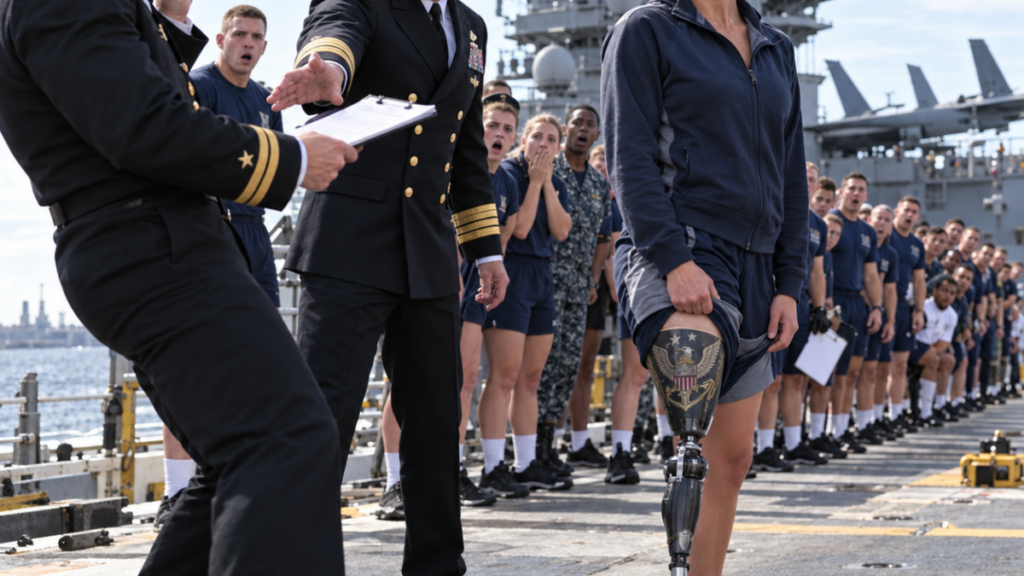
My trouser cuff lifted enough to expose the edge of the prosthetic foot.
“That’s me.”
Pike stopped breathing for about two seconds.
Then he looked down at the folders he had brought into my office.
Part 4
I did not let Pike apologize immediately.
Apologies given while someone believes their career is ending are difficult to separate from survival.
Instead, I told him about the Harrington.
Not the heroic version.
The real one.
I told him about Mateo stepping inside the snapback zone because a fender had come loose, about hearing the line begin to fail, about pushing a nineteen-year-old sailor hard enough that he landed on his back. I told him about waking inside a life I had not planned and spending months discovering that ordinary activities—showering, carrying coffee, stepping off a curb—could become technical problems.
Then I told him about the medical board.
“The senior captain was a good officer,” I said. “He had read my file. He asked intelligent questions. And when he decided against me, he said, ‘You’ll fall, and the Navy will own it.’”
Pike’s eyes closed briefly.
“I said almost the same thing.”
“Exactly the same thing.”
“Ma’am, I—”
“Let me finish.”
He nodded.
“I hated that captain for a long time. Quietly. Eventually I realized he wasn’t afraid of me. He was afraid of the one accident he couldn’t explain afterward.”
Pike stared at the edge of my desk.
“I did CPR on Gilliam for eleven minutes.”
“I know.”
His head came up.
“I read the investigation.”
Something complicated crossed his face: embarrassment, anger, surprise, maybe relief.
“Then you know I did everything I was supposed to do.”
“Every single thing.”
“And they still—”
“Spent twenty-six pages asking whether you should’ve done something else.”
His jaw tightened.
“Yes, ma’am.”
I leaned back.
“So when you saw my blade Thursday, you didn’t see me.”
He swallowed.
“No, ma’am.”
“What did you see?”
For the first time since entering, he stopped sounding like an officer speaking to a superior and sounded like a tired man.
“Gilliam hitting the track.”
The office was quiet except for distant voices in the hallway.
“Good,” I said.
His eyebrows lifted.
“Good?”
“Now we’re talking about the actual problem.”
He looked confused.
I pushed his relief request back toward him.
“I’m denying this.”
“Ma’am?”
“You don’t get to make a serious mistake and solve it by escaping the position where you made it.”
