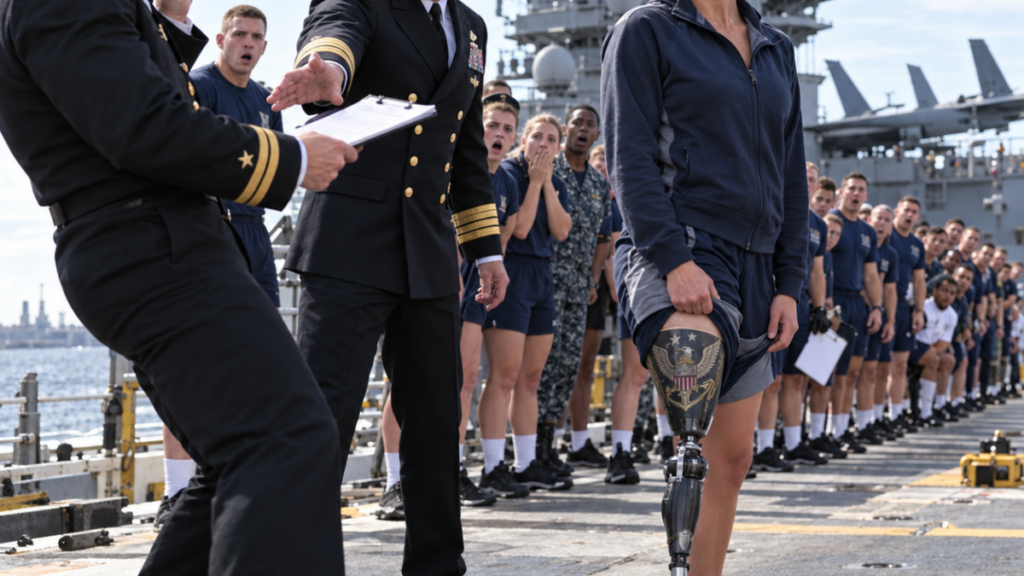
“Maybe.”
“Would you have let me stop you?”
“I probably would’ve called medical.”
“That’s not what I mean.”
I knew.
Would anonymous Claire Rowan have fought as hard as executive officer Claire Rowan?
Would a junior sailor?
Would Castro before anyone asked?
Those questions were why the procedure mattered.
“You had authority over the event,” I said. “Most sailors would’ve obeyed.”
Pike nodded slowly.
“That’s what bothers me.”
“It should.”
We watched Tyler Marsh finish his last lap.
He had improved dramatically since September.
When he crossed the line, Castro called a fake time five minutes faster than reality.
Marsh threw a towel at her.
The gym sounded ordinary.
Boring.
Good.
In February, Pike received orders to department head school.
He came to my office holding the message.
“I got selected.”
“I saw.”
He remained by the door.
“Did you write my recommendation?”
“I did.”
“Can I ask what you wrote?”
“No.”
His shoulders dropped.
“Ma’am.”
I let him suffer for a moment.
“I wrote the truth.”
“That’s not reassuring.”
“It was positive.”
“How positive?”
“Get out of my office.”
He smiled and left.
After the door closed, I reopened the endorsement.
One paragraph mattered most.
Lieutenant Pike’s strongest qualification is not that he avoids error. It is that when confronted with a consequential error, he does not hide behind intent, rank, or procedure. He corrects the system that allowed the error, accepts accountability in front of those affected, and incorporates the lesson into future decisions.
I had not written anything about my prosthetic.
It was no longer the important part.
A week later, another envelope arrived.
This one carried a Virginia return address.
Inside was a photocopy of an old napkin.
Mateo’s drawing.
The Harrington crest.
Under it he had written:
Ma’am, found the original in a box. Kept it after all. Thought you should know I finally sleep sometimes in March.
I read that sentence three times.
Then I sat down.
No dramatic tears.
Just a pressure in my chest that made breathing feel deliberate.
I called him.
He answered immediately.
“Did you get it?”
“Yes.”
“You mad I kept the original?”
“Furious.”
“I knew it.”
“Mateo.”
His joking stopped.
“What changed?”
He was quiet.
“One of my sailors stepped into a zone.”
My stomach tightened.
“Anybody hurt?”
“No. We stopped everything. Restarted the brief.”
He exhaled.
“I was angry. Like really angry. Then I looked at the kid and realized he was nineteen.”
Just like Mateo had been.
“What’d you do?”
“I made him explain what he saw.”
“And?”
“He saw a loose fender.”
Of course.
He had been trying to help.
Mateo continued.
“So I told him the story.”
“All of it?”
“My part.”
Not the stupid sailor.
Not only the lieutenant who saved him.
His part.
That mattered.
“I slept that night,” he said.
I pressed my thumb against the photocopied motto.
“Good.”
In March, exactly eight years after the Harrington accident, I woke before dawn from a dream about mooring lines.
I still had them sometimes.
In the dream, the line always parted but never reached me.
That sounds better.
It wasn’t.
I would wake waiting for impact.
At 0550, instead of lying there, I put on the running blade.
Rain tapped against the window.
Everything ached.
I drove to the gym.
Pike was already there.
He glanced at me.
“Bad weather?”
“Shut up.”
“Medical observation.”
“One more and you’re fired.”
Castro arrived behind us.
“She’s cranky because she’s old.”
“I’m thirty-nine.”
“Ancient.”
We ran.
Slowly.
At lap four, pain sharpened around the socket.
I considered stopping.
Then decided I wanted one more lap.
Not six.
One.
That distinction had taken me years to learn.
Endurance is not ignoring limits.
Sometimes holding fast means knowing exactly when to loosen your grip.
I finished five laps.
Then walked.
Nobody asked me to prove the sixth.
On the way out, I noticed the Thursday sign had been replaced.
The new one read:
NOT YET IS ALLOWED.
CAN’T ISN’T.
I stared at it.
Tyler Marsh appeared beside me.
“Hope you don’t mind, ma’am.”
I shook my head.
“No.”
Tessa had said those words to me in rehabilitation eight years earlier.
I had said them to Tyler once.
Now they belonged to people I had never met.
That is another thing leadership does when it works.
The useful parts stop belonging to you.
That afternoon, Commander Hale called me upstairs.
There was an officer waiting inside his office wearing service dress blues.
Gray hair.
Captain’s insignia.
The face had aged, but I recognized him immediately.
The senior member of my medical board.
The man who had once looked at me across a long table and said the Navy could not risk letting me stay.
He stood when I entered.
“Lieutenant Commander Rowan.”
For one second, I was thirty-one again.
Then I saw the folder in his hands.
And realized he had come because of Pike’s new procedure.
Part 8
His name was Captain Samuel Barrett.
For years, I had remembered only his voice.
“You’ll fall and the Navy will own it.”
He had been reduced in my memory to one sentence spoken across a table while three officers decided whether the career I had built still belonged to me.
Now he stood inside Hale’s office holding a copy of an eleven-page command instruction written partly by the lieutenant who had once marked me unfit.
Life has a sense of humor, but it is usually too slow to enjoy in the moment.
Barrett extended his hand.
“Good to finally meet you again under better circumstances.”
I shook it.
“You remember me?”
His expression changed.
“Lieutenant Commander, I remember every contested fitness board I chaired.”
I had never considered that.
In my version of history, that meeting ruined months of my life and became a permanent landmark.
In his, I assumed it was Tuesday.
Apparently not.
Hale pointed toward the chairs.
Barrett had recently joined a regional working group reviewing how commands handled adaptive equipment and long-term medical modifications.
