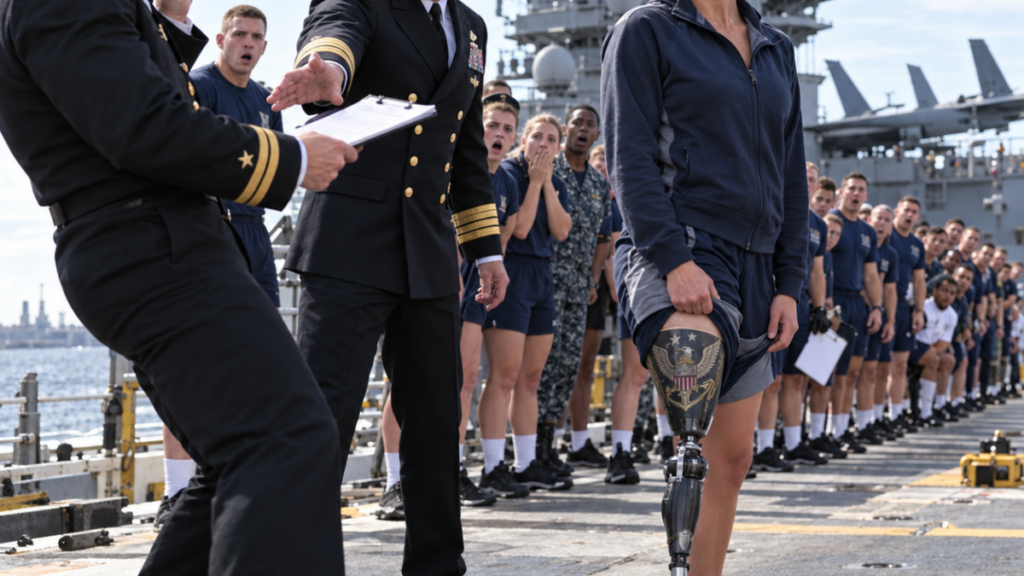
“I was standing still for most of it.”
“That’s not how the story made it over here.”
He had heard about the gym through the Navy’s unofficial information network, which moves rumors faster than operational orders.
Then his voice changed.
“They said your CO recognized the crest.”
“He did.”
“My crest.”
“Your drawing.”
There was wind on his end.
Probably a pier.
He was silent long enough that I wondered whether the call had dropped.
Then he said, “I still don’t sleep much in March.”
Seven years.
My chest tightened.
“I know.”
“Every mooring brief, I tell my sailors about snapback zones. I tell them about a lieutenant who shoved a stupid nineteen-year-old over a cleat.”
“You weren’t stupid.”
“I stepped into the zone.”
“To fix something.”
“I knew better.”
“You were nineteen.”
“Still knew better.”
Some guilt does not respond to facts.
Then Mateo asked something nobody else ever asked me.
“Does your leg still hurt?”
I looked toward the running blade leaning against my wall.
“Sometimes.”
“How often?”
“Rainy days. Long runs. Bad socket days.”
“Mostly weather?”
“Mostly.”
He repeated that quietly, as though storing it.
Before hanging up, I told him something I had wanted to say for years.
“The safety lesson isn’t about my leg.”
“What?”
“It’s about you.”
He said nothing.
“You stepped into danger because you were trying to help. That’s why the lesson matters. If we teach the accident like you’re just the mistake, we teach it wrong.”
Mateo breathed slowly into the phone.
“Yes, ma’am.”
He did not sound convinced.
Maybe he never would be.
That night, I realized I had spent years believing recovery meant returning to the person I had been before the accident.
Pike had made a similar mistake after Gilliam.
He had tried to return to the morning before lap four by controlling every morning that came afterward.
Neither of us could go backward.
The best we could do was decide what the damage taught us.
Then, on Wednesday afternoon, Chief Kowalski appeared at my door.
“Pike finally went into the mess.”
I looked up.
“The card?”
She nodded.
“Ten minutes.”
“What did it say?”
“You’ll have to ask him.”
“How did he look?”
Kowalski considered the question.
“Different.”
The next morning, Pike was waiting at the track.
But for the first time, his stopwatch was still inside his bag.
Part 6
“Six laps?” I asked.
Pike shook his head.
“Can we just run?”
We started without timing anything.
Castro was already on the bike, Tyler Marsh stretched near the bleachers, and two sailors from engineering jogged several yards behind us. What had begun as an awkward correction between an executive officer and a lieutenant had become a Thursday habit, though nobody had formally created it and nobody seemed interested in naming it.
On lap four, Pike finally spoke.
“I read Gilliam’s card.”
I waited.
“It said, ‘Thanks for not giving up on lap four.’”
His breathing stayed controlled.
“That’s all?”
“He wrote more. Asked about people. Told Chief Kowalski he still owed her twenty dollars. But that was the line.”
We rounded the curve.
“I spent almost a year remembering him hitting the floor,” Pike said. “He remembered me staying.”
That sentence stayed with me for the rest of the run.
Pike had built his entire safety philosophy around his failure to prevent something that nobody could have predicted.
Gilliam remembered what Pike did after it happened.
There are people who ruin themselves trying to become powerful enough to erase chance.
The Navy trains us to control risk because uncontrolled risk kills people.
But risk management becomes fear when the goal shifts from reducing danger to eliminating the possibility of blame.
Pike had crossed that line.
So had the captain who once tried to remove me from active service.
If I was honest, so had I.
My habit of entering commands anonymously had begun as a way to learn.
Over time, it had become a way to confirm what I already feared.
Watch people when they don’t know who you are.
Eventually someone will disappoint you.
Then you can tell yourself you were right to expect it.
That was not humility.
That was a grudge wearing professional shoes.
I wrote Commander Bishop a letter.
He had been retired for years and lived in Maine, where he responded to almost all correspondence with postcards depicting lighthouses, fishing boats, or snow.
I told him what happened.
I told him I was retiring his anonymous-arrival tradition.
Two weeks later a postcard appeared in my mailbox.
A white lighthouse stood against dark Atlantic water.
On the back, in Bishop’s square handwriting, were two sentences.
Good.
I should’ve retired it myself.
I laughed alone in my office.
Then I put the postcard inside my notebook.
The command changed slowly, which is the only kind of change I trust.
Sailors with medical modifications began scheduling private check-ins instead of explaining themselves at crowded tables.
Pike stopped assuming questions were challenges to his authority.
Fitness staff attended a briefing from medical about adaptive equipment.
Nobody became magically enlightened.
Nobody needed to.
They became competent.
Competence is underrated.
Three weeks after the new procedure took effect, a young petty officer named Hannah Cole came to the gym wearing an ankle brace and carrying a temporary walking waiver.
I happened to be there.
Pike took her paperwork, stepped away from the line, and spoke quietly enough that nobody else could hear.
“Medical says walking event?”
“Yes, sir.”
“Any route restrictions?”
“No, sir.”
“Want a pacer for the first lap?”
Cole looked surprised.
“Do I need one?”
“No. You can have one.”
She thought.
“Sure.”
Pike pointed at Tyler Marsh.
“Marsh, congratulations.”
Marsh groaned.
“Why me, sir?”
“Because you’re standing there.”
No speech.
No lesson.
No one watched.
Exactly what I wanted.
The more routine it became, the more I understood what the word HOLD FAST actually meant.
For years, I had treated it like a command to endure.
Teeth clenched.
Hands locked.
Never let go.
