Someone had forwarded Pike’s instruction.
“It solves a problem we keep seeing,” Barrett said. “Command-level personnel are making informal medical judgments because the official guidance tells them what authority they have but not how to manage uncertainty.”
I glanced toward Hale.
He kept his face neutral.
Barrett opened the folder.
“Who wrote this?”
“Lieutenant Aaron Pike,” I said.
“Fitness leader?”
“Yes.”
“Good work.”
“There was context.”
Barrett looked at me.
I told him.
Not dramatically.
The line.
The blade.
UNFIT.
His eyes moved toward my left leg even though the prosthetic was hidden under khaki trousers.
When I repeated Pike’s sentence, Barrett went still.
“You’ll fall and I’ll own it.”
He looked down.
“I said something close to that.”
“Exactly that.”
The silence in Hale’s office lasted several seconds.
Barrett closed the folder.
“I owe you an apology.”
Once, hearing those words would have mattered enormously.
Now they landed differently.
“I appreciate that, sir.”
“I believed I was protecting you and the service.”
“I know.”
“I was wrong.”
“You were wrong about the conclusion.”
He looked at me carefully.
“Not the concern?”
“No.”
I thought about Pike.
“Fear isn’t automatically wrong. It’s information. The problem starts when we treat fear as evidence.”
Barrett nodded.
“I wish I’d understood that then.”
“So do I.”
He smiled faintly.
“Fair.”
He recommended the procedure for broader review.
Six months later, portions of it appeared in regional guidance used by several commands.
Pike’s name stayed on the working draft.
I insisted on that.
So did Castro’s.
Medical added theirs.
Systems should remember the people who improved them, not only the incident that forced the improvement.
Pike transferred the following spring.
His last Thursday run drew twenty-three sailors.
He complained bitterly.
“This was supposed to be punishment.”
“You’re the one who kept coming.”
“Direct order, ma’am.”
“I stopped ordering you in November.”
He looked offended.
“I wish you’d told me.”
Castro shouted from the bike, “You would’ve come anyway.”
Pike ignored her.
We ran six laps.
On the final turn, he glanced toward the place Gilliam had collapsed.
Then forward.
He did not slow.
Afterward he handed me his stopwatch.
“Keep it.”
“I don’t want this.”
“It’s government property.”
“Then definitely take it.”
He laughed.
At the door, he stopped.
“Ma’am.”
I looked at him.
“Thank you for not ending my career.”
I shook my head.
“Don’t thank me for that.”
“Why?”
“Because keeping your career wasn’t the favor.”
He waited.
“The chance to repair what you damaged was.”
His expression became more serious.
“Yes, ma’am.”
“And somebody else will eventually make a mistake in front of you.”
“I know.”
“Remember how this felt before you decide what they deserve.”
He nodded.
Then he left.
I never became friends with Aaron Pike.
That isn’t the point.
Leadership stories often get cleaned up afterward until everybody involved becomes either a villain or a mentor.
Real people rarely cooperate with that.
Pike was a competent officer who let fear override his judgment.
I was an experienced officer who let an old wound turn a stranger into a test.
Commander Hale protected me without taking the decision away from me.
Castro challenged my response when silence would have been easier.
Mateo carried guilt for eight years over a decision he made at nineteen while trying to help.
Captain Barrett made a decision that hurt me deeply and, years later, admitted he had been wrong.
Nobody fit into one sentence.
I served as executive officer for two years.
There were harder days than the fitness center.
Personnel problems.
Inspections.
A sailor’s divorce that became a security issue.
A chief whose mother died during deployment preparation.
A maintenance failure that kept half the command awake for forty hours.
Those are the things leadership is mostly made of.
Not speeches.
Not dramatic reveals.
Tuesday at 1430 when everyone is tired and somebody still needs a decision.
Before I transferred, I ran one final official PRT on that track.
I was forty.
The socket fit badly that week.
Rain had moved through the night before, leaving the air heavy.
Castro had already transferred.
Tyler Marsh was now a petty officer.
Chief Kowalski stood near the timing table pretending her knee did not hurt.
Pike was long gone.
The new fitness leader, a first-class petty officer named Elena Brooks, checked my paperwork.
She looked at the prosthetic.
Then at the clearance.
“Everything good with the socket today, ma’am?”
“Good enough.”
“Want lane one clear?”
“Please.”
“Pacer?”
I looked around.
“No.”
She nodded.
“All right.”
That was it.
No audience.
No hesitation.
No special meaning.
I ran.
Lap one felt stiff.
Lap two loosened.
Lap three hurt.
Lap four was boring.
I smiled when I realized it.
By the last lap, Tyler Marsh was standing near the finish line.
He called the time.
“12:41, ma’am.”
I bent forward with my hands on my knees.
“You’re getting slow,” he said.
“You’re getting disrespectful.”
“Leadership development.”
I straightened.
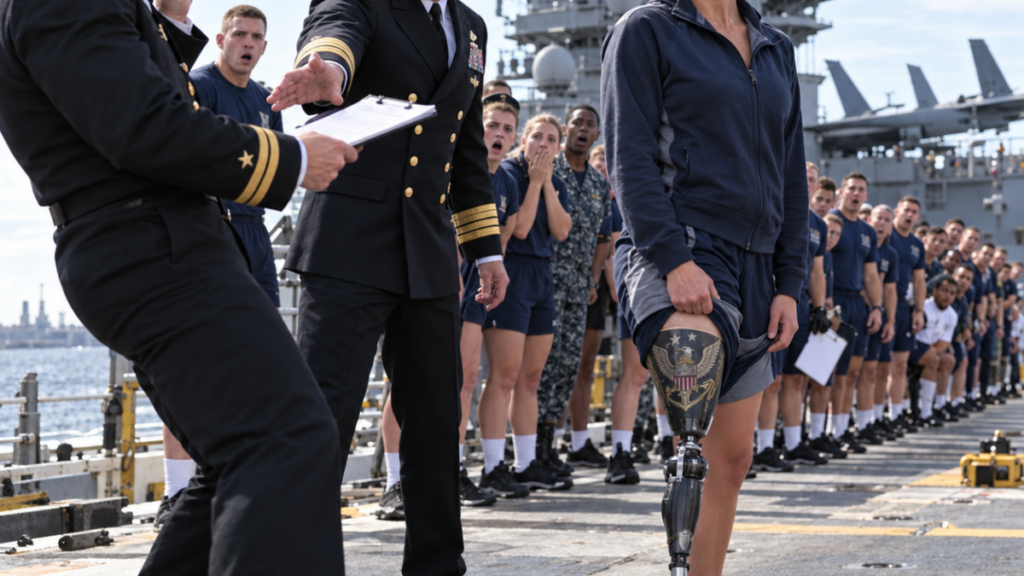
The crest on my socket was visible.
Blue and gold.
Shield.
Anchor.
Mooring line.
Hold fast.
Years earlier, I thought those words meant refusing to let anybody push me out.
Then I thought they meant surviving pain.
Later I thought they meant giving Pike room to repair his mistake.
I know better now.
Holding fast is not clinging to the person you were before something happened.
It is holding onto the part of yourself worth carrying forward while allowing everything else to change.
I lost a leg on the Harrington.
Mateo lost the uncomplicated confidence of being nineteen.
Pike lost the belief that enough control could prevent every disaster.
Barrett lost certainty in a decision he once believed was reasonable.
None of us got those things back.
We built something else.
On my last day with the command, I cleaned out my office.
Old inspection notes.
Coffee mugs.
Bishop’s lighthouse postcard.
Mateo’s photocopied crest.
The index card with the four instructions I had written before meeting Pike.
At the bottom of the drawer was my small notebook from the first week.
