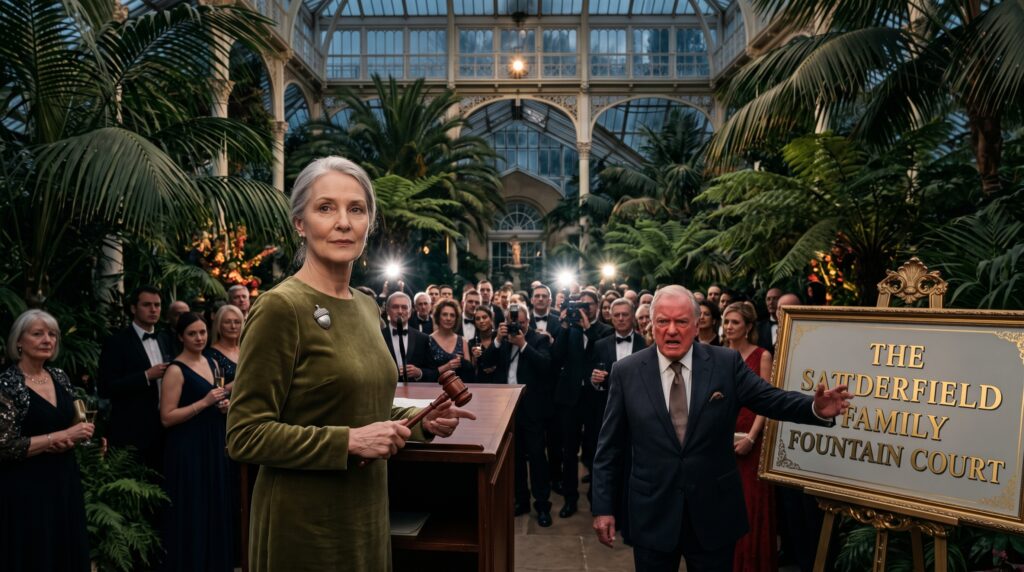
My daughter’s former father-in-law turned around and looked me up and down.
“Couldn’t afford a better dress?” Doyle Satderfield said.
His wife, Joyce, didn’t lower her voice.
“Here to ask for money again?”
A few people laughed.
I said nothing.
I handed my invitation to the young woman at the check-in table, and she scanned the QR code, glanced at her tablet, and lifted her radio.
“Tell the chairwoman she’s here.”
Doyle grinned like a man who had just won a bet.
“There it is. Security.”
But here’s what none of them knew.
At 3:40 the afternoon before, a clerk at the county courthouse had stamped a file with their name on it.
And what happened when the fountain came on that night?
My whole town is still talking about it.
Let me tell you who I am, since the Satderfields never bothered to ask.
I grew up above my father’s shoe repair shop on Water Street in Carden, Ohio, a river town of 18,000 people where everybody knows your car before they know your face.
At 18, I kept the books for Harlo Feed and Grain.
I took accounting classes at night for eight years, one course at a time, and paid for every one of them in cash.
I passed the CPA exam in 1984, the same year my daughter Juliet was born.
In 1992, I opened my own small practice.
For 29 years, I audited the places nobody else wanted to audit. Churches, school districts, volunteer fire departments, village water boards.
I’ve audited 11 churches.
Nobody lies like a building fund.
My husband, Ward Canella, died of a heart attack in 1997. He was 44, and Juliet was 13.
I raised her alone.
I don’t tell you that for sympathy. I tell you so you’ll know I don’t scare easily.
These days, I rent a two-bedroom apartment above Kesling Hardware on Front Street because I like the bell on the shop door.
I drive a 2009 Buick.
People draw conclusions from those two facts, and I let them.
Then there’s the dress.
It’s olive-green silk with a plain neckline and three-quarter sleeves. I bought it off a department store clearance rack for $89 to wear to Juliet’s wedding on June 13, 2009.
The Satderfields paid for the reception at Lakeshore Country Club, and they never once let me forget it.
In the receiving line, Joyce rubbed my sleeve between two fingers and asked, loud enough for the band to hear, “Where did you get that?”
I pinned my mother’s silver acorn brooch at the collar and smiled for the photographer.
That dress would come out of my closet one more time.
And a Satderfield would have something to say about it then, too.
Doyle Satderfield built Satderfield Marine and Powersports out of a gravel lot on Route 7.
And I’ll give him that.
He sold bass boats, pontoons, and jet skis to half the county. And he did it with a big laugh, a gold watch, and a handshake that lasted one second too long.
What he couldn’t buy was a seat at certain tables.
The old Carden families, the ones whose names are carved over the library door and painted on the bandstand, never quite let him in.
Doyle noticed.
Doyle noticed everything that was ever withheld from him.
On Thursday, May 15, 2014, he walked into my office with a folder under his arm.
His dealership wanted a $2.2 million line of credit from First Ohio Valley Bank. The bank wanted his financial statements reviewed by an outside CPA.
And Doyle wanted that CPA to be me because I was family, and he assumed family meant fast.
I spent two evenings with his numbers.
His inventory list included nine boats that had already been sold, complete with hull numbers, sale dates, and buyers’ names.
That was $340,000 worth of boats sitting in other people’s driveways.
I told him I couldn’t put my name on it.
“It’s a rounding error,” he said.
“Rounding errors don’t have hull numbers, Doyle.”
The bank turned him down.
He found a smaller line of credit somewhere else at a worse rate, and he never forgave me.
At Mason’s fifth birthday party, over a sheet cake shaped like a tractor, he finally said it out loud.
“You cost me $2 million over a rounding error.”
In 2016, after a lawsuit over boat warranties, the Harlo County Community Foundation passed him over for its board for the second time.
He decided I’d had something to do with that, too.
I hadn’t.
I wasn’t even on the board yet.
Doyle never forgave a woman who told him no.
He just waited for a room big enough to say it in.
Joyce was harder to read than her husband.
Doyle was loud on the outside. Joyce kept her noise in a locked drawer.
I learned where it came from at Mason’s christening party in May 2010.
It was a warm afternoon at the Satderfields’ lakehouse, and Joyce had two glasses of white wine on the dock, which was one more than she usually allowed herself.
She told me a story I’ve never forgotten.
In 1965, when she was 11, her mother cleaned house for the Fairweathers, the same Fairweathers who gave Carden its botanical garden.
That summer, they held a garden party inside the Palm House, the big Victorian glasshouse with the cast-iron fountain and the three iron herons.
Joyce’s mother brought her along to carry trays.
Little Joyce walked in the front door behind her mother in her Sunday dress, staring straight up at the palms.
The housekeeper caught her by the collar.
“Help goes around back.”
She marched Joyce outside and pushed her through the potting shed door on the north wall.
