Brady turned around in his chair for the first time all night.
I spoke for about 90 seconds.
I thanked Philippa.
I said one thing I’d written on an index card that afternoon.
“We name things after what we want remembered.”
I didn’t look at table four when I said it.
I didn’t need to.
“And now,” I said, “the people who will be running this place when we’re gone. Our youth advisory council.”
My grandson walked up the three steps to the stage.
And at table four, Doyle Satderfield stood up.
Mason read his list from a folded sheet of paper, and his voice only cracked once.
“$4,000 for the county bookmobile. $3,500 for the Carden High robotics team. $2,500 for a community garden on Sycamore Street.”
$10,000 chosen by 12 teenagers.
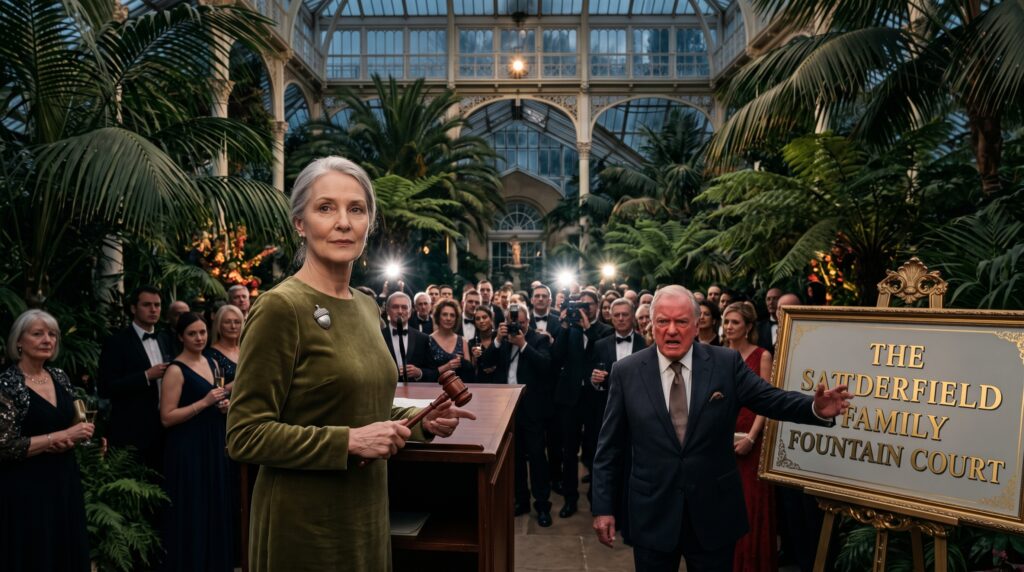
He was reaching for the last line when his grandfather walked to the easel.
Doyle pulled the white sheet off in one motion like a magician.
Underneath was a large rendering of the fountain with gold letters across the top.
THE SATDERFIELD FAMILY FOUNTAIN COURT.
He didn’t need a microphone.
He’d been selling boats for 40 years.
“Before we go on, folks,” he said, “our family gave $250,000 to this Palm House.”
The Courier’s flash went off.
Once.
Twice.
“Now, I know there’s been some paperwork, some noise from certain people.”
He looked right at me.
“I’d like the new chairwoman to confirm our gift right here tonight.”
Mason stood frozen on the top step with his folded sheet of paper.
At table one, Juliet’s hands went flat on the tablecloth.
I set the gavel down on the podium.
I didn’t hurry.
“Mr. Satderfield,” I said, “I have been recused from your funds since August 21. My letter was filed with the magistrate in September. You sat in the front row.”
Doyle’s face went a dark, shiny red.
“Mr. Latimore handles every matter involving your family,” I said. “He’ll answer you.”
Kenneth Latimore rose from table two and buttoned his jacket.
He had answered louder fathers than Doyle.
Kenneth didn’t go to the stage.
He spoke from beside his own table in the voice he must have used at a thousand assemblies.
“Mr. Satderfield, the board has not accepted that name.”
Doyle opened his mouth.
Kenneth kept going.
“Yesterday at 3:40, we deposited the funds, $186,000, with the court. The Harlo County Court of Common Pleas, Domestic Relations Division.”
“It is a public filing. Anyone here can read it Monday morning.”
A ripple went through the tables.
The kind of sound 300 people make when they all lean an inch at once.
“Two parties have claimed that money,” Kenneth said. “The court will decide whose it was. Until then, there is no name on that fountain.”
The file stamped at 3:40 the afternoon before, while the Satderfields were picking up their tuxedo and their pearls.
Doyle found his voice, and it came out much too loud.
“That is our money. We gave it.”
Quincy Wickham stood up from table six.
He’s a small man with round glasses and the manners of a funeral director.
And he didn’t raise his voice at all.
“You gave it to us, Mr. Satderfield. That’s what giving means.”
“I’ll see you in court,” Doyle said.
He swung around to point at the stage, at Kenneth, at Quincy, at me.
“Every one of you.”
“You’re welcome to try,” Quincy said. “The court already has the money. Saves everyone a trip.”
Brady had gone the color of the tablecloth.
He kept glancing at the doors.
Doyle was loud.
Doyle was always loud.
But it was Joyce who broke.
She came up out of her chair so fast it tipped back against the iron rail.
“It was Brady’s bonus!” she shouted. “He earned it! It was ours to give!”
Three hundred people went silent at once.
Even the string quartet had stopped, bows in the air.
Joyce didn’t hear the silence.
She’d been waiting 60 years to be heard in that building.
And now she was.
“She was never getting a dime of what he earned!”
There it was.
The sentence Mason had heard through a garage wall when he was 13, coming out of his grandmother’s mouth in front of the whole county.
Brady stood up.
“Mom, stop.”
He said it quietly, the way you’d say it to someone standing on a ledge.
It was the only true thing I heard him say all year, and it was two years too late.
At table one, Juliet stood up.
She didn’t say a word.
She didn’t have to.
Everybody in that room knew exactly whose dimes Joyce was talking about.
On the top step of the stage, my grandson stood very still, holding his folded piece of paper.
He was hearing it for the second time in his life.
This time, he wasn’t hiding behind a boat trailer.
Joyce turned and found me.
Her eyes were wet and furious.
“You did this,” she said. “You came begging to my door, and now—”
“No, Joyce.”
I said it softly.
I could have whispered, and they’d have heard me at the back wall.
“I didn’t come here to ask for money,” I said. “You did.”
And then Joyce did the one thing I didn’t expect.
She turned around and put her hand on the fountain.
She laid her palm flat on the rim of the lowest basin where she’d touched it during the cocktail hour.
“My mother scrubbed these tiles,” she said.
Not to me.
To the herons, maybe.
For one second, she wasn’t a candidate’s wife in champagne silk.
She was 11 years old in a Sunday dress, holding a tray she wasn’t allowed to carry through the front door.
“I know,” I said. “You told me at Mason’s christening. That’s why I’m sorry it was this money.”
Something moved in her face.
Then it closed like a screen door.
“Your daughter took my son,” she said.
That was all.
No apology.
