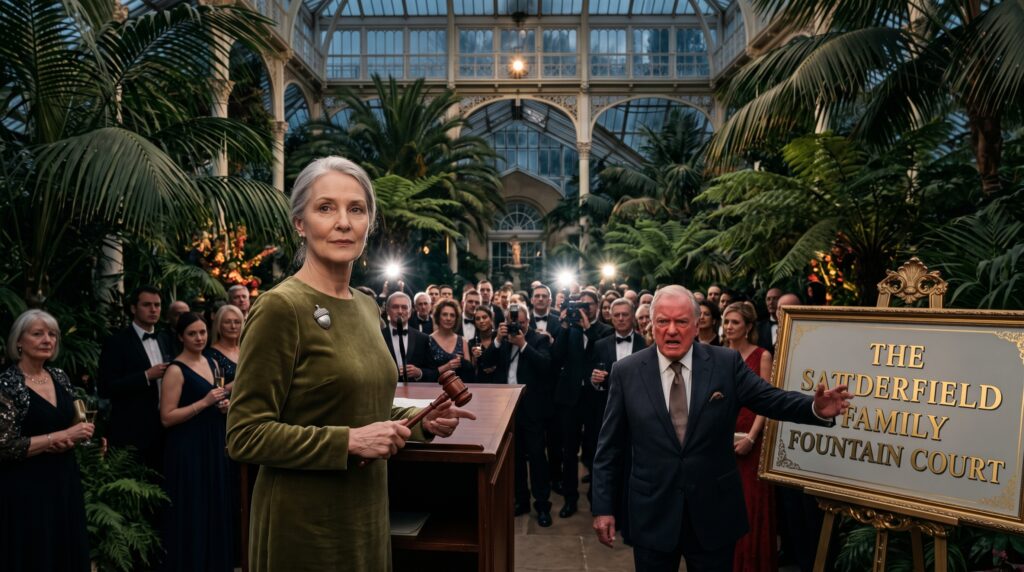
At our board meeting on Thursday, October 9, Kenneth reported in open session that the fountain court naming had been suspended three days earlier pending legal review.
He added one sentence.
“This is a matter in which our chair-elect is recused.”
Then he moved on to the parking plan for the gala.
That’s all I knew.
That’s all I was supposed to know.
Doyle read the word “suspended” as “delayed.”
Men like Doyle always do.
I can tell you what the Satderfields were thinking that month because they told everybody.
Joyce told the Lakeshore Garden Club that I was using my little board seat to steal their gift.
“She came begging once,” she said. “Now she wants our name, too.”
Three women from that club play bridge with me on Tuesdays.
I heard it within the hour, word for word, with the pie.
Doyle told the bar at Lakeshore Country Club that some bitter in-laws and a volunteer weren’t going to stop Carden’s fountain.
His plan, as he explained it over two bourbons, was simple.
If 300 people clapped for the Satderfield name on opening night, no board on earth would dare take it down.
Half that bar plays bridge with me, too.
And Brady told the young man who details boats at the dealership, whose wife teaches second grade down the hall from Juliet, that Juliet couldn’t afford a long fight.
“Her mother’s tapped out,” he said. “We’ll outlast them.”
On Friday, October 10, Pedigrew sent the foundation a letter.
I didn’t see it then.
I read it later in the public court file like everybody else in town.
It demanded that the foundation approve the naming and pay the money to the Palm House before the gala, or else return the gift to Doyle and Joyce.
Otherwise, they would take the foundation to court.
As chair-elect, I did see the gala seating chart.
The Satderfields had bought a full table of ten for $2,500.
Table four, right at the edge of the fountain court.
They’d filled the other seven seats with campaign donors, and they’d invited a photographer from the Carden Courier.
But the day before Pedigrew’s letter, Joyce did something I still haven’t forgiven.
Joyce was still on the pickup list at Carden Middle School, where Quinn had just started sixth grade.
Juliet had never taken her off because she didn’t believe in punishing grandparents for their son.
On Thursday, October 9, Joyce signed Quinn out at 3:00 without telling anyone.
She didn’t take her for ice cream.
She drove her straight to the botanical garden and parked by the construction fence on the north side of the Palm House.
Through the glass, you could see the fountain court and the three iron herons standing around the dry top basin.
“That’s going to have our name on it, sweetheart,” Joyce told her. “And soon you can live by the lake with Grandpa and me.”
Quinn is 11.
She doesn’t hear “soon.”
She hears “now.”
Joyce dropped her at Sycamore Street at 4:30.
Juliet had been calling the school for 20 minutes.
Quinn walked in, sat down on the bottom stair, and cried until she hiccuped.
“Do I have to move away from my whales?”
On Friday morning, Juliet took Joyce off the pickup list.
On Friday evening, Joyce called me.
“You turned my granddaughter against me.”
“No, Joyce,” I said. “You drove her to a fence.”
“She belongs with family.”
“She is with family. She’s in her own bed under her own whales.”
Joyce hung up.
I stood in my kitchen holding the phone.
It was the angriest I’d been in 30 years, and I didn’t raise my voice once, which is a skill you learn telling church treasurers that the candle fund is short.
That weekend, Brady offered a deal.
It sounded like peace.
It was a receipt.
The text came to Juliet on Saturday, October 11, at 10:02 at night.
“Drop the subpoenas and your letter to the foundation. I’ll drop my motion. Support stays the same. Your mother can’t keep paying for this.”
Juliet brought her phone to my kitchen on Sunday after church.
She set it face up on the table between the sugar bowl and the salt.
“Maybe I should take it,” she said. “The kids keep their house. Quinn keeps her whales. Maybe peace is worth $186,000.”
“Peace is worth a great deal,” I said. “But this isn’t peace. This is him buying your silence with your own money.”
She rubbed her eyes.
“And Mom, be honest with me. Can you really keep paying for this? Brady keeps saying you’re tapped out.”
I’d never told her.
I’d never told anyone.
It isn’t the kind of thing a woman from Water Street says out loud.
“Juliet, I have a little over $2 million in retirement accounts. I sold my practice to my two junior partners in 2021. I’ve lived above a hardware store ever since because I like it there.”
She stared at me like I’d spoken Latin.
“I’ve been waiting a long time,” I said, “for something worth spending it on.”
She laughed and cried at the same time, which is a thing only daughters can do.
Then she picked up her phone and typed one word to her ex-husband.
“No.”
On Friday at 3:40 in the afternoon, a clerk at the Harlo County Courthouse stamped a file.
The board met at 5:00 on Friday, October 17, in the Palm House orangery, among stacked chairs and boxes of votive candles for the next night.
Kenneth stood up with a single sheet of paper.
“Earlier this week, the executive committee authorized a filing,” he said.
“At 3:40 this afternoon, the foundation deposited $186,000 with the court, the Harlo County Court of Common Pleas, Domestic Relations Division.”
“It’s called an interpleader.”
When two parties claim the same money, the holder hands it to a judge.
The court will decide who it belongs to.
“Our chair-elect is recused.”
