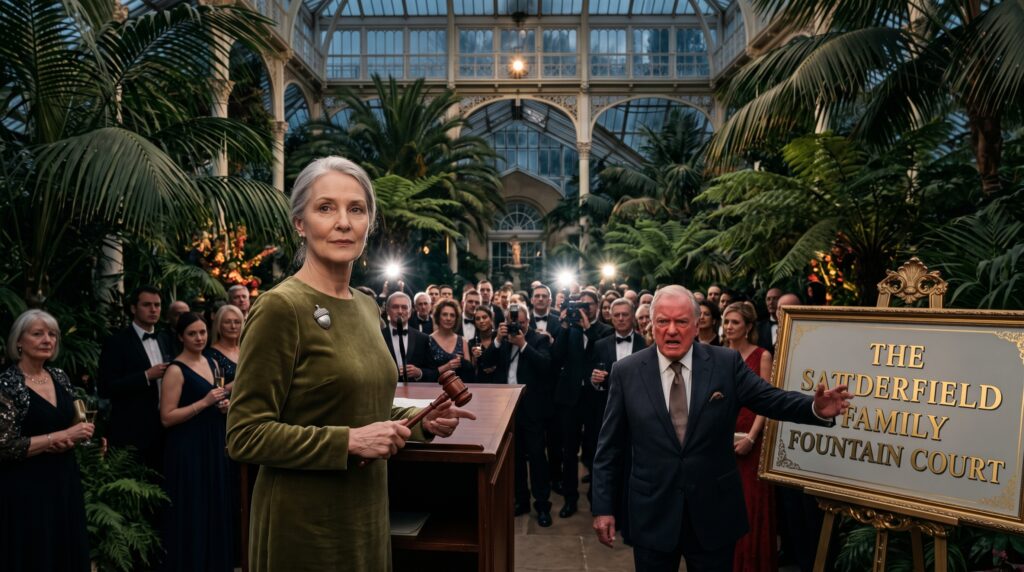
The materials arrived at the meeting itself on Thursday, August 21, at 4:00, in the foundation’s office above a frame shop on Main Street.
Celia handed around five blue folders.
Item four was 11 pages.
Page one said it plainly.
The Satderfield Family Fountain Court.
$250,000.
$186,000 from the Satderfield Family Giving Fund, established April 14, 2023, plus a $64,000 pledge over three years.
The proposed inscription was on page two.
Given by Doyle, Joyce, and Brady Satderfield.
Page nine was the statement our policy required, signed by Doyle and Joyce.
One sentence was underlined in Celia’s blue pen because she underlines anything she thinks the committee should read twice.
“The funds contributed in April 2023 originated from our son Brady as repayment of a family loan.”
I read it twice.
And then I did what I’ve done my whole life.
I counted.
April 2023.
Brady filed for divorce in May 2023.
In July, he told the court he had $3,100 to his name.
No bonus received.
None expected.
I knew those numbers by heart.
I’d paid for the lawyer who read them.
The window unit hummed.
Kenneth Latimore, our vice chair, was unwrapping a cough drop.
Nobody else in the room knew why my hands had gone still.
I closed the folder and slid it to the center of the table.
“I have a conflict on item four,” I said. “I’m leaving the room.”
Kenneth looked up.
He didn’t ask.
He’d run a high school for 22 years, and he knew the difference between a woman who was upset and a woman who was following a rule.
“I’ll take it from here,” he said.
I drove home the long way past my daughter’s house on Sycamore Street.
The kitchen light was on.
I didn’t stop.
At 9:14 that night, I emailed Philippa Danforth and Quincy Wickham, the foundation’s lawyer.
“I have a personal conflict with item four. I will not read, discuss, or vote on any matter involving the Satderfield Family Giving Fund.”
I didn’t sleep that night.
Around two, a freight train crossed the river bridge, and I stood at my kitchen window with a cup of tea I never drank and argued with myself like a jury.
Here’s what I knew.
Our foundation held money for more than 400 families.
Every January, every trustee signs a confidentiality pledge.
And every January, I signed mine without a second thought.
Those families trust us with their memorials, their grief, and sometimes their secrets.
If I carried one sentence from a confidential folder to my daughter’s kitchen, I’d be breaking that trust for all 400 of them.
And it wouldn’t even help her.
The first time Juliet used it, Brady’s lawyer would stand up and call it what it was: information stolen from a locked file by the plaintiff’s mother.
Everything she built on it would fall down, and I’d be the reason.
There was one more thing.
An auditor doesn’t jump from a single sentence to a verdict.
Maybe there really had been a loan.
I didn’t believe it.
But an auditor who stops at what she believes isn’t an auditor anymore.
She’s just a neighbor with an opinion.
Rules aren’t for the easy days.
Anybody can keep a rule that costs nothing.
So I did nothing.
I didn’t call Henrietta.
I didn’t drop a hint.
The honest road was already open because back on August 6, Henrietta had asked for Brady’s tax papers from 2023 and 2024.
All I had to do was stay off that road and let it run.
That’s the hardest thing I’ve ever done with my hands.
Keeping them still.
The mail was about to start talking.
One week later, my grandson rode his bicycle across town to tell me something he’d carried for two years.
Thursday, August 28, about four in the afternoon.
The bell on the hardware store door rang, and Mr. Kesling called up the stairs that my grandson was here and looked like he’d biked through a car wash.
Mason was 15 and all elbows.
He’d ridden all the way from Sycamore Street in 90-degree heat.
I poured him lemonade at my kitchen table, and he drank half of it before he said a word.
“Grandma, can I tell you something? It’s from a long time ago.”
“You can tell me anything.”
He stared at the ice in his glass.
Then it came out in one long breath, the way things come out of boys who have practiced them in their heads for years.
It was July 2023, the summer his father moved back to the lake.
Mason had gone into the garage to find a fishing net.
His dad was on the phone with his grandfather and didn’t know he was there.
He was pacing between the boat trailer and the freezer.
“Not a dime of what I earned, Dad,” Brady said. “Not one.”
Mason didn’t know what it meant.
He was 13.
He only knew it was about his mother and that his father sounded proud of it.
He put the guitar away that weekend because his grandfather had bought it, and he couldn’t look at it anymore.
“And last week, Grandma Joyce said something weird,” he said.
“She said, ‘I’ll see our name in iron at the Palm House.’ She called it our family’s gift. What does that mean?”
I knew exactly what it meant.
I said nothing about item four.
Not to my daughter and not to her son.
“Tell your mother what you just told me,” I said. “And tell her lawyer if she asks you.”
“Is Dad in trouble?”
“Your dad made his own choices, sweetheart. You don’t have to carry them around on a bicycle.”
He finished his lemonade, and I drove him home with his bike sticking out of my trunk.
Five days later, Brady’s lawyer finally sent the papers the magistrate had ordered.
Brady’s lawyer was a man named Lynden Pedigrew, and Doyle was paying him.
