Somebody asked whether the donors had been told.
Quincy said the papers had gone out by certified mail.
In Harlo County, certified mail takes three days, sometimes four.
Philippa caught my elbow on the way out.
She’s 83 and five feet tall, and she leans on a cane with a silver head shaped like a pinecone.
“Tomorrow, the gavel,” she said. “Wear something you can stand up in.”
At home, I opened my cedar closet and took out the olive-green silk.
I’ll tell you why.
I could have bought a new dress.
I could have bought 50.
But that dress was what I wore the day I was proudest of my daughter, the day she walked down an aisle sure of her own heart.
She’d been through hell since then, and she’d come out standing.
I wanted to stand in that dress again.
I braided my hair, copper gone mostly gray, into a crown the way my mother used to wear hers and pinned her silver acorn at the collar.
At 8:15, Juliet called.
Henrietta had received the court’s e-service at 4:02.
Juliet wasn’t crying this time.
At 6:40 on Saturday evening, I parked my Buick in the volunteer lot.
The Satderfields were in line ahead of me.
The line stretched out of the Palm House doors and down the brick walk under strings of white lights.
Inside, the air smelled like wet soil and gardenias, and a string quartet was playing something by Vivaldi among the 40-foot palms.
Doyle wore a tuxedo with a campaign pin on the lapel.
Joyce wore champagne silk and the same pearls she’d worn to court.
Brady stood behind them in a gray suit, scrolling his phone.
A young man from the campaign carried a large easel board wrapped in a white sheet, holding it like a window he’d been told not to drop.
Doyle turned around and saw me.
He looked at the dress from neckline to hem, taking his time so the couple behind me could watch him do it.
“Couldn’t afford a better dress?”
Joyce turned, too, and she smiled the way she’d smiled through her screen door.
“Here to ask for money again?”
The couple behind me laughed, then stopped, unsure.
A woman from the garden club looked down at her shoes.
I said nothing.
I hadn’t answered their gossip in 17 months.
A few more seconds wouldn’t kill me.
I handed my invitation to the young woman at the check-in table.
Her name was Raylin.
She was 24, and she was the foundation’s events coordinator.
She scanned the QR code.
Her tablet flashed green, and I could read the line on it upside down.
“Board. Notify P. Danforth on arrival.”
Raylin lifted her radio.
“Tell the chairwoman she’s here.”
Doyle grinned at Joyce.
“There it is. Security.”
“Good,” Joyce said. “Philippa can tell her to stay out of family business.”
They walked inside together, arm in arm, the young man with the easel trotting behind them.
Brady didn’t look at me at all.
Then the crowd parted near the palms, and Philippa Danforth came through it on her pinecone cane.
She didn’t look at the Satderfields.
She looked at me.
Philippa put both arms around me, cane and all, right there in the entrance.
“You’re here. Good,” she said. “Stand by me at 7:45.”
Over her shoulder, I saw Joyce stop walking.
She was ten feet away with a glass of champagne halfway to her mouth, watching the chair of the Harlo County Community Foundation hug the beggar from Water Street.
Doyle steered her toward their table before she could ask anybody why.
The next hour was cocktails.
Doyle worked the room like a parade route again, shaking every hand that stood still.
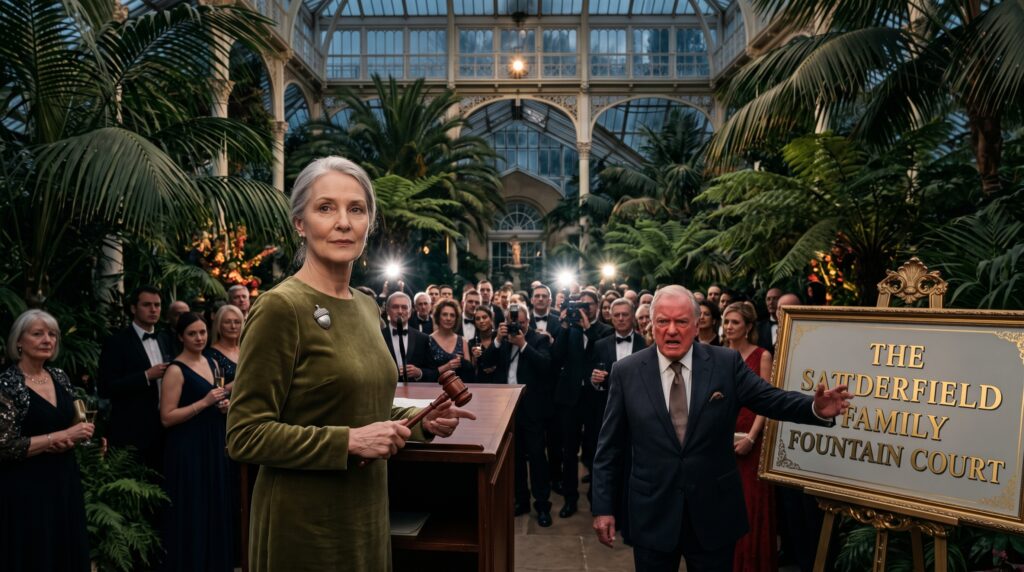
The young man set up the wrapped easel beside table four, right at the low iron rail of the fountain court, where every camera would find it.
The Courier’s photographer checked his flash against the palms.
Juliet arrived at seven in a borrowed blue dress.
She sat with me at table one near the small stage and squeezed my hand under the tablecloth.
Quinn was at home with a neighbor, eating popcorn under her whales.
Mason came by in a navy blazer, his youth advisory council badge clipped crooked on his pocket.
He kissed my cheek.
“I present at eight,” he whispered. “Don’t make me laugh.”
Brady sat at table four with his back to us.
He didn’t look at his son.
And Joyce stood alone at the fountain.
It still hadn’t been turned on.
She ran her fingers along the rim of the lowest basin.
Slowly, the way you’d touch a piano you weren’t allowed to play.
At 7:45, the lights over the palms dimmed.
Philippa tapped the microphone twice.
Celia welcomed everyone in two sentences, which is why I’ve always liked Celia.
Then Philippa stood at the little podium beside the stage, both hands on her cane.
She talked about nine years as chair, about the chain-link fence and the cracked glass, and the day the first new pane went in.
Then she looked straight down the room, past the palms, toward table four.
“I asked our door staff to tell me the moment she walked in,” Philippa said. “I didn’t want to start one minute without her.”
She held out her hand to me.
“Ladies and gentlemen, your new chairwoman, Athena Galbraith.”
She put a cherrywood gavel in my hand.
It had been turned on a lathe from a cherry tree that fell in the garden during a storm in 2019.
It was heavier than I expected.
Most important things are.
The room stood up.
Three hundred people clapping under 4,200 panes of glass.
At table four, Joyce didn’t stand.
I heard her say, “That’s not… She’s not…”
And then nothing, as if somebody had pulled the plug on the rest of the sentence.
Doyle had a glass of whiskey halfway to his mouth, and it stayed there.
