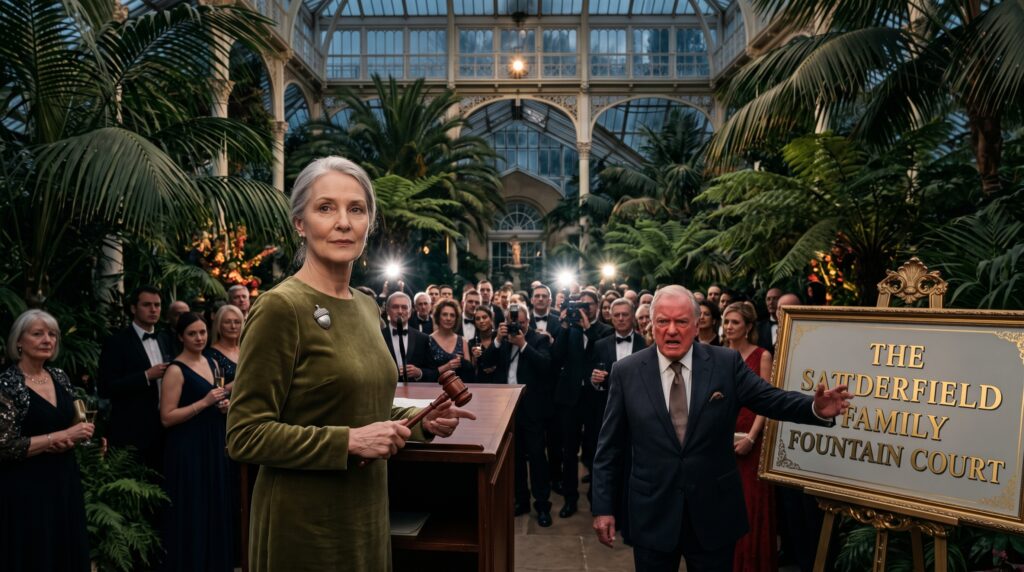
I hadn’t expected one, and I wasn’t going to wait for it.
Doyle came around the table and took her by the arm.
Then he looked up at me at the podium, and his voice carried the way it always does.
“You cost me $2 million once,” he said.
“No, Doyle,” I said. “Your inventory did. And tonight, your son did.”
The young man from the campaign was already rolling up the rendering, gold letters turned inward.
The Courier’s photographer took one more picture of the empty easel, standing alone beside three iron herons.
The front entrance was full of guests and cameras.
So Doyle steered Joyce the other way, along the north wall, toward a narrow service door behind the potting benches.
Raylin hurried ahead and held it open for them.
I watched Joyce walk through it.
The potting shed door.
The same one a housekeeper had pushed her through in 1965.
Nobody pushed her this time.
She chose it.
And I think that was the saddest part of the whole night.
Brady was the last Satderfield to reach that door.
Mason was standing in his way.
Nobody had seen Mason come down off the stage.
He’d slipped along the palms while everyone watched Joyce.
And now he stood between his father and the door, 15 years old, in a navy blazer with his badge still crooked.
He didn’t raise his voice.
He’s my grandson.
“I heard you, Dad,” he said. “In the garage two summers ago.”
Brady stopped.
“Not a dime,” Mason said. “That’s what you said. Not a dime.”
Brady opened his mouth.
I watched him look for something, anything.
A joke or an excuse or a lie he’d already used.
Nothing came out.
He was a 43-year-old man standing in front of his son with nothing in his hands.
He stepped around Mason and went out through the potting shed door, and Raylin let it close behind him with a soft click.
Mason stood there for a moment.
Then he walked back along the palms, climbed the three steps, unfolded his paper, and read the last line he’d been about to read before his grandfather stood up.
“And thank you to everyone who gives,” he said, “without needing their name on it.”
I don’t know who started clapping first.
I know it lasted a long time.
I picked up the cherrywood gavel and tapped it once lightly on the podium.
“Dessert is in the orangery,” I said. “And Celia, would you turn on the fountain, please?”
Celia nodded to someone by the wall.
There was a gurgle in the old pipes, then a cough, and then water rose up through the top basin and spilled past the three iron herons for the first time since 1985.
Juliet came up beside the podium, found my hand, and held on.
Here’s how it shook out by the numbers.
I’m an accountant.
On Thursday, October 30, Magistrate Fitzhugh denied Brady’s motion.
She found that he had hidden a $274,000 bonus during the divorce, that he had left a $96,000 job by choice, and that his income would be counted at $96,000.
Child support stayed at $1,410 a month.
Henrietta’s separate motion to reopen the property division was set for December.
On Tuesday, November 4, Doyle Satderfield got 31% of the vote.
Mayor Ruth Anne Burchard got the rest.
The Courier’s front page that week was the photograph of the empty easel beside the herons.
Doyle never filed his lawsuit either.
Quincy keeps an empty folder for it on his desk, the way some people keep a candle in the window.
Doyle and Joyce’s accountant amended their 2023 tax return and gave up the $186,000 charitable deduction, with interest.
I know that only because their own lawyer filed it with the court, hoping it would make them look like they’d meant well.
On Thursday, December 11, the court divided the money the foundation had deposited.
$93,000 went to Juliet, her half of a bonus earned during the marriage.
Another $14,800 went to pay her lawyer.
Brady was ordered to pay the rest of Henrietta’s fees himself, and he brought the first check to her front desk in person.
He didn’t take a peppermint.
The remaining $78,200 stayed with the foundation.
It couldn’t go back to Doyle and Joyce.
A gift is a gift.
Quincy had told Doyle so in front of 300 people, and a judge told him again in writing.
Juliet signed a two-year lease on the gray house on Sycamore Street.
Quinn’s whales stayed exactly where they were.
Mason took his guitar out of the closet in January.
He’s learning a song I don’t recognize, and he plays it too loud, and I’ve never been happier to have a headache.
In January, the board voted on what to put on the fountain court.
I stepped out of the room for that one, too.
The youth advisory council had sent a recommendation, and the board accepted it without changing a word.
Mason voted for it.
Now there’s a small bronze plaque at the base of the lowest basin.
“GIVEN BY THE PEOPLE OF HARLO COUNTY.”
As for the Satderfields, here are my rules, and I’ve kept every one of them.
They see the children during Brady’s parenting time under the court schedule, and nowhere else.
Nobody talks about money in front of the kids.
Joyce is not going back on the school pickup list.
I don’t go to their parties.
I don’t answer their gossip.
And I don’t take their phone calls.
If they want to reach me, they can write to the foundation like everybody else.
I still run into Doyle at the hardware store sometimes.
He buys bait.
I buy light bulbs.
We nod.
In March, the school district offered Juliet the music director’s job again, the one from 2019.
This time, nobody told her to turn it down.
And Philippa still calls me every Sunday at four to ask whether I’ve broken anything yet.
