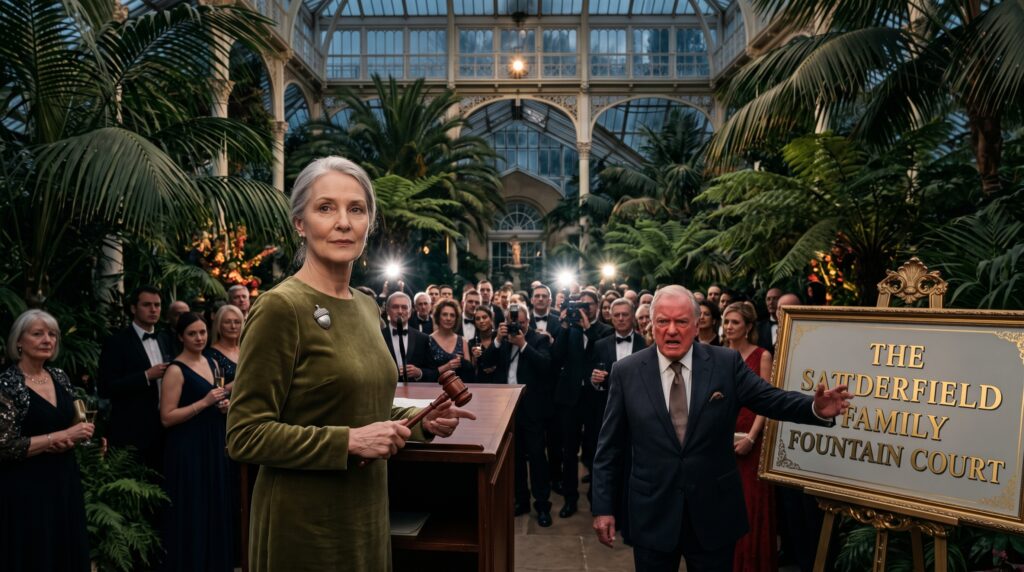
And that’s where Joyce spent the party, washing glasses beside sacks of fertilizer and listening to the fountain through the brick.
“One day my name will be inside that glass,” she told me on the dock. “You watch.”
I’ll be fair to Joyce.
She loved those grandchildren.
She knit Mason a blue hat every winter until he turned nine.
But she never forgave my daughter for taking Brady to a house with a piano instead of a boat.
And she never forgave me for being the kind of woman she assumed looked down on her.
I didn’t.
But I counted things for a living.
And to Joyce, that was the same thing.
I should have taken that sentence on the dock more seriously.
Joyce didn’t make wishes.
Joyce made plans.
Brady Satderfield was Doyle’s only son, and he spent 40 years being measured against his father and coming up a few inches short.
When Juliet brought him home, he was charming in a borrowed way, like a man wearing his dad’s sport coat.
In 2019, the school district offered Juliet the job of running its whole music program.
Brady made her turn it down.
“Who’s going to be home?” he said.
I think that was the year he started keeping score.
By 2023, he was a sales manager at Vandermir Climate Supply, an HVAC distributor in Carden, making $96,000 a year.
That spring, Vandermir was sold to a national company out of Atlanta.
Juliet asked what it meant for his job.
“Nothing,” he said. “They kept me on.”
On Monday, May 8, 2023, he filed for divorce.
“I need my life back,” he told her, standing in the kitchen she had painted herself.
He moved into his parents’ lakehouse that same week.
That summer, he filed his financial disclosure with the court.
Salary: $96,000.
Bonus: None received and none expected.
Checking account: $3,100.
He signed every page.
Then he made the divorce expensive on purpose.
“I’ll fight for the kids,” he told Juliet. “Every weekend, every holiday. Ask your mother how long she can pay.”
Juliet had stayed home with the children for six years, then taught music part-time at Riverside Elementary.
She was terrified of a custody war.
On Thursday, November 16, she signed.
She got $19,400 from the house, her car, and child support of $1,410 a month.
No spousal support.
I paid her lawyer $23,000, and I would have paid ten times that.
But I watched her sign.
I’d seen Brady’s story shift a little every month, and I kept quiet because she was a grown woman, and it was her name on the line.
That’s the part I carry.
“It’s your signature, honey,” I told her. “I’ll stand next to it.”
Brady told his parents I’d emptied my retirement savings on that lawyer.
They believed him.
It was exactly the kind of thing they wanted to believe.
Juliet rented a little gray house on Sycamore Street for $1,650 a month, inside the Carden School District, so the kids wouldn’t have to change schools on top of everything else.
She went full-time at Riverside Elementary, teaching music for $52,000 a year.
Quinn, who was nine by then, chose the bedroom with the whale wallpaper and declared it hers forever.
Mason was 13, and he went quiet.
It started after a weekend at the lakehouse in July 2023, while his father was living there.
He came home and put away the guitar his grandfather had bought him, and he never took it out again.
When we asked, he shrugged.
Teenagers shrug.
That’s what I told myself.
And I’ve audited enough books to know when I’m the one fudging the numbers.
In January 2024, Brady quit Vandermir and went to work for his father as sales director at Satderfield Marine.
His new salary was $44,000 a year, which is an interesting choice for a man with two children and a support order.
In February, the child support stopped.
March, nothing.
April, nothing.
That was $4,230.
Three months of groceries and electric bills, and a fourth-grade field trip to Columbus that Quinn didn’t get to take.
Juliet filed with the Harlo County Child Support Enforcement Agency, and they told her, “These things take time.”
I printed the arrears statement on my home printer.
One page.
$4,230 in black and white.
Juliet asked me not to drive out to the lake.
I went anyway.
And that was the day I became, in the eyes of the Lakeshore crowd, a beggar.
Saturday, May 11, 2024.
I drove my Buick down the gravel road to the Satderfields’ lakehouse, a white two-story with green shutters, a flagpole, and a pontoon boat under a blue cover.
I parked behind Brady’s truck.
I carried the arrears statement in a manila folder because I’m a CPA, and I can’t carry a piece of paper any other way.
Joyce opened the inside door, but not the screen door.
She looked at the folder before she looked at me.
“Here to ask for money?”
“I’m here to ask you to talk to your son,” I said. “As grandparents.”
Doyle came up behind her, drying his hands on a dish towel.
“Tell your daughter to get a second job.”
“She has two children and one paycheck.”
“Doyle, he has a boat.”
I could hear a television somewhere in the house.
Brady never came to the door.
Joyce closed it.
Not hard, just firmly, the way you close a door on a salesman.
I didn’t argue.
I don’t argue on porches.
A week later, at the Lakeshore Garden Club spring luncheon, Joyce told a table of eight women that Juliet’s mother had driven out to the lake with her hand out.
By Memorial Day, the story had reached my hairdresser.
By the Fourth of July, a woman I’d known for 30 years squeezed my arm in the grocery store and asked very kindly if I needed help.
Here’s the funny part.
