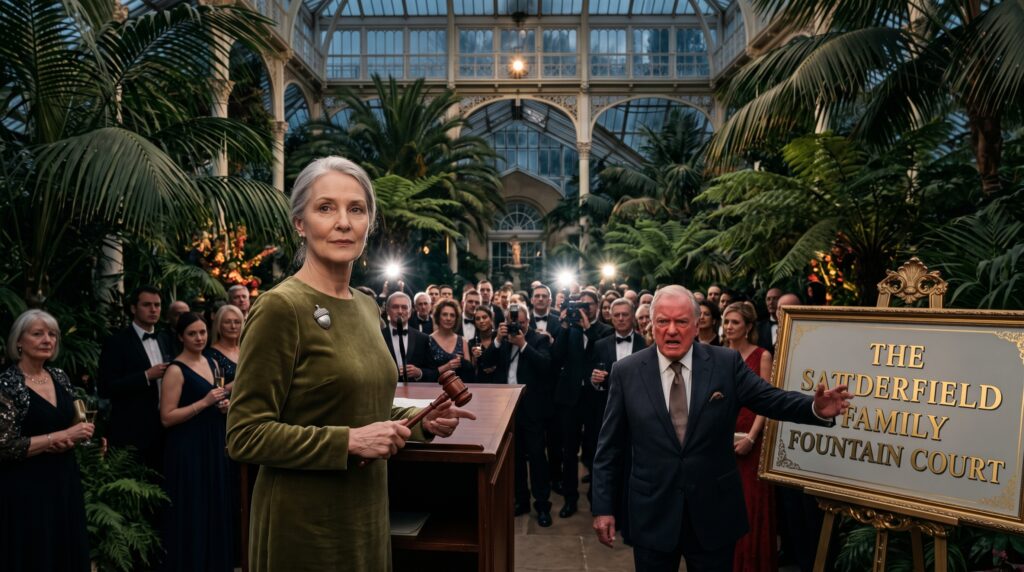
The Satderfields sat in the front row behind their son, Doyle in a campaign pin and Joyce in pearls.
Quincy Wickham had filed a short statement for the foundation because the foundation didn’t care to be called a leaky bucket in a public courtroom.
Attached was my email of August 21, timestamped 9:14 p.m., along with the confidentiality policy I sign every January.
Then Henrietta stood up with two pieces of paper.
The first was her own request for Brady’s tax documents, dated August 6.
That was 15 days before any committee meeting.
The second was the 2023 W-2 produced by Brady’s own lawyer on September 2 under court order.
“Box one says $370,000,” Henrietta said. “That’s why we subpoenaed his bank. Nobody’s mother needed to whisper it.”
Pedigrew argued for 11 minutes about appearances.
Magistrate Fitzhugh let him finish, then took off her reading glasses.
“The bank subpoena rests on Mr. Satderfield’s own document,” she said. “The motion is denied.”
Brady stared at the table.
Joyce reached for his shoulder, and he shrugged her off.
Doyle caught me in the hallway by the drinking fountain, standing too close the way he always does.
“Couldn’t stay out of it, could you?”
“I did stay out of it, Doyle,” I said. “That’s why you lost.”
Joyce walked past us without turning her head.
Brady walked behind her, looking at his phone like it might have an exit on it.
I went downstairs and bought a bag of pretzels from the vending machine because nobody tells you how hungry it makes you to be right.
Eight days later, Carden Federal Savings mailed two pages.
Wednesday, September 24.
Two pages from Carden Federal Savings, the bank where Brady had kept his checking account since high school.
Line one.
Friday, March 31, 2023.
Deposit: $186,240.
The description said, “Vandermir CC bonus net.”
$274,000 minus taxes.
Almost exactly what I’d scribbled on the back of that church bulletin.
Line two.
Monday, April 10, 2023.
Outgoing wire: $186,000 to Doyle and Joyce Satderfield.
The memo line said two words.
“Loan repayment.”
Juliet read it three times.
“There was never a loan,” she said. “We never borrowed a dime from his parents. Joyce would have had it engraved on a plaque.”
Brady’s deposition was that Friday, September 26, at Pedigrew’s office over the bank.
I wasn’t there.
Juliet was.
And she told me afterward exactly how it went, word for word, because she said she wanted me to hear every one of them.
Henrietta laid the bank pages in front of Brady and asked him a plain question.
“What loan?”
Pedigrew objected.
Brady answered anyway.
He’s always been his father’s son that way.
Too sure he’s the smartest man at the table.
“It wasn’t a loan exactly. It was family money.”
“Where is it now, Mr. Satderfield?”
He actually smiled.
“They gave it to charity. The community foundation. It’s their fund now.”
Then he leaned back in his chair.
“You can’t touch charity.”
Pedigrew put a hand flat on the table the way you’d stop a glass from sliding off.
Henrietta wrote one line on her legal pad and underlined it twice.
She thanked him.
The deposition ended at 11:52.
Juliet didn’t go home after that.
She drove straight to my apartment, and she didn’t knock.
She came up my stairs two at a time and stood in the doorway with her car keys still in her fist.
“Mom, that’s your foundation.”
“I know.”
“You knew?”
Her voice cracked right down the middle.
“Since when?”
“Since August 21,” I said. “I recused that night. I couldn’t tell you, Juliet. Not one word.”
“You let me think we had nothing. You let me sit at that table and count to 612.”
I didn’t defend myself.
Some accusations you just let land because they’re half true.
“If I had told you,” I said, “Pedigrew would own your case. Everything you found would have come out of a stolen folder. You’d have lost the kids’ house over my good intentions.”
“So I waited. I let the truth come to you through a door nobody can close.”
She stood there breathing hard.
Then she sat down at my kitchen table, picked up a cold oatmeal cookie from the plate, and ate the whole thing without tasting it.
“Is this what you did for 40 years?” she asked. “Sit on things?”
“Mostly, I said no to men like Doyle.”
That got half a laugh out of her.
And half was plenty.
“It hurt, Mom, thinking you didn’t see it.”
“I saw it, sweetheart. I just couldn’t be the one to show you.”
She wiped her face with the heel of her hand, exactly the way she did when she was seven.
“Next time,” she said, “at least tell me there’s a door.”
“Deal.”
We sat there until the streetlight came on outside the hardware store.
Neither one of us said the number out loud, but we both knew it.
$186,000 sitting inside the foundation I was about to lead.
On Monday, Henrietta served the foundation, and the foundation had to decide whose money it was holding.
On Monday, September 29, Henrietta served the foundation with a subpoena for every record of the Satderfield Family Giving Fund.
On Wednesday, she sent a second letter.
It said the $186,000 was marital property moved out of the marriage to hide it from the court, and that my daughter claimed her share.
It asked the foundation not to spend a single cent of it.
That same Wednesday, Doyle’s campaign mailer landed in every mailbox in Carden, including mine.
Glossy cardstock.
A photo of Doyle and Joyce in front of the Palm House fence.
Underneath, in gold script:
Coming this fall: The Satderfield Family Fountain Court. Giving back.
I put it on my refrigerator with a magnet shaped like a pear.
I had no part in what the foundation did next, and I want that to be very clear.
